

What is a union printing company? It’s a question that businesses and organizations often encounter when searching for professional printing services. A union printing company employs union-represented workers to produce printed materials, often using an authorized union label to identify qualifying work.
For labor organizations, nonprofits, schools, political campaigns, and businesses, choosing a union print shop can be about more than printing quality or pricing. It may also reflect their commitment to supporting union labor, meeting purchasing requirements, and working with reliable production partners.
But how do you identify a legitimate union printer and choose the right one for your needs? This guide explains how union printing companies work, what makes them different, and what to consider before placing an order.
Key Takeaways
- A union printing company performs qualifying printing through an applicable union labor arrangement.
- Authorized union labels help identify qualifying union-produced materials.
- Union printing and union garment manufacturing are different requirements.
- Buyers should verify union affiliation, production location, and labeling authorization.
- Price, product quality, printing methods, and turnaround all matter when comparing suppliers.
- Shirt.co identifies its operation with Allied Printing Trades Council Local 76.
What Is a Union Printing Company?
A union printing company is a commercial printing business with workers represented by a labor union or an authorized union production arrangement.
These companies can provide many of the same services as other commercial printers, including screen printing, embroidery, promotional merchandise, flyers, banners, and campaign materials.
The key difference concerns the labor and authorization associated with production.
A qualifying union print shop may apply an authorized union label to eligible printed products. This label helps buyers identify the applicable union printing operation.
However, union affiliation does not automatically mean every product or production process is covered by the same authorization.
That’s why businesses should confirm the specific requirements of their orders before approving production.
How Does a Union Print Shop Work?
A union print shop generally follows a familiar commercial printing workflow, with additional attention to applicable labor and labeling requirements.
The process typically involves:
- Order review: The printer confirms products, quantities, artwork, and deadlines.
- Union requirement verification: The supplier checks whether the project requires an authorized union bug or other documentation.
- Artwork preparation: The design is prepared for the appropriate decoration method.
- Proof approval: The buyer reviews artwork, placement, and any required union label.
- Production: Qualifying work is completed under the applicable production arrangement.
- Quality checks and delivery: The finished products are inspected and shipped or prepared for collection.
If an organization requires a particular union label, that requirement should be discussed before production begins.
An unauthorized printer cannot legitimately satisfy a union printing requirement simply by copying a union symbol into the artwork.

What Is the Union Bug, and Why Does It Matter?
The union bug is a small mark placed on qualifying printed materials to identify production associated with an authorized union label program.
It may appear on campaign T-shirts, political literature, promotional products, or other printed items.
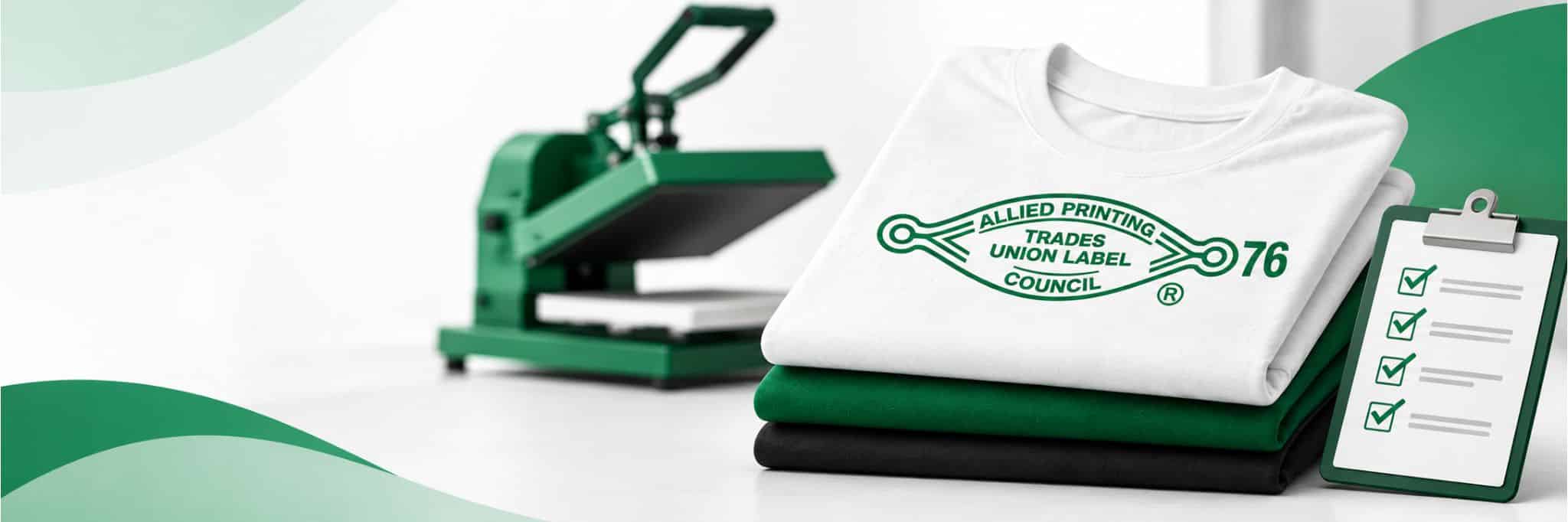
The Allied Printing Trades Council label is one recognized example in commercial printing.
Depending on the applicable label, its identifying features may include the union organization, label wording, and an assigned local or establishment number.
For buyers, the label can provide useful evidence about the printing operation, but its meaning depends on the authorization governing its use.
For a detailed explanation, read Shirt.co’s guide to what the union bug means on apparel.
Union-Printed vs. Union-Made Apparel
These terms are often confused.
Union-printed apparel refers to garments decorated through qualifying union printing or production arrangements.
Union-made apparel generally refers to garments manufactured under qualifying union labor arrangements.
For example, a T-shirt might be manufactured at one facility and screen-printed at another. A union label identifying the printing does not necessarily establish that the fabric, cutting, and sewing were also completed by union workers.
Similarly, a union bug does not automatically mean the garment was made in the United States.
If your purchasing agreement requires union printing, union-manufactured blanks, or domestic manufacturing, verify each condition separately.
Why Do Businesses Choose Union Printing Companies?
Organizations select union printers for different reasons, depending on their purchasing requirements, values, and intended audience.
Supporting Union Labor
Labor organizations and unionized workplaces may prefer suppliers whose production aligns with their purchasing commitments.
For these buyers, choosing a qualified union printing company helps connect purchasing decisions with their organizational priorities.
Meeting Procurement Requirements
Some political campaigns, contractors, institutions, and organizations have purchasing policies that specify union printing.
In those situations, an authorized union label or other documentation may be important.
Requirements are not universal, so buyers should review the applicable agreement rather than assume every project needs a union printer.
Accessing Experienced Production Teams
Established union print shops may offer experienced operators, standardized workflows, and commercial production capabilities.
However, union affiliation alone does not guarantee superior print quality.
Buyers should still evaluate samples, equipment, customer support, and the supplier’s experience with similar projects.
Managing Recurring Merchandise Orders
Businesses often need repeatable printing for employee apparel, campaigns, promotional events, and branded merchandise.
A reliable production partner can help maintain consistent garment selection, artwork placement, colors, and delivery schedules across multiple orders.
What Products Can a Union Printing Company Produce?
Union printers may offer different products depending on their equipment, expertise, and authorization.
Common categories include:
🛍️ Common Union Printing Product Categories
Explore popular products and their typical uses for organizations, campaigns, and businesses.
| Product Category | Typical Applications |
|---|---|
| Custom T-shirts | Campaigns, rallies, events, employee apparel |
| Hoodies and sweatshirts | Union merchandise, workwear, fundraising |
| Embroidered apparel | Polos, jackets, uniforms |
| Hats and headwear | Branded merchandise and promotional campaigns |
| Signs and banners | Political events and organizational promotions |
| Printed paper materials | Flyers, brochures, postcards, and campaign literature |
| Promotional products | Bags, drinkware, and branded giveaways |
Before placing an order, confirm which products the printer can produce with the required union label and whether the production process meets your organization’s requirements.
Not every union print shop produces every category.
A commercial printer specializing in paper materials may not have the same capabilities as an apparel decoration facility.
If your project involves custom clothing, choose a provider with relevant experience in garment decoration.
Shirt.co offers screen printing services for custom T-shirts, workwear, campaign merchandise, and bulk apparel orders.
How to Choose the Best Union Printing Company
The best supplier is not necessarily the closest printer or the one advertising the lowest unit price.
It is the provider that can meet your specific union requirements while delivering the right products, quality, and schedule.
1. Verify Union Affiliation and Authorization
Start by asking which union organization the printing company is affiliated with.
Confirm the applicable union label, identifying number, and whether the production facility is authorized to use it.
If the printer uses outside production partners, ask how that arrangement affects the eligibility of the finished products.
A general claim of supporting organized labor is not a substitute for the authorization required by a particular union label program.
2. Match the Printer’s Capabilities to Your Project
Different decoration methods suit different products and artwork.
For example:
- Screen printing: Often practical for medium and large apparel orders with repeatable designs.
- Embroidery: Suitable for polos, jackets, hats, and professional workwear.
- Direct-to-film printing: Useful for detailed, multicolor designs and certain smaller apparel runs.
- Promotional product decoration: Supports branded giveaways and event merchandise.
Confirm that the selected method and production arrangement satisfy your organization’s union requirements.
3. Compare Complete Quotes
A competitive quote should account for more than the blank garment.
Ask about setup charges, printing colors, decoration locations, artwork preparation, union label placement, shipping, and rush fees.
For example, one supplier may advertise a lower shirt price but charge separately for setup and shipping. Another may offer a higher unit price with those costs included.
Compare the total delivered price for identical specifications.
Bulk ordering may reduce unit costs, but purchasing unnecessary inventory can increase overall spending.
4. Review Print Quality and Relevant Experience
Ask for samples of work similar to your project.
Look at print alignment, color consistency, readability, garment quality, and finishing.
For embroidered products, examine stitching quality and the clarity of small lettering.
Also consider whether the printer has handled comparable order quantities or event deadlines.
A provider experienced with campaign apparel may be better prepared for a large rally order than a shop focused primarily on small custom gifts.
5. Confirm Production and Delivery Timelines
Ask when production begins and whether the quoted turnaround includes shipping.
Many printers start their production clock only after artwork approval.
If you need shirts for a Saturday event, confirm the expected delivery date rather than relying solely on a quoted production period.
Allow time for artwork revisions, size changes, and unexpected shipping delays.
6. Evaluate Communication and Proofing
A dependable union printing company should explain its process clearly.
Before production, you should know:
- Which products and quantities are approved
- What decoration method will be used
- Where the union bug will appear, if required
- Whether garment sourcing requirements are satisfied
- When the order is expected to ship
- Who to contact if changes are needed
A digital proof is especially useful because it allows you to catch errors before printing begins.
Seven Questions to Ask Before Hiring a Union Print Shop
Use these questions when comparing suppliers:
- Which union organization are you affiliated with? Confirm the specific affiliation and applicable label authorization.
- Can you use the required union bug? Ask whether your order qualifies and how the label will appear.
- Where will production take place? Establish whether printing is handled directly or subcontracted.
- Do you offer the decoration method I need? Confirm capabilities for the selected garments and artwork.
- What is included in the quote? Review setup, labeling, shipping, and other charges.
- Can you meet my delivery deadline? Obtain a realistic schedule based on proof approval.
- Can you provide an artwork proof? Check the final design before production.
These questions are particularly useful for purchasing managers, political campaign teams, promotional distributors, and contractors with labor-related procurement requirements.

Is Union Printing More Expensive?
Union printing does not have one universal price premium.
Pricing depends on the supplier’s operating costs, garment selection, quantity, artwork complexity, decoration locations, and production schedule.
An authorized union label may affect setup costs if it requires an additional screen, color, or decoration location.
However, buyers should not assume that every union printer charges more than every nonunion printer.
Request itemized quotes from qualified providers and compare the actual cost of meeting your requirements.
For additional guidance, see Shirt.co’s screen printing cost guide.
Why Consider Shirt.co for Union Printing?
Shirt.co is an Allied Printing Trades Council Local 76 union-certified printing company.
The company has operated since 1975 and provides custom apparel and promotional merchandise for businesses, political campaigns, labor organizations, and other customers.
Its services include screen printing, embroidery, direct-to-film decoration, promotional products, and contract decoration.
According to Shirt.co’s published union printing information, its services include:
- Union affiliation: Allied Printing Trades Council, Local 76
- Minimum screen-printed shirt order: 24 pieces
- Standard production turnaround: Five business days after proof approval
- Rush production: Options as fast as 24 hours, subject to availability
- Fulfillment: Nationwide shipping across all 50 states
- Proofing: Digital artwork proofs before production
Specific availability, eligibility, and turnaround depend on the order.
Organizations can explore Shirt.co’s union screen printing services to discuss garment selection, artwork, quantities, and authorized label requirements.
For agencies and promotional distributors, Shirt.co also offers contract decoration, which may help coordinate qualifying production for client merchandise.
Common Mistakes to Avoid When Choosing a Union Printer
The most frequent problems arise when buyers treat union certification as a minor design preference instead of a production requirement.
Avoid these mistakes:
- Assuming every union-affiliated shop can use the same label. Authorization can differ by organization and production arrangement.
- Confusing union printing with union-made garments. Verify manufacturing requirements separately.
- Choosing based only on price. A low quote is not useful if the supplier cannot meet your requirements.
- Ignoring subcontracting. Confirm where qualifying production actually takes place.
- Approving artwork too quickly. Check the design and required union identification before printing.
- Ordering too close to an event. Allow enough time for production and shipping.
For large apparel programs, accurate size planning is equally important. Ordering too many of one size can create unnecessary inventory, while shortages can lead to expensive reorders.
Final Thoughts
Understanding what a union printing company does is the first step toward choosing a supplier that meets your organization’s needs.
A reliable union print shop should be able to explain its affiliation, confirm the applicable label requirements, demonstrate suitable production capabilities, and provide transparent pricing and realistic delivery schedules.
Whether you’re ordering campaign T-shirts, union local merchandise, employee apparel, or promotional products, verify the production requirements before approving the order.
For organizations seeking union-certified custom apparel, Shirt.co offers printing and decoration services through its Allied Printing Trades Council Local 76 operation.
Frequently Asked Questions
What does union-printed mean?
Union-printed generally means that the covered printing or decoration was completed under an applicable union labor arrangement. When an authorized union label is used, the work must also satisfy the relevant label requirements.
What is a union printing company compared with a regular printer?
A union printing company has qualifying union-represented or union-affiliated production arrangements. A regular commercial printer may offer similar products but does not necessarily have the labor arrangements or authorization required to use a union printing label.
Are unions beneficial for printing company employees?
Unions can provide collective bargaining representation concerning wages, benefits, working conditions, and workplace procedures. Their effects depend on the agreement, employer, workforce, and circumstances. Employees may value the representation, while others may have concerns about dues or workplace flexibility.
Why would a printing company choose to operate as a union shop?
A company may have a unionized workforce through employee representation and collective bargaining. Union operations can also serve customers that specifically require qualifying union printing. The business implications depend on its labor agreement, operating model, and customers.
What products can be union-made or union-printed?
Union-produced goods can include apparel, printed literature, promotional merchandise, and other products, depending on the workers and production arrangements involved. Union printing commonly covers T-shirts, campaign materials, brochures, signs, and related items where qualifying production is available.
How can I verify a union print shop?
Ask for the printer’s union affiliation, applicable label identification, and confirmation of the production facility. If a specific label is required, verify that the supplier is authorized to apply it to your order.
Does a union printing company have to be local?
No. A qualified union printer may accept orders online and ship nationwide. However, buyers should confirm shipping costs, delivery timelines, and any geographic requirements in their purchasing agreements.
Can a union printing company handle bulk T-shirt orders?
Yes, provided it has the necessary production capacity and decoration capabilities. Confirm minimum quantities, pricing tiers, artwork requirements, and the expected turnaround before placing a large order.