


If a customer has ever asked whether a shirt has a union bug on apparel, you may have wondered what they were actually looking for. At first glance, the small mark inside a garment can seem like just another label. For certain organizations, however, it represents something much more significant: the labor and production standards behind the apparel they purchase.
A Union Bug, also referred to as a union label, can identify apparel or decoration associated with union labor. It may be important to unions, nonprofits, agencies, businesses, and other organizations that have specific purchasing or sourcing requirements.
Understanding what is a union bug, where it appears, and what it does, and does not, tell you can help prevent confusion when ordering custom apparel.
It is also important to distinguish union-made apparel from Made-in-USA apparel. These terms can overlap, but they do not automatically mean the same thing. If a client specifically requests a union label, the requirement should be verified before production begins.
What Is a Union Bug on Apparel?
A Union Bug is a small mark, label, or emblem associated with union labor. On apparel, it can indicate that a particular garment or production process meets applicable union requirements.
The term “Union Bug” is commonly used to describe the small union identification mark that may appear on apparel, printed products, or other union-produced goods. Its exact appearance can vary depending on the union and the type of product or production involved.
For someone purchasing apparel, the easiest way to think about it is this: the Union Bug provides information about the labor behind a product, rather than simply describing the garment itself.
A conventional apparel label might tell you the garment’s size, fabric composition, manufacturer, and care instructions. A union label serves a different purpose by identifying a connection to union production or representation.
Where Can You Find a Union Bug?
A union bug on apparel is usually small and is often placed somewhere that doesn’t interfere with the garment’s primary design.
Depending on the garment and labeling arrangement, you may find it:
- Inside the neck label
- Along an interior side seam
- Near the bottom hem
- On a sewn-in or printed label
- On a hangtag or other product identification
Because the mark is generally not intended to be the primary visual feature of the garment, customers may not notice it until they specifically look for it.
If a customer requires union apparel, don’t assume that every garment with a similar-looking symbol meets their requirements. The relevant union, garment manufacturer, decorator, or purchasing specification should be verified.
What Does a Union Label Communicate?
The meaning of a particular union label depends on the applicable union and production arrangement. In general, it can provide a way to identify products associated with union labor.
For customers, that can matter because their purchasing decisions may be influenced by:
- Union membership or organizational affiliation
- Labor standards
- Procurement policies
- Worker representation
- Domestic sourcing preferences
- Contractual purchasing requirements
The important point is that the label should be treated as a meaningful production or sourcing indicator, not as a decorative graphic that can simply be added to an apparel order.
Why Does a Union Bug on Apparel Matter to Clients?
For many customers, the union bug on apparel represents more than a tiny mark hidden inside a shirt. It can support purchasing policies and organizational values related to union labor and responsible sourcing.
This is particularly relevant when apparel is being purchased for an organization rather than an individual consumer.
A company ordering a few promotional shirts may have little concern about a union label. A labor organization, government-related buyer, nonprofit, or business operating under specific procurement requirements may have very different expectations.
Clients May Have Union Purchasing Requirements
Some customers specifically require apparel to meet union-related production standards. This requirement may be included in an organization’s purchasing policy, contract, or project specifications.
For example, a customer might ask a print shop:
“Can you provide union apparel?”
That question may involve more than choosing a particular blank shirt. The customer may need confirmation about the garment manufacturer, production facility, decoration process, or applicable union requirements.
This is why print shops and promotional companies should clarify the requirement before quoting an order.
A simple checklist can help:
- Does the customer require a union-made garment?
- Does the decoration also need to be produced under union conditions?
- Is a specific union label required?
- Does the customer have an approved garment or supplier list?
- Are domestic production requirements included?
- Is documentation or verification required?
Getting these answers early is much easier than discovering a production requirement after the garments have already been purchased.
It Can Reflect Organizational Values
Union apparel may also be selected because it aligns with an organization’s broader values.
Labor unions naturally have a strong interest in supporting union labor. Other organizations may choose union-produced goods because they want their purchasing decisions to reflect commitments to worker representation, responsible sourcing, or particular labor standards.
For these buyers, apparel isn’t simply merchandise. It can become part of how an organization communicates its priorities.
That is one reason a customer may care about a label that most people would never notice.
Why the Label Can Affect an Apparel Order
If union status is a client requirement, it should be treated as part of the product specification from the beginning.
A print shop might otherwise focus primarily on:
- Shirt style
- Garment color
- Decoration method
- Artwork
- Quantity
- Delivery date
But when union requirements are involved, production details become equally important.
A garment that looks perfect and meets the customer’s design specifications may still be unsuitable if it doesn’t satisfy the required union criteria.
Union Bug Apparel vs. Made-in-USA Apparel: Are They the Same?
One of the most important distinctions to understand is that union-made and Made in USA are not automatically the same thing.
A customer may request both, but each describes a different aspect of production.
“Made in the USA” generally relates to where a product is manufactured. Union status relates to the labor relationship and applicable union requirements.
That means a domestically manufactured garment is not automatically union-made, and the presence of a union-related production claim should not automatically be treated as proof of every other domestic sourcing claim.
Union-Made Doesn’t Automatically Mean Made in the USA
Consider two separate questions:
Where was the garment produced?
This concerns geographic origin and domestic manufacturing.
Was the applicable work performed under union conditions?
This concerns union labor and the relevant production requirements.
Those questions can have different answers.
For this reason, businesses should avoid using “union-made,” “Made in USA,” and “union-decorated” interchangeably.
If a customer requires both union production and domestic sourcing, both requirements should be independently confirmed.
What Does “Union-Made” Actually Tell You?
The term can relate to production performed by workers represented by a labor union under applicable agreements or requirements.
However, the specific meaning depends on the product and the production process.
This is particularly important for decorated apparel because there may be multiple stages involved:
Garment manufacturing → Shipping → Decoration → Finishing → Fulfillment
A garment could be manufactured in one location and decorated somewhere else. If a customer requires union production, you need to understand which stage their requirement applies to.
For example, a customer may care about the garment itself, the decoration facility, or both.
Why Verification Matters
Before promising a customer that an order is union-compliant, verify the details rather than relying on assumptions.
Confirm:
- The union status of the garment when required.
- Whether decoration must also meet union requirements.
- The applicable union or label requirements.
- Whether the requested Union Bug is appropriate and authorized.
- Any customer-specific procurement specifications.
- Whether documentation needs to be maintained.
This approach protects both the buyer and the business fulfilling the order.
Don’t Assume Every Union Bug Means the Same Thing
A small union symbol can be meaningful, but its exact significance depends on the applicable union and production arrangement.
Businesses should therefore avoid copying, printing, or adding a Union Bug to apparel simply because a customer asks for one.
Instead, determine which label or certification applies and confirm that the production partner can meet the requirement.
How Does Union Label Apparel Printing Work?
Union label apparel printing starts with understanding the customer’s requirements—not with putting artwork on a shirt.
For print shops, promotional companies, and agencies, the process can be approached as a straightforward production workflow:
Client requirement → Garment verification → Union requirements confirmed → Decoration → Quality control → Fulfillment
Each step helps reduce the risk of delivering apparel that looks right but doesn’t meet the customer’s purchasing specifications.
What Happens Before the Order Goes Into Production?
The first step is communication.
Ask the customer exactly what they mean when they request union apparel. “Union” can refer to the garment, decoration, or a combination of requirements.
Once those details are clear, verify the appropriate garment and production process.
Only after those requirements are confirmed should you finalize the quote and production plan.
Choosing the Right Garment and Decoration Method
Once the requirements are clear, the decoration method can be selected based on the artwork, garment, quantity, and intended use.
Common options include:
- Screen printing
- Embroidery
- Patches
- Promotional products
- Other specialty decoration methods
For large quantities of printed apparel, professional screen printing services can be a practical option, particularly when consistent reproduction across a sizable order is important.
Embroidery can be useful when the project calls for a more textured or traditional appearance, especially for polos, jackets, hats, and other structured garments.
Why the Decoration Facility Matters
One of the easiest mistakes is to focus entirely on the blank garment.
A customer may ask for a union garment but also have requirements concerning where the apparel is decorated.
That’s why print shops and agencies should establish whether the union requirement applies only to garment manufacturing or also to the decoration process.
For businesses without suitable in-house production capabilities, contract decoration can provide a way to fulfill specialized orders without building an entire production operation internally.
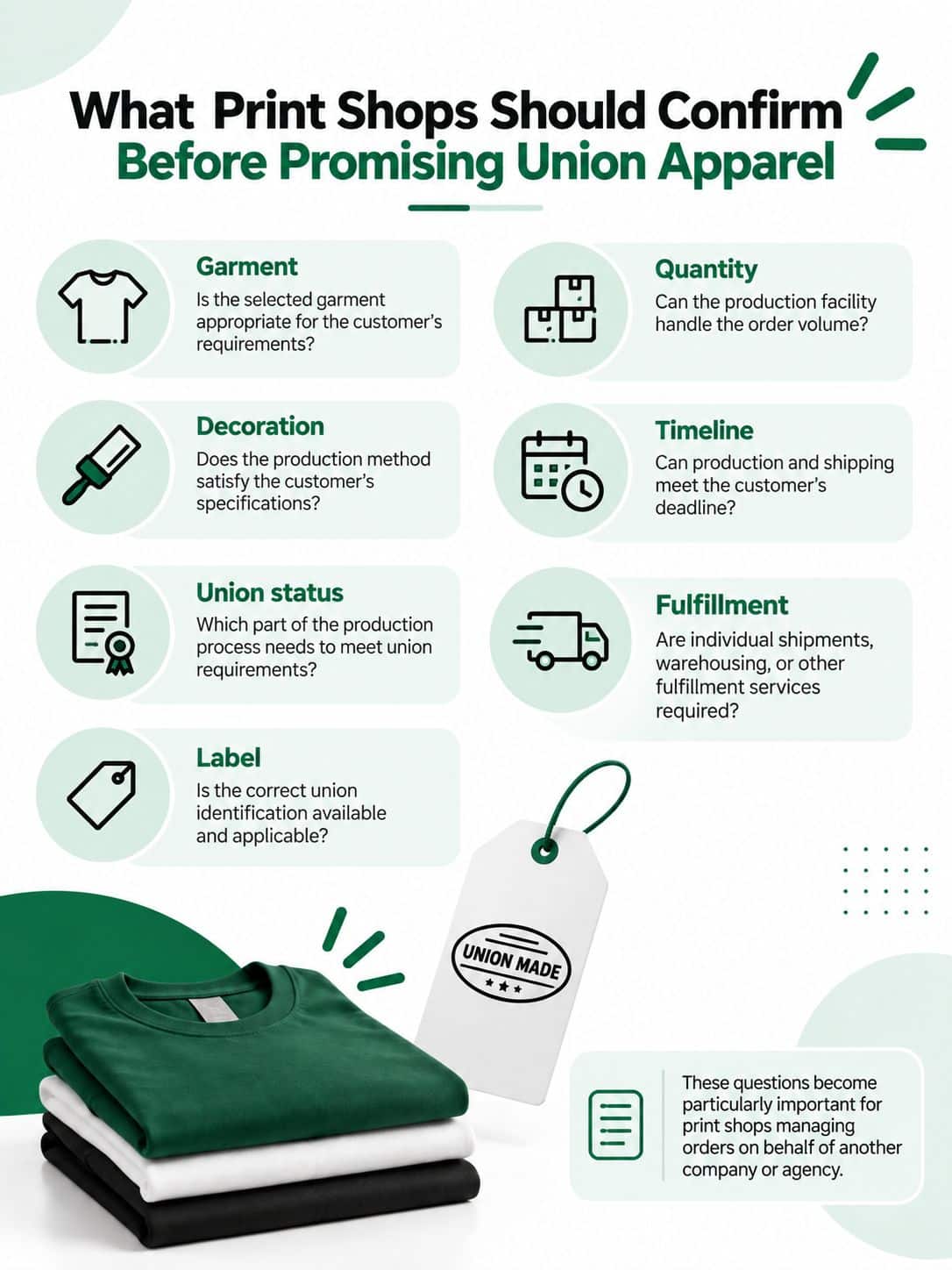
What Print Shops Should Confirm Before Promising Union Apparel
Before accepting a union apparel project, confirm:
- Garment: Is the selected garment appropriate for the customer’s requirements?
- Decoration: Does the production method satisfy the customer’s specifications?
- Union status: Which part of the production process needs to meet union requirements?
- Label: Is the correct union identification available and applicable?
- Quantity: Can the production facility handle the order volume?
- Timeline: Can production and shipping meet the customer’s deadline?
- Fulfillment: Are individual shipments, warehousing, or other fulfillment services required?
These questions become particularly important for print shops managing orders on behalf of another company or agency.
When Outsourcing Makes Sense
Not every print shop needs to own every piece of production equipment.
Outsourcing can make sense when you:
- Receive an order larger than your normal production capacity
- Work with agencies or promotional companies
- Need union contract production
- Don’t have in-house embroidery or screen printing
- Need fulfillment support
- Want to expand the services you can offer clients
A specialized contract decorator can handle production while the print shop or agency maintains the customer relationship.
For businesses exploring this model, union contract services can provide access to contract screen printing, embroidery, fulfillment, and related production capabilities without requiring the business to build those operations internally.
How to Order Union Apparel Without Creating Compliance Problems
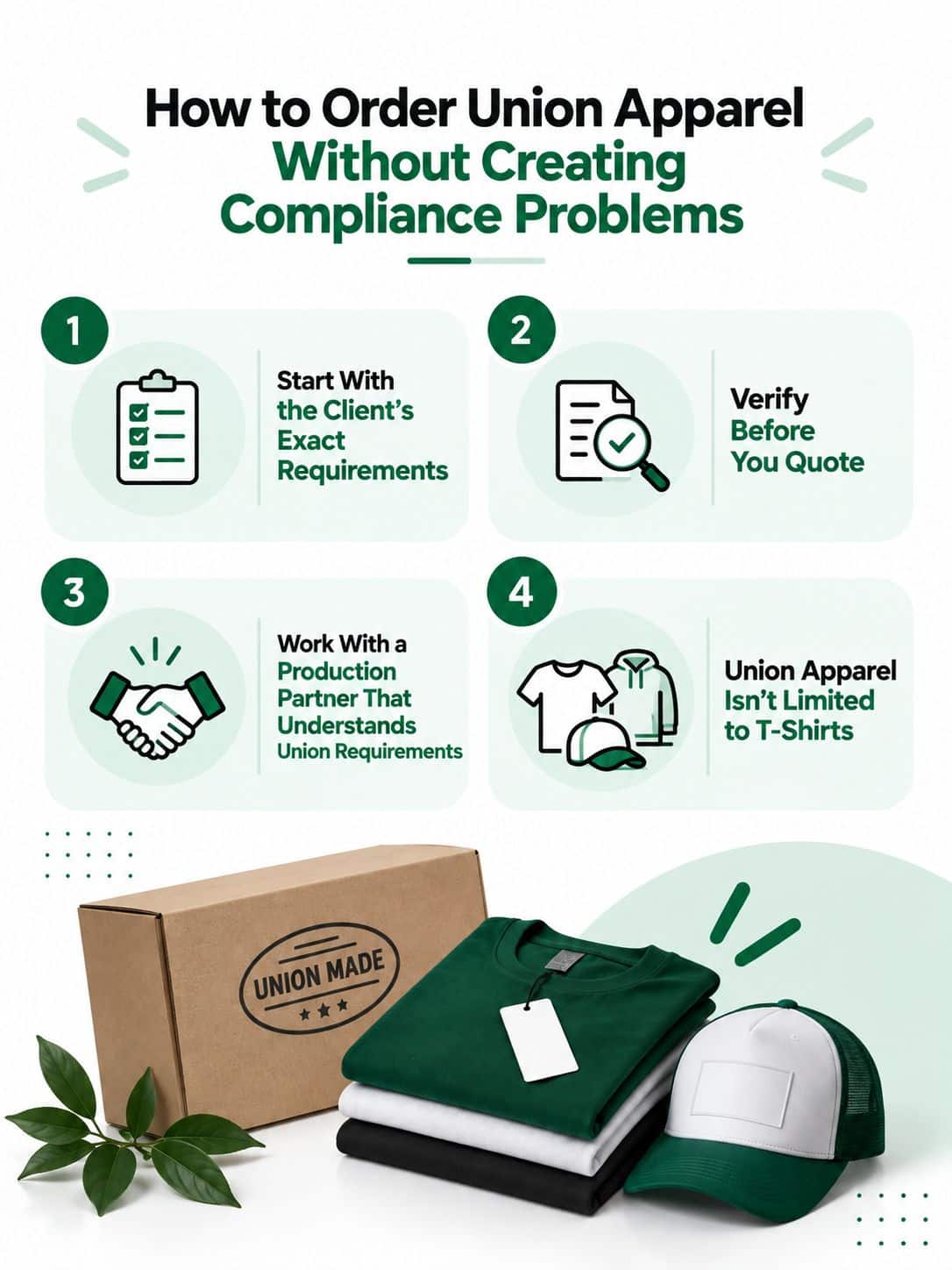
The easiest way to avoid problems is to treat union requirements as a production specification from day one.
Start With the Client’s Exact Requirements
Don’t rely on a simple “yes” or “no” answer to whether the customer wants union apparel.
Ask what they specifically require.
For example:
- Union-made garment?
- Union decoration?
- Specific Union Bug?
- Domestic manufacturing?
- Specific garment supplier?
- Specific production facility?
- Documentation of compliance?
The more precise the requirement, the easier it is to find the right production solution.
Verify Before You Quote
Verification should happen before purchasing garments or promising a delivery date.
This matters because a specialized garment or production process may affect:
- Product availability
- Production cost
- Decoration options
- Minimum quantities
- Turnaround time
- Shipping
- Fulfillment
For high-volume projects, bulk printing services can also help when production volume exceeds your normal in-house capacity.
Work With a Production Partner That Understands Union Requirements
A reliable production partner should understand that union apparel isn’t simply a matter of adding a small label to a finished shirt.
The partner should be able to discuss the applicable production requirements, garment options, decoration process, quality control, and fulfillment needs.
For businesses that need more than apparel printing, related services can also be useful. Depending on the project, customers may need embroidered apparel, patches, stickers, banners, or promotional merchandise alongside their main apparel order.
For example, custom embroidery services can complement printed apparel programs, while premium patches online can provide another decoration option for suitable projects.
Likewise, organizations running broader promotional campaigns may need custom printed promo products alongside their apparel.
Union Apparel Isn’t Limited to T-Shirts
Although T-shirts are a common starting point, union-focused apparel programs can involve many different products.
Depending on the requirements and production capabilities, projects may include:
- T-shirts
- Polo shirts
- Sweatshirts
- Jackets
- Workwear
- Hats
- Embroidered apparel
- Patches
- Promotional merchandise
For campaigns that extend beyond apparel, custom sticker printing services can also be useful for adding branded stickers, banners, or other printed materials to the same promotional program.
The key is to keep these services connected to the customer’s actual project rather than treating them as unrelated add-ons.
The Smallest Mark on the Shirt Can Carry a Big Message
The union bug on apparel may be small, but it can represent an important part of how a garment was produced and the labor standards a customer expects.
For print shops, agencies, apparel businesses, and procurement teams, the most important lesson is not simply recognizing the Union Bug. It’s understanding what the customer actually requires before production begins.
Remember the distinction between union-made, union-decorated, and Made-in-USA apparel. They can overlap, but they should not be treated as interchangeable terms.
When a customer requests a union label, verify the garment, production process, applicable union requirements, and decoration facility before making a commitment.
When your business needs to fulfill specialized or large-scale apparel projects without handling every production step internally, working with an experienced contract production partner can make the process considerably easier.
For a deeper look at the production process, explore the union contract apparel printing guide and learn how contract apparel production can fit into your business workflow.
Common Questions About the Union Bug and Union Label Apparel Printing
What is a Union Bug?
A Union Bug is a small union-related mark or label used to identify apparel or other products associated with union labor or applicable union production requirements.
What does the Union Bug on apparel mean?
It generally communicates that a product or production process is associated with union labor. The exact meaning depends on the applicable union and production arrangement.
Is a Union Bug the same as a Made-in-USA label?
No. A Union Bug and a Made-in-USA claim address different aspects of production. Union status relates to union labor and applicable requirements, while Made in USA relates to domestic manufacturing.
Where is the Union Bug usually located?
It may appear inside the garment label, along a seam, near the hem, on a hangtag, or in another unobtrusive location.
Can any apparel company add a Union Bug?
Businesses should not simply add a Union Bug to apparel because a customer requests one. The applicable union requirements and authorization should be verified before using a union identification mark.
Why do clients request union apparel?
Clients may request it because of union affiliation, organizational values, procurement requirements, labor standards, or preferences concerning responsible or domestic sourcing.
Can a print shop outsource union apparel production?
Yes. Print shops, promotional companies, and agencies can work with contract production partners when they don’t have the appropriate in-house capabilities or need specialized union production support.nbsp;