


Selecting the right ink for screen printing is one of the most important decisions in apparel decoration. The ink you choose influences print appearance, durability, production speed, and even customer perception of your products. Whether you produce branded apparel for businesses, promotional merchandise, retail clothing, or corporate uniforms, matching the ink to the garment and intended use is essential.
Today’s print shops also have more options than ever before. Alongside traditional screen printing, many decorators now combine specialty inks with alternative technologies like ready-to-press DTF transfers for specific applications where flexibility or shorter production runs make more sense. Understanding each ink type helps businesses deliver consistent, professional-quality results while controlling production costs.
Key Takeaways
- The best ink for screen printing depends on your fabric, artwork, durability requirements, and production volume.
- Plastisol remains the most widely used ink because of its versatility and vibrant color performance.
- Water-based inks provide a softer feel and are ideal for fashion and premium retail apparel.
- Specialty inks create unique visual and tactile effects that help products stand out.
- Choosing the right ink improves customer satisfaction, print longevity, and production efficiency.
- Professional screen printing services often recommend ink based on both garment type and branding goals rather than price alone.
Ink for Screen Printing: Why Your Ink Choice Matters
Many businesses focus heavily on artwork and garment selection, yet overlook the importance of selecting the proper ink for screen printing. In reality, ink determines how vibrant a design appears, how long it lasts, and how comfortable the finished garment feels after repeated wear and washing.
The wrong ink can create cracking, fading, poor opacity, or an uncomfortable print surface. The right ink, however, enhances durability, improves wash performance, and creates the premium finish customers expect from quality branded apparel.
Businesses investing in professional screen printing services also benefit from expert recommendations based on garment construction, production quantity, and intended use, ensuring every order performs well long after delivery.
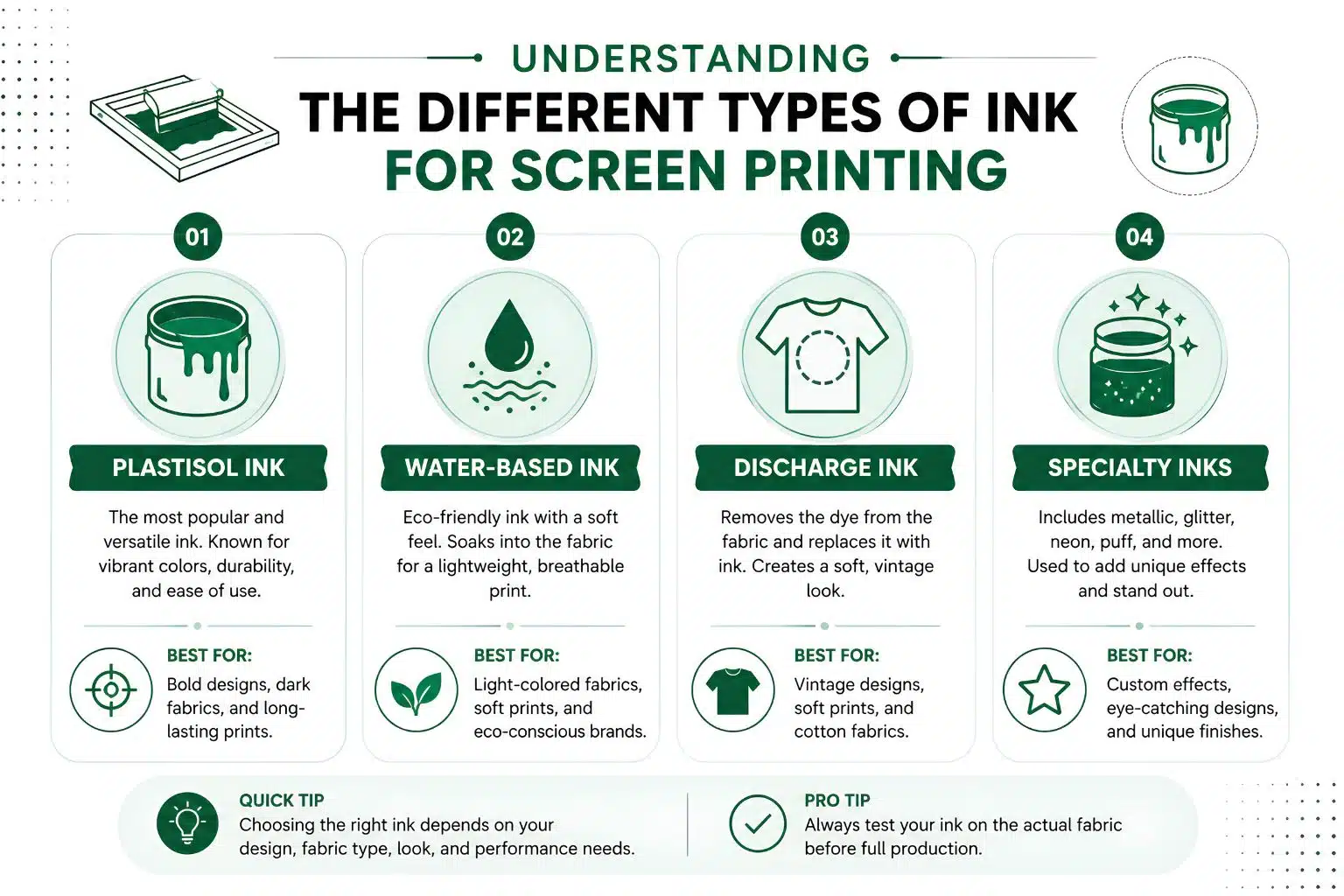
Understanding the Different Types of Ink for Screen Printing
Modern apparel decoration uses several different screen printing inks, each designed for specific garments, production methods, and customer expectations. Understanding these options makes selecting the best solution much easier.
Plastisol Ink
Plastisol remains the industry standard because it offers exceptional color vibrancy, excellent opacity, and consistent results across cotton, cotton blends, and many synthetic fabrics. It is especially popular for:
- Corporate apparel
- Promotional T-shirts
- School spirit wear
- Sports uniforms
- Bulk commercial printing
Its forgiving production process also makes plastisol an excellent choice for high-volume jobs where consistency is essential.
Water-Based Ink
Water-based ink penetrates the garment fibers rather than sitting heavily on top of the fabric. This creates a noticeably softer feel, making it popular among premium fashion labels and lifestyle apparel brands.
It performs especially well on:
- Premium cotton garments
- Retail collections
- Lightweight apparel
- Fashion-focused merchandise
Although production can require tighter environmental controls, many brands consider the superior comfort worth the additional effort.
Discharge Ink
Discharge ink removes existing garment dye before replacing it with new pigment, creating extremely soft prints while maintaining excellent vibrancy on suitable cotton garments.
This method works best when decorators need:
- Vintage aesthetics
- Soft retail-quality prints
- High-end fashion collections
- Lightweight garments with minimal print feel
Not every fabric responds equally well, so garment selection becomes especially important.
Specialty Inks
Specialty inks help brands create distinctive products that stand apart from ordinary apparel. Popular options include:
- Puff ink
- Metallic ink
- Glow-in-the-dark ink
- High-density ink
- Glitter ink
- Reflective ink
These inks add visual interest and elevate premium merchandise collections without requiring major production changes.
Ink for Screen Printing Based on Fabric Type
Selecting the correct ink for screen printing begins with understanding the fabric you’re decorating. Different fibers interact with ink differently, affecting adhesion, wash durability, flexibility, and appearance.
Cotton
Cotton remains the easiest material to decorate because it accepts nearly every major screen printing ink. Plastisol provides excellent durability, while water-based and discharge inks produce softer, retail-quality finishes that many fashion brands prefer.
Cotton Blends
Blended fabrics require greater attention because polyester content can introduce dye migration during curing. Low-bleed plastisol formulations often produce the most reliable results, especially for athletic or corporate apparel.
Polyester
Polyester presents additional challenges because heat can activate dyes within the fabric. Choosing specialty polyester inks helps prevent color bleeding while maintaining crisp, vibrant graphics.
Performance Fabrics
Stretch fabrics require inks that move with the garment without cracking. Flexible plastisol systems and carefully formulated specialty inks typically provide the best long-term durability for activewear and uniforms.
Understanding garment construction before printing prevents expensive production issues and improves overall customer satisfaction.
Ink for Screen Printing and Print Durability
Durability often separates premium apparel from products customers wear only a few times. Businesses comparing different ink for screen printing options should evaluate long-term performance rather than focusing only on initial appearance.
High-quality screen printing inks are engineered to resist:
- Repeated washing
- Cracking
- Peeling
- Fading
- Stretch damage
- Everyday abrasion
Several factors influence durability beyond ink selection itself, including curing temperature, garment composition, artwork size, and proper production practices.
For businesses offering multiple decoration methods, combining traditional screen printing with ready-to-press DTF transfers can also provide flexibility for short runs or complex artwork while maintaining professional-quality finished products.
Plastisol vs Water-Based Ink for Screen Printing
One of the most common comparisons in DTF and sublimation printing discussions is between plastisol and water-based inks, but when choosing ink for screen printing, these two options deserve their own comparison. Each has strengths depending on the garment, customer expectations, and production workflow.
Plastisol Ink
Plastisol is the industry standard because it offers exceptional versatility and reliable production. It sits on top of the fabric rather than soaking into the fibers, creating bright, opaque prints that remain vibrant after repeated washing.
It performs especially well for:
- Corporate uniforms
- Promotional apparel
- School spirit wear
- Event merchandise
- Dark-colored garments
- High-volume production
Its forgiving curing process also reduces production errors, making plastisol ideal for commercial operations.
Water-Based Ink
Water-based ink penetrates garment fibers, creating a much softer print with a premium retail appearance. Fashion brands often prefer this finish because customers can barely feel the printed design.
Water-based inks are commonly used for:
- Boutique apparel
- Lifestyle clothing
- Fashion collections
- Vintage-inspired graphics
- Premium cotton garments
Although production requires greater control over curing and humidity, many brands consider the improved comfort worth the additional attention.
Quick Comparison
| 🎨 Feature | 🖌️ Plastisol Ink | 💧 Water-Based Ink |
|---|---|---|
| 🌈 Color Opacity | ★★★★★ | ★★★★☆ |
| 🧸 Softness | ★★★☆☆ | ★★★★★ |
| 👕 Dark Garments | ✅ Excellent | 👍 Good |
| ⚡ Production Speed | 🚀 Excellent | ⏳ Moderate |
| ✨ Fashion Appeal | 👍 Good | 🌟 Excellent |
| 🧼 Wash Durability | 💪 Excellent | 💪 Excellent |
Plastisol ink is the industry standard for vibrant colors, high-opacity prints, and fast production, especially on dark garments. Water-based ink delivers an ultra-soft feel with a premium retail look, making it a popular choice for fashion brands and eco-conscious apparel while still providing excellent wash durability.
Bottom line: Plastisol remains the safest choice for most commercial projects, while water-based ink excels when softness and premium retail feel are the priority.
Ink for Screen Printing Based on Your Project
Different printing projects have different priorities. Selecting the right ink for screen printing becomes much easier when you first define what you’re producing rather than starting with the ink itself.
Corporate Apparel
Corporate apparel demands consistent colors, sharp logos, and long-term durability. Plastisol generally delivers the most reliable results because it produces excellent opacity across large production runs while maintaining brand consistency.
Many businesses producing branded apparel also prioritize repeatability, ensuring every reorder matches previous shipments regardless of garment color or production date.
Retail Fashion
Retail customers often prioritize softness as much as visual appearance. Water-based inks frequently become the preferred option because they create lightweight garments with a premium hand feel that customers associate with higher-quality clothing.
Promotional Merchandise
Promotional campaigns usually emphasize cost efficiency, durability, and production speed. Plastisol continues to dominate these applications because it balances affordability with long-lasting print performance.
Athletic Programs
Sports uniforms require flexible inks that tolerate repeated movement and frequent washing. Selecting specialized formulations helps maintain vibrant graphics while reducing cracking over time.
Ink for Screen Printing Color Performance
Color quality often determines whether customers perceive apparel as premium or inexpensive. Even excellent artwork cannot compensate for poor ink performance.
Several factors influence color reproduction:
- Pigment concentration
- Fabric color
- Underbase quality
- Ink opacity
- Proper curing
- Mesh selection
Plastisol generally produces the brightest colors on dark garments because its opaque formulation completely covers underlying fabric colors. Water-based inks create exceptionally vibrant prints on light garments but may require additional preparation when printing darker fabrics.
Color consistency also becomes increasingly important as businesses scale production. Companies fulfilling repeat corporate orders benefit from standardized ink systems that maintain identical colors across thousands of garments.
Specialty Ink for Screen Printing Projects
Not every project requires standard plastisol or water-based ink. Specialty inks allow businesses to create apparel that immediately attracts attention while commanding higher retail prices.
Popular specialty inks include:
- Puff ink for raised graphics
- Metallic ink for reflective finishes
- Glitter ink for decorative apparel
- Glow-in-the-dark ink
- High-density ink
- Reflective safety ink
These finishes work particularly well for premium merchandise collections, limited-edition releases, and lifestyle brands seeking unique visual identity.
However, specialty effects often require additional production expertise. Businesses without specialized equipment sometimes combine traditional screen printing with contract decoration services, allowing experienced decorators to produce complex specialty finishes while maintaining consistent quality.
Eco-Friendly Ink for Screen Printing
Sustainability continues influencing purchasing decisions across apparel, especially among younger consumers and environmentally conscious brands. Many companies now evaluate ink for screen printing based not only on print quality but also on environmental impact.
Water-based inks are frequently viewed as the more environmentally friendly option because they contain lower levels of PVC and certain chemical additives commonly associated with traditional plastisol formulations.
Businesses pursuing sustainability often consider:
- Lower environmental impact
- Reduced chemical exposure
- Softer finished garments
- Eco-conscious branding
- Premium retail positioning
That said, modern plastisol technology has also improved significantly, with many manufacturers offering phthalate-free and low-impact formulations that meet strict regulatory requirements.
Ultimately, sustainability involves more than ink selection. Garment sourcing, production efficiency, shipping, and waste reduction all contribute to a product’s overall environmental footprint.
Ink for Screen Printing Cost Considerations
Price matters, but focusing only on the cost of ink often leads businesses toward expensive production mistakes. The true cost of ink for screen printing includes labor, curing time, waste, production efficiency, and customer satisfaction.
When evaluating printing costs, businesses should consider:
- Ink price
- Setup labor
- Production speed
- Waste percentage
- Reprint frequency
- Long-term durability
Higher-quality inks often reduce overall operating costs because they produce fewer production errors, better wash performance, and fewer customer complaints.
Large commercial orders also benefit from bulk printing services, where production efficiency significantly lowers per-unit decoration costs while maintaining consistent quality across thousands of garments.
Common Mistakes When Choosing Ink for Screen Printing
Even experienced decorators can make poor ink selections when deadlines are tight or garment specifications change. Choosing the wrong ink for screen printing often leads to preventable quality issues that increase production costs and reduce customer satisfaction.
Some of the most common mistakes include:
- Selecting plastisol for projects that require an ultra-soft retail finish.
- Using water-based ink on garments that aren’t compatible with its curing requirements.
- Ignoring polyester dye migration on synthetic fabrics.
- Choosing specialty inks without testing cure settings.
- Using incorrect mesh counts for fine-detail artwork.
- Under-curing or over-curing garments.
Testing garments before full production is always more cost-effective than replacing an entire order after delivery. Creating sample prints helps verify adhesion, wash durability, and color accuracy before committing to commercial quantities.
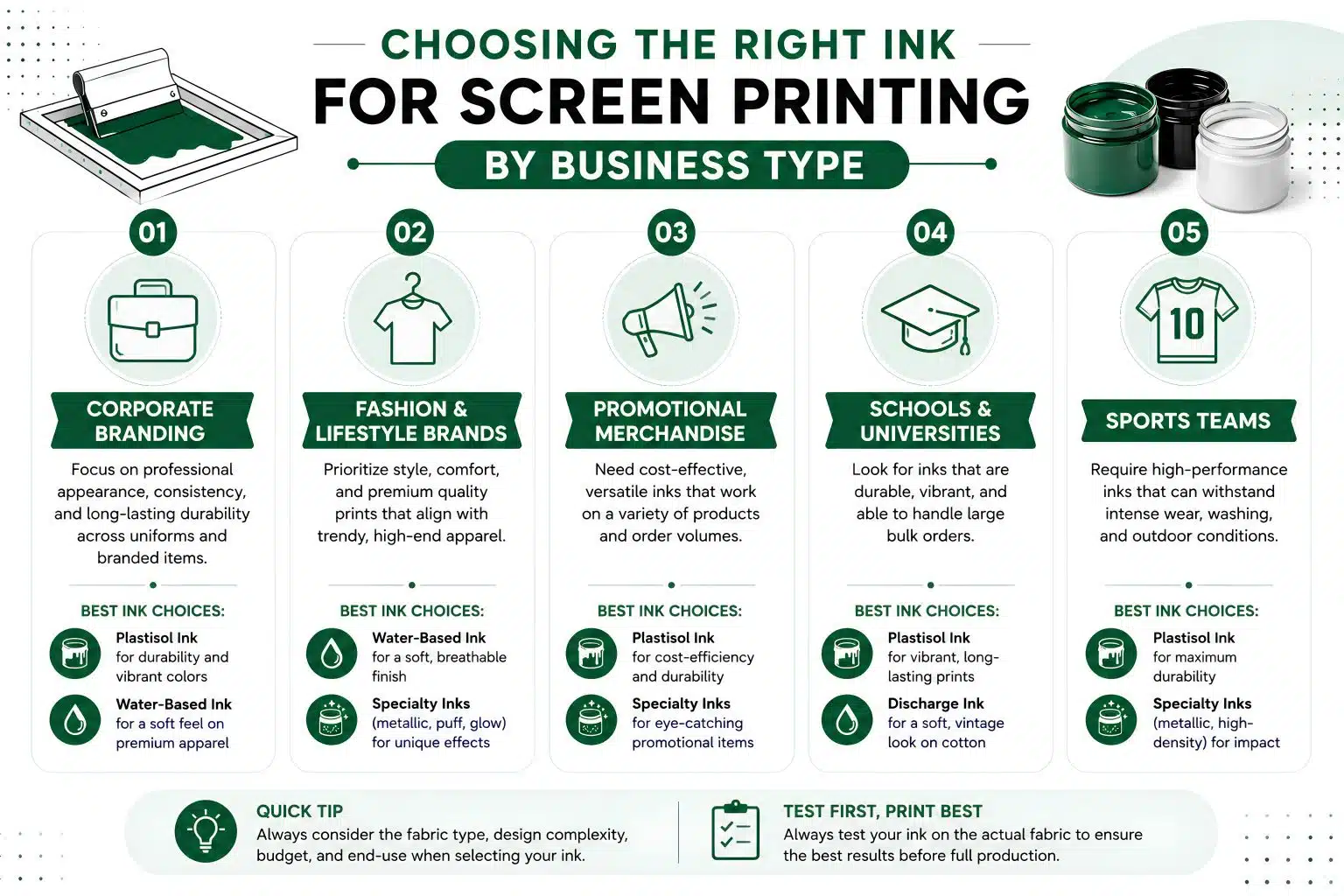
Choosing the Right Ink for Screen Printing by Business Type
Different industries have different decoration priorities. Selecting the best ink for screen printing starts with understanding how the finished apparel will actually be used.
Corporate Branding
Businesses ordering employee apparel typically prioritize consistency, durability, and professional appearance. Plastisol remains the preferred option because it delivers crisp logos and excellent long-term performance across large production runs.
Fashion & Lifestyle Brands
Retail brands often focus on softness, comfort, and premium garment feel. Water-based inks frequently provide the elevated finish customers expect from higher-end apparel collections.
Promotional Merchandise
Promotional campaigns emphasize affordability and production speed. Durable plastisol inks allow businesses to maximize value while maintaining vibrant branding on event shirts, giveaways, and uniforms.
Schools & Universities
Spirit wear requires bright colors, repeated washing, and long-lasting prints. Plastisol continues to perform exceptionally well for these applications due to its outstanding opacity and durability.
Sports Teams
Athletic apparel benefits from flexible inks that tolerate stretching, movement, and frequent laundering. Specialized athletic formulations help maintain print integrity throughout an entire season.
When Screen Printing Isn’t the Best Choice
Although selecting the proper ink for screen printing solves many production challenges, there are situations where traditional screen printing may not be the most efficient solution.
Projects involving:
- One-off orders
- Variable names and numbers
- Small production runs
- Highly detailed multicolor artwork
- Frequent design changes
can often become expensive because every screen setup requires additional labor and production time.
Why Businesses Partner with Shirt.co for Professional Apparel Decoration
Successful apparel programs require much more than selecting the right ink for screen printing. Businesses also need dependable production, consistent decoration quality, scalable fulfillment, and experienced technical support.
At Shirt.co, we help organizations simplify apparel production through:
- Commercial-grade screen printing
- Precision embroidery
- Contract decoration
- On-demand fulfillment
- Bulk production management
- Brand consistency across every order
Whether you’re launching a new clothing brand, managing employee uniforms, or producing promotional merchandise for nationwide campaigns, our production team focuses on maintaining color accuracy, print consistency, and dependable turnaround throughout every stage of manufacturing.
Businesses requiring premium stitched logos can also take advantage of our professional embroidery services, ensuring garments maintain a polished appearance across uniforms, hats, polos, and premium retail apparel.
As companies continue growing, managing inventory becomes increasingly complex. Shirt.co also supports brands with flexible on-demand merchandise, allowing businesses to fulfill orders efficiently without maintaining large warehouse inventories.
Future Trends in Screen Printing Ink Technology
Innovation continues shaping the future of ink for screen printing, giving businesses more options than ever before. Modern formulations improve sustainability, increase production efficiency, and create better customer experiences without sacrificing durability.
Emerging trends include:
- PVC-free plastisol formulations
- Eco-friendly water-based systems
- Softer specialty inks
- Improved low-cure technologies
- Higher-opacity pigments
- Better stretch performance
These innovations allow decorators to serve increasingly diverse markets while maintaining premium-quality finished apparel.
As customer expectations continue evolving, businesses that stay informed about printing technology gain a competitive advantage through higher-quality products and more efficient production workflows.
Final Thought
Choosing the right ink for screen printing ultimately depends on your garments, branding goals, production volume, and customer expectations. Plastisol continues to dominate commercial apparel because of its durability and vibrant colors, while water-based inks deliver the premium softness favored by fashion brands.
Specialty inks provide unique finishes that elevate retail merchandise, and selecting the correct formulation improves print quality, wash performance, and customer satisfaction. Rather than focusing solely on ink cost, evaluate the complete production workflow and long-term value. At Shirt.co, we combine expert decoration, scalable production, and dependable fulfillment to help businesses create professional custom apparel that consistently represents their brand.
FAQs
What is the best ink for screen printing?
Plastisol is generally considered the best all-around ink for screen printing because it offers vibrant colors, excellent durability, and reliable production across many fabric types. Water-based ink is preferred when softness and premium feel are top priorities.
Is plastisol better than water-based ink?
Neither is universally better. Plastisol performs exceptionally well for promotional apparel, uniforms, and dark garments, while water-based ink provides a softer finish that many retail and lifestyle brands prefer.
Which ink lasts longer on T-shirts?
Properly cured plastisol and water-based inks both provide outstanding wash durability. Longevity depends more on correct production techniques than the ink type alone.
Can I use the same ink on cotton and polyester?
Some inks work across multiple fabrics, but polyester often requires specialty low-bleed formulations to prevent dye migration and maintain color accuracy.
What ink is best for corporate apparel?
Plastisol remains the preferred choice for most corporate branding because it delivers consistent logo reproduction, excellent opacity, and long-lasting durability.
Does water-based ink feel softer?
Yes. Water-based inks penetrate garment fibers instead of sitting on the surface, creating a softer, lighter print that many customers associate with premium apparel.
What is the most durable screen printing ink?
High-quality plastisol inks are generally considered the most durable for commercial apparel, especially when garments receive frequent washing and heavy everyday use.
Is screen printing still better than DTF?
For large production runs, screen printing remains one of the most economical decoration methods. For short runs, personalization, and complex artwork, DTF often provides greater flexibility.
How do I choose the right ink for my project?
Consider garment material, artwork complexity, production quantity, durability requirements, and customer expectations before selecting an ink system.
Where can businesses order professionally printed custom apparel?
Businesses looking for dependable commercial apparel decoration can partner with Shirt.co for expert screen printing, embroidery, contract decoration, bulk production, and scalable branded merchandise solutions.