


How long does custom apparel take? It’s one of the first questions businesses ask when planning branded merchandise, uniforms, or promotional campaigns. But the answer depends on several factors, including the decoration method, artwork approval, garment availability, production capacity, and shipping.
Whether you’re ordering for apparel brands, ecommerce stores, schools, sports teams, promotional companies, corporate apparel programs, or marketing agencies, understanding the production timeline is essential for meeting launch dates and event deadlines.
From employee onboarding kits to retail product drops, knowing what influences turnaround helps you avoid delays, manage expectations, and keep projects on schedule. This guide breaks down every stage of the process so you can plan your next custom apparel order with confidence.
Key Takeaways
- Most custom apparel orders take 7–15 business days, depending on the decoration method and order size.
- Artwork approval and blank garment availability are often the biggest factors affecting production speed.
- Screen printing usually requires more setup time than DTF for small orders.
- Embroidery lead times vary based on stitch count, logo complexity, and machine scheduling.
- Larger bulk orders require longer production but significantly reduce per-unit costs.
- Planning ahead helps avoid rush fees and ensures on-time delivery for launches, events, and corporate programs.
The Duration of Apparel Customization: What Determines Turnaround Time?
A typical decoration process may take from 7 to 15 days. But there isn’t a single production timeline that fits every project. Custom apparel turnaround time varies because every order has different artwork, decoration methods, garment availability, production schedules, and shipping requirements. A simple one-color T-shirt order may be completed within a week, while a large corporate uniform program with embroidery and multiple garment styles can take considerably longer.
Several factors influence custom apparel processing time, including:
- Artwork approval and revision cycles
- Decoration method (screen printing, embroidery, or DTF)
- Blank garment inventory and supplier availability
- Production queue during peak seasons
- Total order quantity
- Selected shipping speed and destination
Understanding each of these variables allows businesses to estimate delivery more accurately and avoid unnecessary delays.
Typical Custom Apparel Printing Timeline
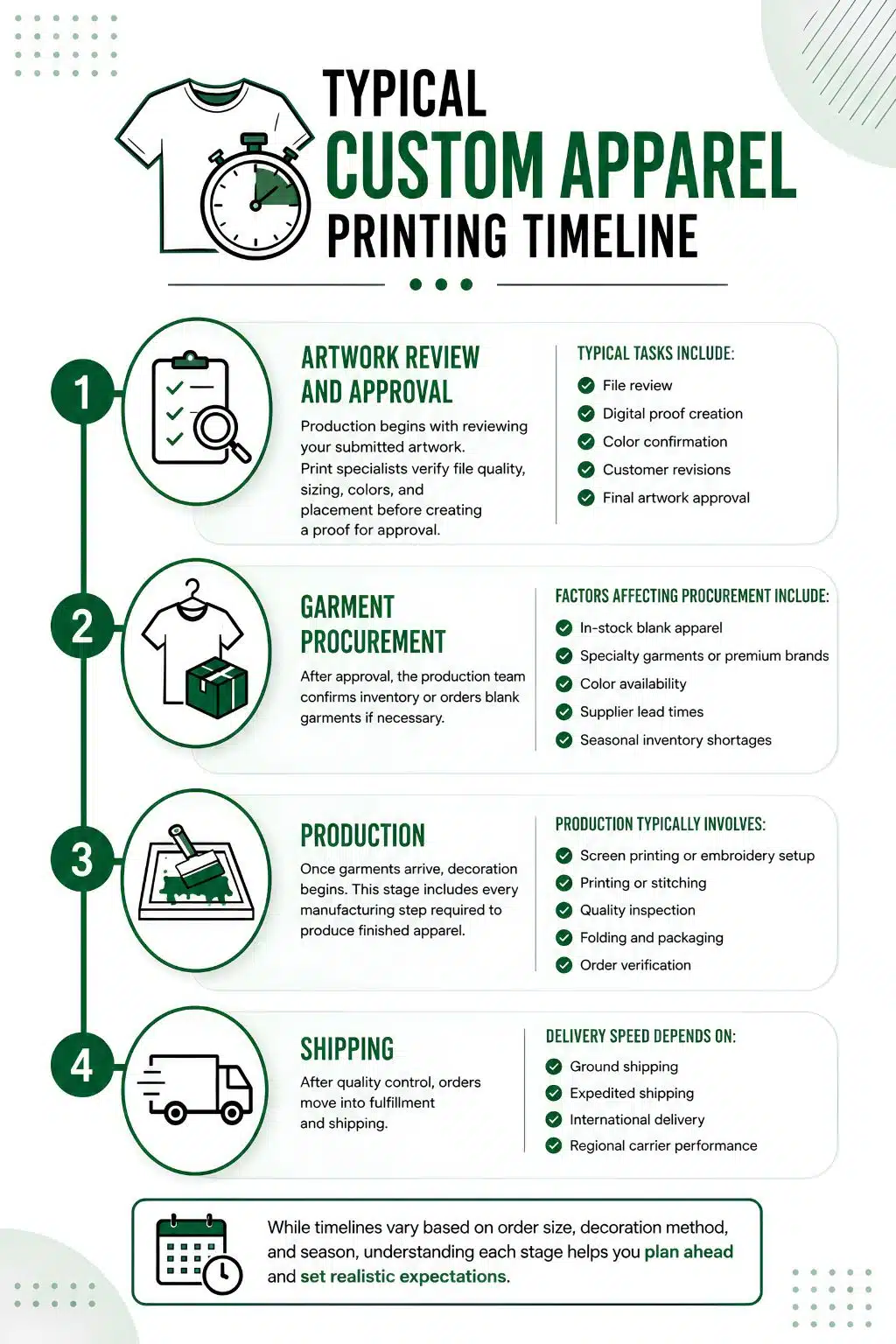
Every order follows a structured production workflow before it reaches your door. While timelines vary between providers, most commercial apparel decorators follow the same general process as follows.
Artwork Review and Approval
Production begins with reviewing your submitted artwork. Print specialists verify file quality, sizing, colors, and placement before creating a proof for approval.
Typical tasks include:
- File review
- Digital proof creation
- Color confirmation
- Customer revisions
- Final artwork approval
Artwork approval is often the first bottleneck because production cannot begin until the customer signs off on the proof.
Garment Procurement
After approval, the production team confirms inventory or orders blank garments if necessary.
Factors affecting procurement include:
- In-stock blank apparel
- Specialty garments or premium brands
- Color availability
- Supplier lead times
- Seasonal inventory shortages
Standard apparel is usually sourced quickly, while specialty products may require additional days.
Production
Once garments arrive, decoration begins. This stage includes every manufacturing step required to produce finished apparel.
Production typically involves:
- Screen printing or embroidery setup
- Printing or stitching
- Quality inspection
- Folding and packaging
- Order verification
Large commercial facilities often process multiple jobs simultaneously to maintain consistent turnaround.
Shipping
After quality control, orders move into fulfillment and shipping.
Delivery speed depends on:
- Ground shipping
- Expedited shipping
- International delivery
- Regional carrier performance
Typical Production Timeline
Typical Custom Apparel Production Timeline
Understanding each stage of the production process helps you plan your custom apparel order and meet important deadlines.
| 📋 Production Stage | ⏱️ Typical Time |
|---|---|
| 🎨 Artwork Approval | 1–2 business days |
| 👕 Garment Sourcing | 1–3 business days |
| 🖨️ Production | 3–7 business days |
| ✅ Quality Check | 1 business day |
| 🚚 Shipping | 2–5 business days |
Most custom apparel orders are completed in approximately 7–15 business days, depending on artwork approval, garment availability, order quantity, decoration method, and shipping destination. For trade shows, corporate events, or fundraisers, place your order at least 2–3 weeks in advance to allow sufficient time for production and delivery.
This custom apparel printing timeline means most standard projects are completed within one to two weeks from artwork approval.
Custom Apparel Turnaround Time by Decoration Method
Different decoration methods require different production workflows, which directly affect turnaround times.
Screen Printing
Typical turnaround:
5–10 business days
Screen printing involves additional setup before production can begin. Each color requires its own screen, ink preparation, and press registration, making setup more labor-intensive than digital methods.
Production time depends on:
- Screen creation
- Ink mixing
- Multi-color registration
- Press scheduling
- Large production batches
Businesses ordering through screen printing services can expect exceptional durability and cost efficiency for medium to large runs, although setup typically adds extra production time.
Embroidery
Typical turnaround:
5–12 business days
Embroidery requires logo digitization before stitching begins. Complex designs with high stitch counts take longer to produce than simple logos.
Factors affecting embroidery production include:
- Digitizing artwork
- Stitch count
- Machine scheduling
- Thread color changes
- Garment hooping
Professional embroidery services often include quality checks throughout production to ensure clean stitching and consistent branding.
DTF Transfers
Typical turnaround:
2–5 business days
Direct-to-Film (DTF) decoration generally offers the fastest production for smaller orders because it eliminates traditional screen setup.
Advantages include:
- Faster artwork setup
- Excellent for short runs
- Full-color printing
- Flexible production scheduling
- Efficient handling of detailed artwork
Businesses using ready-to-press DTF transfers often benefit from shorter lead times, especially for low-volume or personalized apparel orders.
How Order Quantity Affects Production Time
Order size plays a major role in determining custom clothing lead time. While larger orders usually require more production days, they also allow decorators to run equipment more efficiently, reducing overall costs.
Small orders often move through production quickly because they require fewer garments, while wholesale projects demand additional press time, inspection, and packaging.
Typical Production Times by Quantity
| Quantity | Average Production Time |
| 12–24 shirts | 3–5 business days |
| 25–100 shirts | 5–7 business days |
| 100–500 shirts | 7–10 business days |
| 500+ shirts | 10–15 business days |
Although larger orders extend production, commercial print facilities offset this with batch workflows that improve efficiency and reduce the cost per garment.
Custom Shirt Printing Turnaround for Different Business Types
Different organizations require different production schedules based on how apparel supports their operations.
- Ecommerce stores often prioritize consistent inventory replenishment and predictable fulfillment timelines.
- Corporate apparel programs usually schedule production weeks in advance for employee onboarding and company events.
- Schools frequently place seasonal spirit wear and fundraiser orders tied to academic calendars.
- Sports teams require uniforms before tournaments, making deadline planning essential.
- Promotional campaigns depend on precise delivery dates for trade shows, conferences, and marketing events.
- Retail brands typically align apparel production with product launches and seasonal collections.
Understanding your organization’s goals helps determine the ideal custom shirt printing turnaround and ensures apparel arrives when it’s needed most.
Factors That Delay Custom Apparel Orders
Even when a print provider has fast equipment and experienced staff, several variables can extend production timelines. The most common delays happen before garments ever reach the press.
Artwork revisions, incomplete design files, and slow customer approvals frequently add several business days to a project. Since production cannot begin until artwork is approved, every revision pushes the schedule further back.
Garment availability is another major factor. Popular sizes and colors generally remain in stock year-round, but premium brands, seasonal collections, and specialty fabrics may require additional sourcing time. During busy periods such as back-to-school season, holiday promotions, or major sporting events, suppliers may experience temporary shortages that affect lead times.
Large or complex decoration jobs also require additional planning. Orders featuring multiple print locations, specialty inks, oversized graphics, or mixed garment styles typically move through production more slowly because each garment requires additional setup and quality control.
Common causes of delayed production include:
- Multiple artwork revisions
- Slow proof approvals
- Out-of-stock garment colors or sizes
- Multiple print locations (front, back, sleeves)
- Specialty inks such as metallic, puff, or glow-in-the-dark
- International garment sourcing delays
- Holiday production demand
- Weather-related shipping disruptions
Planning ahead and approving artwork promptly remains the easiest way to reduce production delays.
Rush Orders vs Standard Production
Many commercial decorators offer rush production for customers working against tight deadlines. Rush services prioritize your order in the production queue, allowing printing to begin sooner than standard scheduling. While this can significantly reduce turnaround time, it often comes with additional production fees and expedited shipping costs.
Rush production works best when artwork is already finalized and blank garments are immediately available. If garments must still be sourced or extensive revisions are required, paying for rush service may not significantly reduce the delivery timeline.
Standard Production vs. Rush Production
Compare turnaround times, pricing, and fulfillment options to determine which production schedule best fits your project.
| 📋 Feature | 📅 Standard Production | ⚡ Rush Production |
|---|---|---|
| 🏭 Production Queue | Normal scheduling | Priority scheduling |
| ⏱️ Average Turnaround | 7–15 business days | 2–5 business days |
| 🚚 Shipping | Standard shipping | Expedited shipping |
| 💲 Cost | Standard pricing | Rush surcharge applies |
| 🎯 Best For | Planned orders with flexible timelines | Events, product launches, and urgent deadlines |
Whenever possible, choose standard production to maximize garment availability and minimize costs. If you have a strict event date or last-minute order, rush production can reduce turnaround to as little as 2–5 business days, though additional fees and limited garment availability may apply.
Rush production is worthwhile for conferences, employee onboarding, trade shows, product launches, and last-minute promotional campaigns where meeting the deadline is more valuable than minimizing production costs.
Bulk Printing Services and Production Scheduling
Large production facilities rely on sophisticated scheduling systems to process hundreds or even thousands of garments efficiently. Instead of printing one order at a time, commercial shops organize jobs into production batches that minimize setup changes and maximize equipment utilization.
Batch production improves consistency while reducing downtime between jobs. Production managers coordinate press schedules, embroidery machines, garment inventory, staffing, and shipping so multiple orders move simultaneously through different stages of manufacturing.
Additional scheduling considerations include:
- Batch production planning
- Automatic press scheduling
- Workforce allocation
- Inventory management
- Quality inspection checkpoints
- Shipping coordination
Businesses using professional bulk printing services benefit from predictable production schedules, lower per-unit costs, and consistent quality across large apparel programs.
Planning Large Custom Apparel Orders
Ordering apparel for dozens or hundreds of people requires more planning than placing a small online order. Organizations that schedule production well in advance experience fewer delays and lower costs.
Large orders commonly include:
- Employee uniforms
- Sports leagues and tournaments
- School spirit wear
- Conferences and trade shows
- Retail product launches
- Seasonal promotional campaigns
One of the biggest planning challenges involves ordering the correct garment quantities and size distribution. Estimating sizes accurately before production begins reduces expensive reorders and inventory shortages.
The guide on how to plan shirt sizes for large screen printing orders provides helpful strategies for forecasting quantities and organizing large apparel purchases more efficiently.
On-Demand Merchandise vs Traditional Production
On-demand production has become increasingly popular among ecommerce brands because it eliminates inventory storage and allows garments to be produced only after customers place orders.
Traditional production offers lower unit costs for larger quantities but requires inventory planning and warehouse space. On-demand production trades some manufacturing efficiency for greater flexibility and lower upfront investment.
Comparison highlights include:
- Inventory requirements
- Fulfillment flexibility
- Production speed
- Per-unit pricing
- Warehousing costs
- Scalability
Businesses selling personalized or seasonal products often benefit from on-demand merchandise, while organizations with predictable demand usually achieve better margins through larger production runs.
Promotional Products and Apparel Timelines
Marketing campaigns frequently involve more than custom shirts alone. Businesses often coordinate apparel with drinkware, bags, pens, notebooks, and other branded giveaways that must arrive simultaneously before an event.
Synchronizing multiple product categories requires careful production scheduling. Delays in one product can impact the entire campaign, making communication between suppliers especially important.
Working with a provider that offers both apparel and promotional products simplifies project management and improves shipping coordination for trade shows, conferences, employee appreciation events, and customer giveaways.
How Shirt.co Helps
Businesses depend on reliable production schedules because missed deadlines affect product launches, employee onboarding, retail sales, and promotional campaigns. Experienced production partners reduce uncertainty by following structured workflows from artwork approval through final delivery.
Shirt.co supports commercial apparel programs with comprehensive artwork review, organized production scheduling, and consistent quality control. Reliable communication throughout every stage helps customers monitor progress and plan around important deadlines.
Companies also value Shirt.co’s nationwide fulfillment capabilities, and commercial production capacity.
How to Reduce Your Custom Apparel Delivery Time
Businesses can significantly improve custom apparel delivery time by following several simple planning strategies before production begins.
The most effective ways to shorten production include:
- Approve artwork as quickly as possible.
- Order well before event deadlines.
- Select standard garment colors that remain in stock.
- Consolidate garment sizes and styles when possible.
- Minimize unnecessary artwork revisions.
- Work with experienced production partners.
- Plan seasonal orders several weeks ahead.
- Choose expedited shipping only when necessary.
These practices help reduce overall custom T-shirt shipping time while minimizing rush fees and production bottlenecks.
To Wrap Up
So, how long does custom apparel take? The answer depends on artwork approval, decoration method, garment availability, production capacity, shipping, and overall project planning. Screen printing, embroidery, and DTF each follow different production timelines, while larger orders require additional scheduling despite offering better pricing.
Businesses that plan ahead, approve artwork quickly, and work with experienced production partners consistently receive faster, more reliable results. Rather than focusing only on printing time, evaluate the complete production process from design through delivery. Shirt.co helps businesses manage every stage efficiently, delivering high-quality custom apparel with dependable turnaround for organizations of every size.
FAQs
How long does custom apparel take?
Most custom apparel orders are completed within 7–15 business days, depending on artwork approval, decoration method, order size, garment availability, and shipping.
What is the average custom apparel turnaround time?
The average turnaround for commercial apparel production is approximately 1–2 weeks, although rush production may shorten this to just a few business days.
How long does custom T-shirt production take?
Most custom T-shirt production requires 3–7 business days after artwork approval and garment availability have been confirmed.
What affects custom apparel delivery time?
Artwork revisions, inventory availability, production queues, decoration methods, shipping distance, and seasonal demand all influence delivery schedules.
Does screen printing take longer than embroidery?
Not always. Screen printing usually requires additional setup for multi-color jobs, while embroidery time depends heavily on stitch count and logo complexity.
How quickly can rush custom apparel orders be completed?
Rush orders can often be produced in 2–5 business days, depending on garment availability and artwork readiness.
How does bulk ordering affect production time?
Larger orders typically require more production days but significantly reduce per-unit costs because equipment runs more efficiently.
What delays custom clothing lead time?
Common delays include missing artwork approvals, out-of-stock garments, specialty inks, multiple print locations, supplier shortages, and holiday demand.
How can I speed up custom apparel processing?
Approve proofs promptly, use standard garment colors, avoid repeated revisions, order early, and choose an experienced production partner.
Where can businesses order custom apparel with reliable turnaround?
Businesses looking for dependable scheduling, consistent print quality, and commercial-scale production can work with experienced providers like Shirt.co for professionally managed custom apparel projects.