
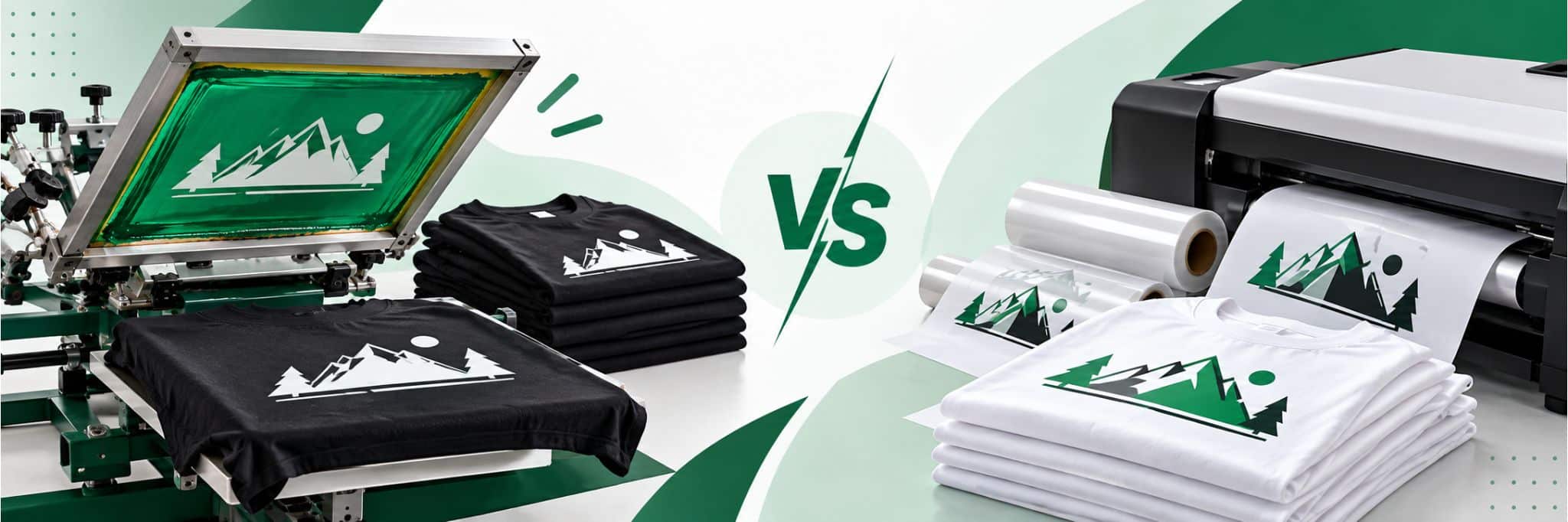

When you need hundreds or even thousands of printed garments, choosing the right printing method can affect your budget, production schedule, design flexibility, and final product. Two of the most common options are traditional screen printing and Direct-to-Film (DTF) printing.
The right choice is not based on order quantity alone. Bulk screen printing vs DTF depends on how many identical designs you need, the number of colors, artwork complexity, garment type, and how often your designs change.
For large runs of the same simple design, screen printing can become increasingly cost-efficient. DTF, on the other hand, can be more practical when an order includes complex artwork, multiple designs, or personalization.
Bulk Screen Printing vs DTF: How Each Process Handles Large Orders
Screen printing and DTF use very different production processes, which affects how they handle bulk orders.
How Bulk Screen Printing Works
Screen printing uses a separate screen for each color in a design. The artwork is prepared and separated into colors before ink is applied to the garment and cured.
This creates an initial setup requirement. However, once the screens are prepared, the setup cost can be distributed across a large number of identical garments.
That is why screen printing is particularly suited to large orders where the same design is repeated many times.
For example, a large order of company shirts featuring a simple two-color logo can benefit from the efficiency of repeating the same print throughout the production run.
How Bulk DTF Printing Works
DTF printing takes a digital approach. The design is printed onto transfer film, prepared with adhesive powder, cured, and then applied to the garment using a heat press.
Because the design is digitally printed, DTF does not require a separate screen for every color. This makes it easier to reproduce full-color graphics, gradients, photographs, and detailed artwork.
DTF can therefore be useful when a bulk order contains multiple designs or when each design is required in relatively small quantities.
Why Total Quantity Is Not the Only Number That Matters
One of the most important considerations in a bulk order is quantity per design.
Consider two orders of 1,000 shirts:
- 1,000 shirts with the same two-color logo
- 1,000 shirts divided across 100 different designs
Although both orders contain 1,000 garments, their production requirements are very different.
The first order allows a screen-printing setup to be repeated across a large number of garments. The second would require repeated screen setups for many different designs, making DTF potentially more practical.
This distinction is important when comparing DTF vs screen printing at scale. Total order volume matters, but the number of identical prints produced before changing designs can matter just as much.
Bulk Screen Printing vs DTF for Cost and Production Efficiency
Cost is often the first consideration for a large apparel order. However, comparing only the advertised printing price can give an incomplete picture.
Setup, artwork preparation, production time, garment requirements, and the number of designs can all influence the overall cost.
Where Bulk Screen Printing Becomes More Cost-Efficient
Screen printing has a higher initial setup requirement because screens need to be prepared for the artwork and its colors.
The advantage comes after setup. When the same design is printed repeatedly, that initial cost is spread across a larger number of garments. As the run grows, the cost per garment can become increasingly efficient.
This makes screen printing a strong option for applications such as:
- Large corporate apparel orders
- School and team apparel
- Event merchandise
- Employee uniforms
- Recurring wholesale orders
- Simple logos with limited colors
For example, printing a simple two-color logo on hundreds or thousands of identical shirts allows the same screens and production setup to be used repeatedly.
Where Bulk DTF Printing Can Be More Practical
DTF has a different cost structure. Because it does not require traditional screen setup for each color, it can be easier to manage orders with multiple designs.
This becomes particularly useful when artwork includes:
- Full-color graphics
- Gradients
- Photographic details
- Fine artwork
- Personalized names and numbers
- Multiple designs in relatively small quantities
The absence of traditional screen setup can make DTF more flexible when a large overall order is divided into many smaller design runs.
Cost Factors to Compare
💰 Screen Printing vs. DTF Cost Factors
Compare setup, artwork, personalization, and bulk-order considerations.
| Cost Factor | Screen Printing | DTF |
|---|---|---|
| Initial setup | Higher | Low |
| Repeated identical designs | Highly efficient | Convenient |
| Multiple designs | Requires repeated setup | More flexible |
| Simple artwork | Strong fit | Good fit |
| Full-color artwork | More complex | Strong fit |
| Personalized designs | Less convenient | More practical |
| Very large identical runs | Often highly efficient | May have higher unit costs |
Compare more than the base price when choosing a printing method. Setup requirements, design variety, personalization, order size, and artwork complexity can all affect the overall cost.
The important point is that neither method has the same economics for every bulk order. The most useful comparison considers the entire production requirement rather than simply asking which technology has the lower advertised price.
Bulk Screen Printing vs DTF for Complex Designs and Multiple SKUs
Artwork complexity can significantly change the production equation.
A simple logo with one or two colors has very different requirements from a detailed photograph or a large order containing dozens of unique designs.
Simple Designs With Limited Colors
Screen printing works particularly well with simple artwork and a limited number of colors.
Each additional color can require another screen and additional setup. Therefore, designs with only a few spot colors can be easier to reproduce efficiently across a large run.
This is one reason screen printing remains widely used for standardized apparel programs and large quantities of similar garments.
Full-Color and Photographic Artwork
Complex artwork can require more preparation when produced through traditional screen printing.
Gradients, photographs, and highly detailed graphics can involve additional color separations and production considerations.
DTF can reproduce these types of designs digitally without requiring a separate traditional screen for every color. This makes it a practical option when visual complexity is more important than minimizing setup across a very large identical run.
Multiple Designs in One Bulk Order
Multiple SKUs can change the economics of an order.
Imagine a company ordering 500 shirts but using 25 different designs. The total quantity is substantial, but each individual design may only appear on a small number of garments.
With screen printing, each design may require its own setup. DTF can simplify this type of production because each design can be digitally prepared as a transfer.
This is where screen printing vs DTF becomes less about total quantity and more about production variety.
Personalized Names, Numbers, and Small Variations
Sports teams, employee programs, events, and other apparel projects may require individual names or numbers.
Digital transfer printing can be useful for these variable designs because the artwork can be changed without creating a new traditional screen setup for every variation.
Bulk Screen Printing vs DTF for Garment Types, Durability, and Production Needs
The garment itself is another consideration when deciding between printing methods.
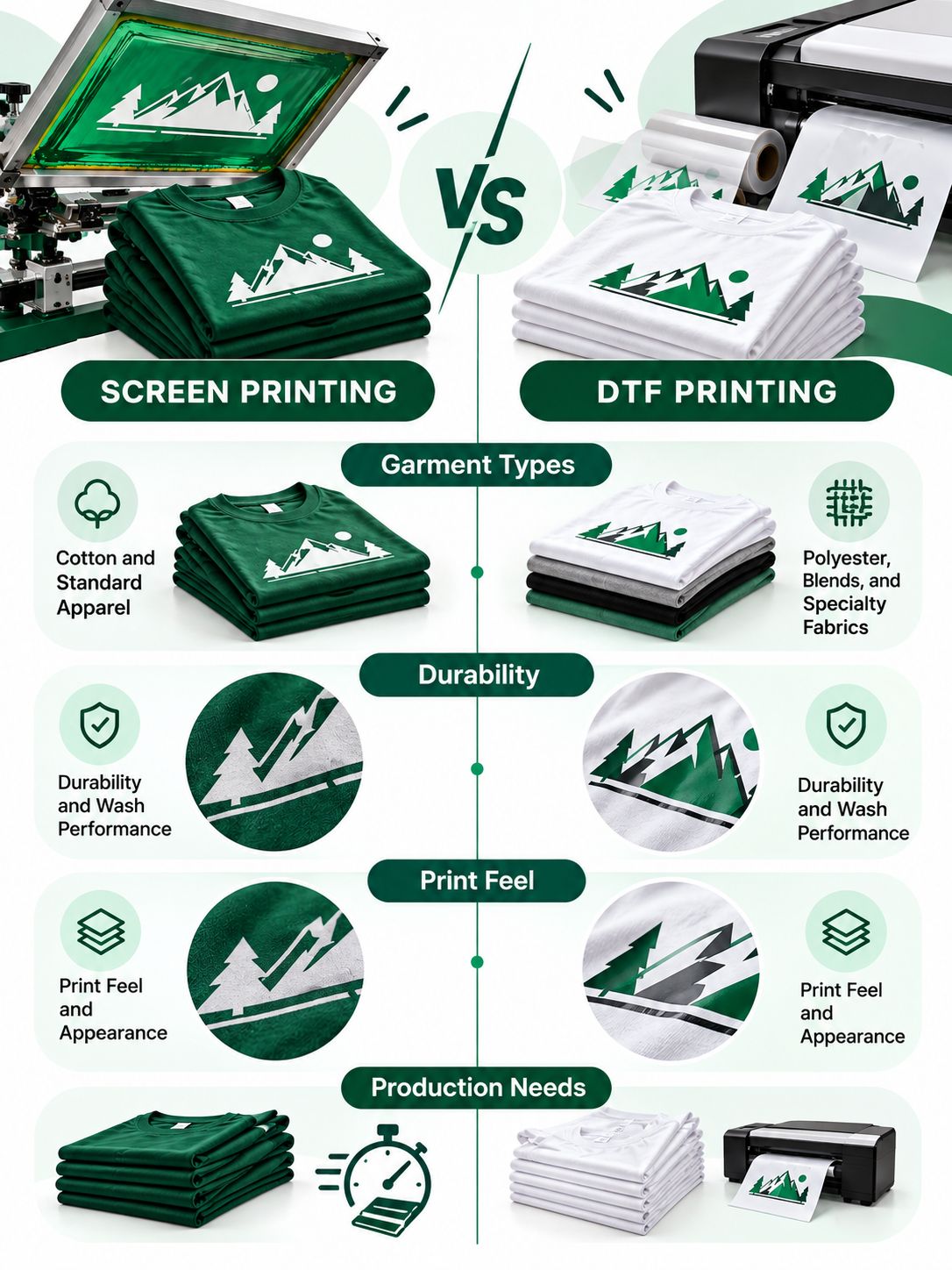
Cotton, polyester, blends, and specialty fabrics can have different production requirements, so the printing method should be selected alongside the garment rather than separately.
Cotton and Standard Apparel
Screen printing is a strong fit for many high-volume cotton apparel orders, particularly when the artwork is consistent across the entire run.
The type of ink and proper curing are important parts of achieving a durable result.
Polyester, Blends, and Specialty Fabrics
Fabric composition can influence the appropriate printing process.
DTF can provide flexibility across cotton, polyester, blends, and some other garment types. However, the specific garment and production requirements should still be considered before selecting a process.
Durability and Wash Performance
Both screen printing and DTF can produce durable apparel when the production process is properly controlled.
For screen printing, ink selection and curing are important. For DTF, transfer quality and pressing conditions matter.
Garment care also affects long-term performance. Washing conditions and general garment handling can influence how long a printed design maintains its appearance.
Print Feel and Appearance
The feel of the finished print can also differ.
Screen printing can provide a soft print feel, particularly with appropriate ink and application choices. DTF prints can have a somewhat more film-like feel, especially with larger solid areas.
For buyers, the right option depends on the design, garment, intended use, and preferred finish.
Screen Printing vs DTF: Which Method Fits Your Bulk Order?
Instead of treating one printing process as the universal solution, consider the characteristics of your specific order.
Bulk Screen Printing May Be a Good Fit When:
- You are ordering hundreds or thousands of essentially identical garments.
- The design uses a limited number of colors.
- The artwork will remain consistent.
- You expect to reorder the same design.
- Production efficiency for a standardized design is a major priority.
Bulk DTF Printing May Be a Good Fit When:
- Your order contains multiple designs.
- Artwork is full-color or highly detailed.
- You need personalized names or numbers.
- Each design has a relatively small quantity.
- You are working with different garment colors or materials.
- Your artwork changes frequently.
Consider a Hybrid Production Strategy
You do not necessarily have to use one printing process for every design in a large apparel program.
For example, a business could use screen printing for a standardized high-volume logo while using DTF for smaller quantities, complex graphics, or personalized garments.
This approach allows each production method to be used where its characteristics make the most sense.
How to Plan a Cost-Efficient Bulk Apparel Printing Order
Before requesting a quote, collect the information a printer needs to understand the full scope of the project.
Start With the Right Order Details
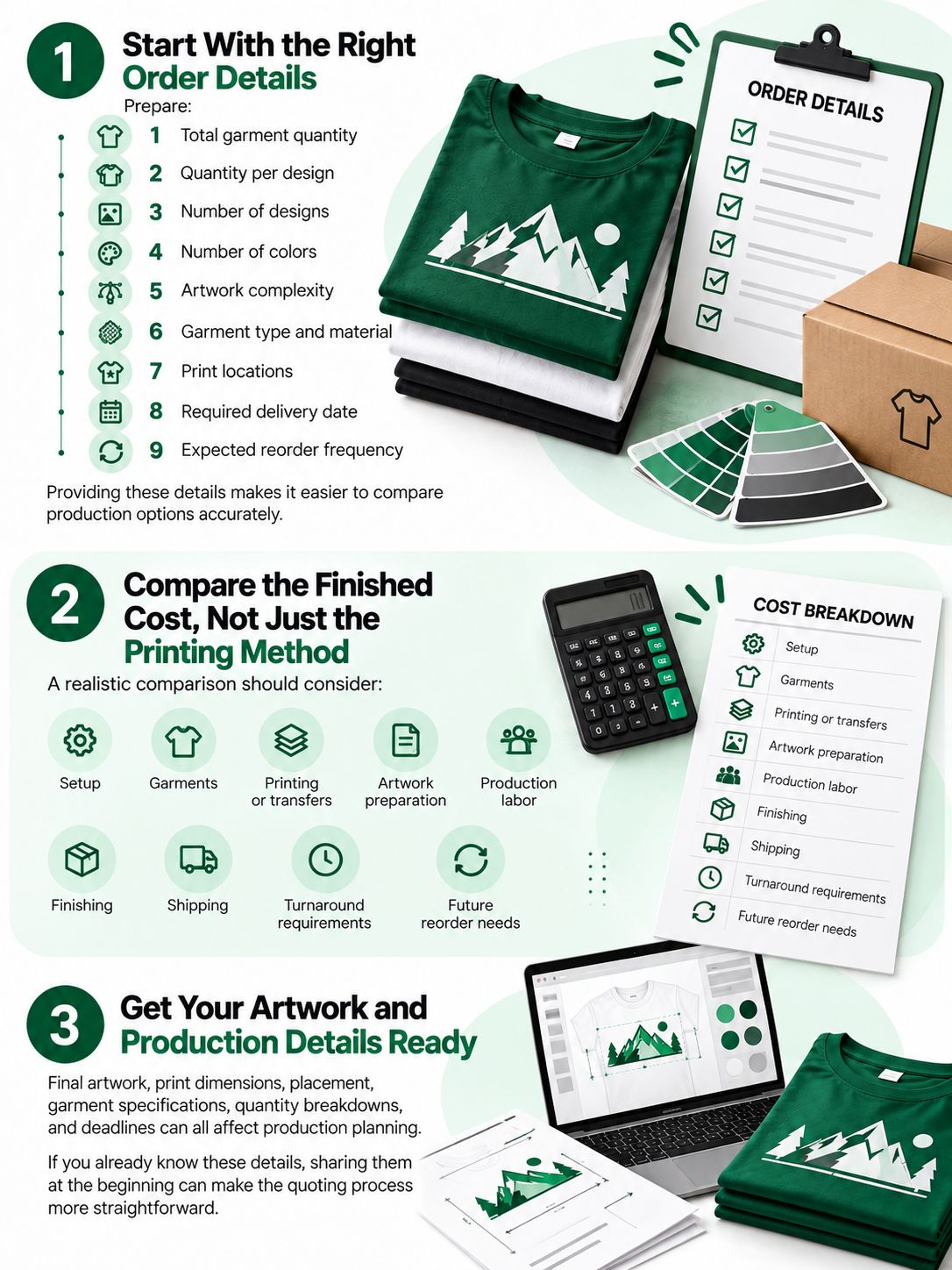
Prepare:
- Total garment quantity
- Quantity per design
- Number of designs
- Number of colors
- Artwork complexity
- Garment type and material
- Print locations
- Required delivery date
- Expected reorder frequency
Providing these details makes it easier to compare production options accurately.
Compare the Finished Cost, Not Just the Printing Method
A realistic comparison should consider:
- Setup
- Garments
- Printing or transfers
- Artwork preparation
- Production labor
- Finishing
- Shipping
- Turnaround requirements
- Future reorder needs
For businesses placing larger apparel orders, professional bulk printing services can help simplify production planning and coordinate these requirements.
Get Your Artwork and Production Details Ready
Final artwork, print dimensions, placement, garment specifications, quantity breakdowns, and deadlines can all affect production planning.
If you already know these details, sharing them at the beginning can make the quoting process more straightforward.
Bulk Printing Services for Different Apparel and Promotional Needs
Large apparel projects often involve more than one type of printed product.
For standardized apparel runs, professional screen printing services can support large quantities of consistent designs.
Businesses may also need complementary products for the same campaign, event, or organization. Depending on the project, that could include custom sticker printing services, premium patches online, custom embroidery services, or custom printed promo products.
Organizations managing larger workforce apparel programs may also need specialized union contract services.
Working with one production partner for related needs can simplify ordering and coordination, particularly when multiple products need to be delivered for the same event or program.
Final Takeaway: Bulk Screen Printing vs DTF Depends on Your Order Structure
There is no single answer to bulk screen printing vs DTF because the better production method depends on how your order is structured.
For hundreds or thousands of identical garments with simple, limited-color artwork, screen printing can become increasingly cost-efficient as the setup cost is distributed across the production run.
For complex artwork, multiple designs, personalization, or smaller quantities per design, DTF can offer greater production flexibility without traditional screen setup for every color and design.
The key is to look beyond total order quantity. Consider quantity per design, artwork complexity, garment type, number of colors, production requirements, and future reorders before choosing a printing method.
For businesses planning a large apparel project, Shirt.co can help evaluate the production requirements and determine which printing approach fits the specific order.
Frequently Asked Questions About Bulk Screen Printing vs DTF
Is screen printing cheaper than DTF for bulk orders?
Screen printing can become more cost-efficient for very large quantities of the same design, particularly when the artwork uses a limited number of colors. The actual cost depends on setup, quantity, artwork, garments, and production requirements.
Is DTF good for large bulk orders?
Yes. DTF can be used for bulk orders, especially when they include multiple designs, detailed artwork, personalization, or relatively small quantities per design.
How many shirts make screen printing more cost-effective than DTF?
There is no universal quantity that applies to every project. The crossover depends on the number of colors, setup requirements, quantity per design, artwork complexity, garment type, and production pricing.
Is DTF or screen printing more durable?
Both can provide durable results when produced correctly. Screen-print durability depends on factors such as ink and curing, while DTF durability depends on transfer quality and proper application. Garment care also affects long-term performance.
Can you use both screen printing and DTF for the same bulk order?
Yes. A large project can use screen printing for standardized high-volume designs and DTF for complex, personalized, or smaller-volume designs.
What information should I provide for a bulk printing quote?
Provide the total quantity, quantity per design, number of designs and colors, artwork, garment type, print locations, and required delivery date. These details help determine the most appropriate production approach.