

Custom Halloween shirts turn a costume party, office contest, school event, or family night into something people remember. A good order of custom Halloween shirts takes more than a fun graphic, though. You need a design that prints cleanly, sizes that fit everyone, and a schedule that leaves room for art approval, production, and delivery before October 31. This guide walks through the full process, from the first sketch to the final box, including design choices, printing methods, group ordering, and the mistakes that cause delays. It is written for bulk buyers, event organizers, and teams who want a smooth order.
What Are Custom Halloween Shirts and Who Orders Them?
Custom Halloween shirts are garments printed with seasonal artwork, text, or logos that the buyer chooses. Unlike novelty tees from a store shelf, custom Halloween shirts are made to order, so you control the graphic, the shirt style, the color, and the quantity. Most orders fall into a few categories, and knowing which one fits your project helps you make better decisions early.
Businesses order custom Halloween shirts for staff costume days, customer events, and seasonal promotions. Schools and booster clubs use them for fall festivals and fundraisers. Breweries, restaurants, and retail shops often print limited seasonal designs to sell during October. Families and friend groups order matching custom Halloween shirts for trick-or-treating, haunted attractions, and neighborhood parties.
The common thread is planning. Ordering custom Halloween shirts takes longer than picking a shirt off a shelf, and the best results come from buyers who settle the design, quantity, and deadline before they ask for a quote. Shirt.co has printed custom apparel since 1975, and the sections below reflect the decisions that come up most often when an order moves from idea to production.
How Do You Create a Halloween Shirt Design That Prints Well?
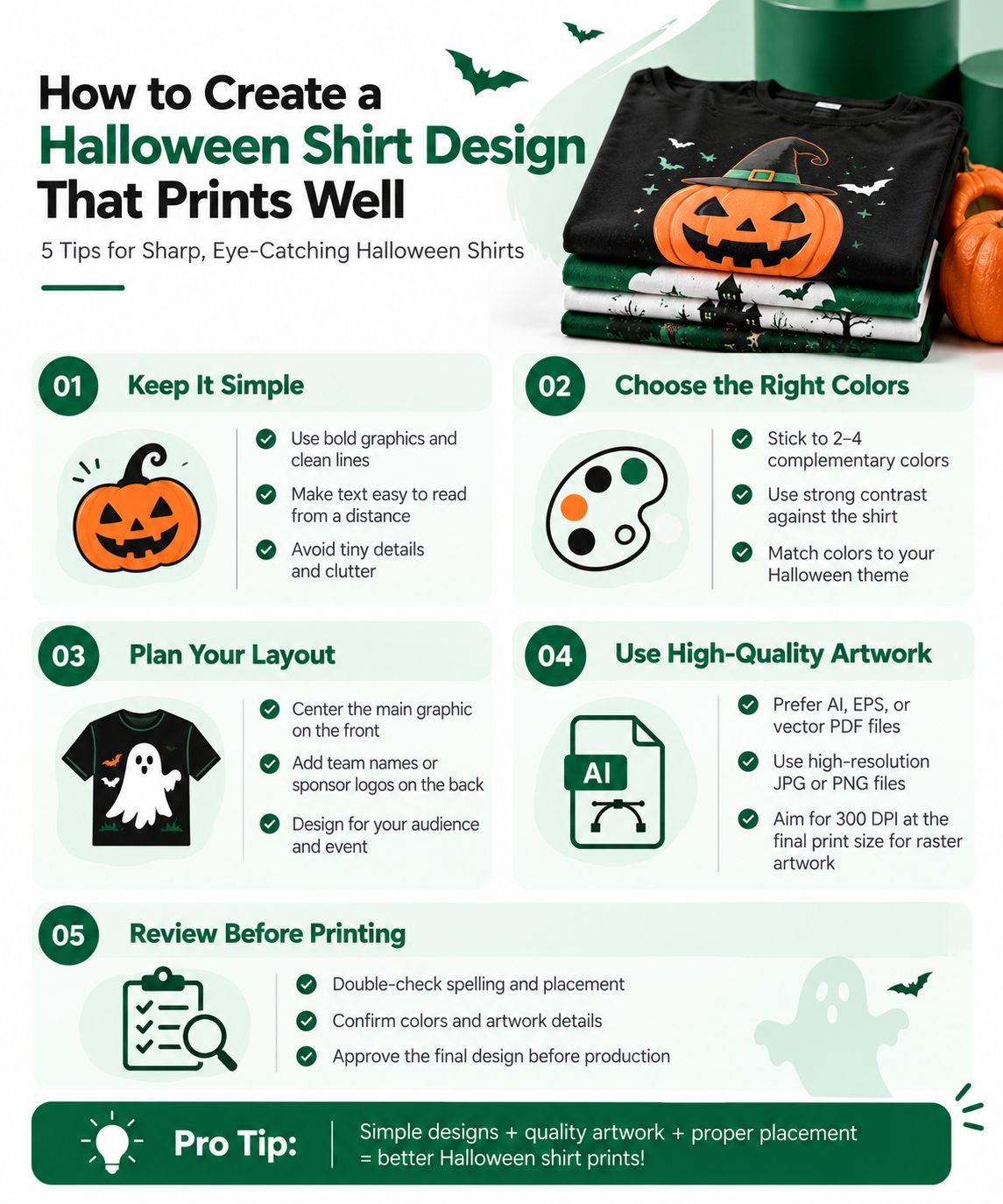
A strong Halloween shirt design is simple enough to read from several feet away, uses a limited number of colors, and is built from artwork large enough to print sharply. Those three traits matter more than how detailed the idea is. A bold pumpkin face with clean lines will usually look better on fabric than a haunted house scene with dozens of tiny elements.
Start with the concept and the audience. A staff costume day calls for something playful but workplace-friendly. A haunted attraction crew may want darker artwork and a logo on the back. Once you know the message, sketch the layout: where the main graphic sits, whether text goes above or below it, and whether the back needs anything. Front-and-back layouts are common for group events because the back can carry a team name or a sponsor logo.
Artwork quality is the next hurdle. Printers generally prefer vector files, such as AI, EPS, or PDF, because they scale without losing sharpness. A JPG or PNG can still work if the resolution is high enough for the print size. Shirt.co’s quote form accepts JPG and PNG uploads up to 50 MB, and the team sends art approvals before production so you can check the layout and spelling. A typo caught at approval is easy to fix; one caught after printing means reordering.
If you need ideas, the Shirt.co logo ideas gallery shows finished custom work that can help you picture layouts, placement, and color combinations before you brief a designer.
Which Halloween Shirt Design Styles Work Best?
The best styles for custom Halloween shirts are the ones that suit the group and the print method. Humor is popular for office events, with puns and simple graphics people will happily wear again. Vintage horror looks, such as distressed lettering and retro monsters, appeal to teens and adults. Cartoon ghosts and smiling pumpkins suit families and younger kids. A small chest logo with a spooky icon works for corporate teams that want something subtle.
Color matters as much as the graphic. Orange, black, purple, and lime green are the classic Halloween palette, and a black shirt with orange and white ink is a reliable combination because the contrast is strong. Pale ink on a dark shirt and dark ink on a light shirt both read well. Avoid a dark graphic on a dark shirt unless it has an outline or underbase, since it can look muddy.
What Makes Personalized Halloween Shirts Different From a Standard Design?
Personalized Halloween shirts include details specific to the wearer or group instead of one identical graphic for everyone. Common examples are individual names on the back, numbers, family surnames, department names, or a different character for each person within a shared theme. Personalization turns the shirt into a keepsake and helps at events where people need to be identified quickly.
It also adds work. Every name must be collected, spell-checked, and matched to a size. For a large group, keep names and sizes in one spreadsheet with a single person responsible for final approval. Mention personalization when you first request pricing, because the quote and timeline depend on how many variations are involved.
Which Printing Method Is Best for Custom Halloween Shirts?
The best method depends on quantity, number of colors, and how detailed the artwork is. Screen printing is typically the better value for larger orders with few colors, while direct-to-film (DTF) transfers suit small runs and full-color artwork. The choice affects cost, durability, and how the print feels.
When Does Screen Printing Make Sense?
Screen printing pushes ink through a mesh screen onto the shirt, one color at a time. Each color needs its own screen, so designs with fewer colors cost less to set up, and the price per shirt tends to drop as quantity rises. That makes it a natural fit for custom Halloween shirts at school events, company-wide orders, and fundraisers that need dozens or hundreds of identical shirts. Screen prints are known for strong color on dark garments and for holding up through repeated washing when cared for properly.
For Halloween, it works especially well for bold, flat-color graphics such as a pumpkin, a bat silhouette, or a slogan. If your art includes gradients, photographs, or many colors, setup gets more complex and cost rises.
When Are DTF Transfers the Better Choice?
DTF transfers are full-color designs printed on film and then heat-pressed onto the shirt. They handle detailed artwork and gradients without the per-color setup of screen printing. Shirt.co’s site describes DTF as a no-minimum option suited to small runs and complex designs, which suits a family that wants one detailed graphic or a team that needs a few personalized pieces.
A practical rule is to compare colors against quantity. A two-color design on 100 shirts usually points to screen printing. A six-color illustration on 12 shirts usually points to DTF. If you land in the middle, ask for quotes on both. The guide to T-shirt printing methods compares the options in more depth.
How Should You Choose Shirt Styles, Colors, and Sizes?
Choose the style based on who will wear the shirt and for how long, pick a color that makes your ink stand out, and order sizes from a confirmed headcount rather than a guess. The garment affects comfort and how the print looks, so custom Halloween shirts deserve as much attention to the blank as to the artwork.
A cotton or cotton-blend tee is the default for most custom Halloween shirts. Shirt.co’s quote form lists good, better, and best tee options, from a Gildan Softstyle to a District tri-blend and a Bella+Canvas triblend, so you can weigh cost against softness. Hoodies and crewneck sweatshirts make sense for outdoor events and fall festivals that run into the evening.
Sizing is where many group orders go wrong. The quote form offers adult sizes from small through 5XL and youth sizes on many styles, which covers a wide range of ages and body types. Brands cut shirts differently, so a medium in one style may fit differently than a medium in another. The complete guide to custom shirt sizing explains how to read size charts. If you cannot confirm sizes, the form includes an “Other” option so the team can follow up before production.
How Do Halloween Shirts for Groups Work for Teams, Families, and Events?
Ordering Halloween shirts for groups means coordinating one design across many people, sizes, and delivery needs. The main tasks are choosing one decision-maker, collecting sizes by a set deadline, and deciding how shirts will reach each person. Groups that assign these roles early avoid the last-minute changes that slow production.
Small groups, such as families and friend circles, have a simple process: one person picks the design, gathers sizes, and places a single order. Workplaces, schools, and community organizations have more moving parts. Someone needs to approve artwork for everyone, handle payment, and answer questions about fit. Send the proposed design to the whole group once, with a firm feedback date, instead of collecting opinions in an endless loop.
Distribution is another planning point. Shirt.co’s order form lets buyers choose between one person picking up everything, having the order shipped to the organization, or shipping individual orders to each recipient. A single office can receive one box and hand out shirts at the event, while a remote team may need individual shipping.
When people want to choose their own size and style, an online store removes much of the manual work. Shirt.co builds custom branded storefronts where each person picks a size and style, and the printing, packing, and shipping are handled for you. That helps schools, fundraisers, and companies with employees in different locations.
When Should You Order Custom Halloween Shirts?
Order custom Halloween shirts as early as your design and headcount allow, ideally several weeks before the event, so there is time for quoting, art approval, production, and shipping. Shirt.co lists a standard turnaround of five business days, but that covers production only, not design finalization or carrier delivery.
Plan backward from the date you need shirts in hand. Start with the event date, subtract shipping time, subtract production time, and then subtract the days needed for quote review and art approval. Add a buffer in case a change request or size count shifts. For an October 31 event, that means reserving time for headcount collection, a design review window, quote approval, production, and delivery, with a few spare days at the end. The custom shirt order timeline guide walks through each stage.
If the date is already close, ask about rush options. Shirt.co’s rush services offer faster production than the standard schedule, and the order form notes that a rush fee may apply. Rush does not remove the need for a finished design, though. Have final files and sizes ready before you request it.
What Factors Affect the Price of a Halloween Shirt Order?
The price of custom Halloween shirts is shaped by quantity, garment choice, the number of ink colors or the size of a transfer, the number of print locations, and the timeline. Understanding these helps you decide where to spend and where to save.
Quantity usually has the biggest effect on screen printing because setup work is spread across more shirts. The garment is the next lever, since a premium tri-blend costs more than a basic cotton tee and the difference multiplies across a large order. Adding a back or sleeve print means more production work, and rush timelines can add fees.
Shirt.co does not publish a fixed price for every combination, so the best way to get an accurate number is to request a quote with your design, quantity, shirt preference, and deadline. When comparing quotes from different suppliers, make sure each covers the same garment, print locations, and turnaround. A lower price that quietly uses a thinner shirt or a smaller print is not really lower.
What Mistakes Should You Avoid When Ordering Halloween Shirts?
The most common mistakes with custom Halloween shirts are rushing the design, guessing at sizes, ignoring contrast between ink and shirt color, and approving artwork without a careful proofread. A short checklist prevents most of them:
- Submit final artwork in the highest quality available, not a screenshot.
- Confirm headcount and sizes before requesting a quote.
- Proofread names, dates, and spelling on the art approval.
- Keep a written record of the final design, quantity, and deadline.
Another frequent problem is overloading the design. When too many ideas compete on one shirt, none reads clearly. Also think about how people will wear the shirt after the event. A clever, well-made graphic gets worn again, and following the guide to caring for custom shirts helps prints last longer, which matters if the shirts double as team gear or fundraiser merchandise. For quick answers to common questions, the top custom apparel FAQs cover many basics.
What Do Buyers Ask Most About Custom Halloween Shirts?
How many custom Halloween shirts can I order?
Quantity depends on the product and method. Shirt.co states that most products have no minimums, and DTF is described as a no-minimum option, so small orders are possible. For larger quantities, screen printing generally lowers the price per shirt. Request a quote with your exact count so the team can confirm what applies.
How long does it take to receive custom Halloween shirts?
Shirt.co lists a standard production turnaround of five business days for custom Halloween shirts, with faster rush production for tighter deadlines. Delivery time is separate and depends on the shipping method and destination. Also allow time for quote approval and art approval, since production begins after the design is final.
What file type should I use for a Halloween shirt design?
Vector files such as AI, EPS, or PDF are the best choice because they stay sharp at any size. High-resolution PNG or JPG files can also work. Shirt.co’s quote form accepts JPG and PNG uploads up to 50 MB, and art approvals are sent before production.
Can I order personalized Halloween shirts with individual names?
Personalization on custom Halloween shirts is generally possible but needs more coordination. Prepare a clear list of names and sizes, check the spelling carefully, and mention personalization when you request your quote. The number of variations can affect both price and timeline.
What is the best way to order Halloween shirts for groups with different sizes?
Collect sizes from everyone before ordering custom Halloween shirts, keep them in a single spreadsheet, and name one person to approve the final count. For large or scattered groups, an online store lets each person choose a size and style. If you cannot confirm sizes ahead of time, discuss options with the print team before production.
Which shirt color works best for custom Halloween shirts?
Black is dependable because orange, white, purple, and lime inks stand out on it. Orange and charcoal shirts also pair well with dark or white ink. Because the right answer depends on your artwork, review the proof carefully before you approve it.
How Can You Start Your Custom Halloween Shirts Order?
A successful order for custom Halloween shirts comes down to four decisions made early: a simple design, the right printing method, a confirmed headcount, and a realistic schedule. With those in place, production runs smoothly and the shirts arrive ready for the event instead of becoming a last-minute worry.
When you are ready, gather your artwork, estimated quantities and sizes, and event date, then request a free quote from Shirt.co. The team can confirm the best method, suggest garments, and explain the timeline for your order, so you can plan with real numbers instead of estimates.