


If you’re planning to order custom T-shirts, one of the first questions you’ll probably ask is: how much does screen printing cost?
The answer depends on several factors, including how many shirts you order, the type of garment, the number of ink colors, and where you want the design printed.
For a typical U.S. order, screen printing can become significantly more affordable per shirt as the quantity increases. A small order may have a higher screen printing cost per shirt because setup expenses are spread across fewer garments, while larger orders can benefit from volume pricing.
Understanding what goes into your quote can help you choose the right printing method and avoid unexpected costs.
Short Answer
How much does screen printing cost? In the U.S., screen-printed shirts typically cost around $10–$25 per shirt for smaller orders, while larger bulk orders can have significantly lower per-shirt prices. The final screen printing cost per shirt depends on quantity, garment type, number of ink colors, print locations, artwork complexity, setup fees, and turnaround time.
How Much Does Screen Printing Cost?
There isn’t one universal screen printing price per shirt. Professional printers typically calculate the total project cost based on the garment, artwork, quantity, colors, print locations, and production requirements.
As a general guide, a basic screen-printed T-shirt may cost around $10–$25 per shirt for smaller orders, while larger bulk orders can bring the per-shirt price down considerably. Premium garments, multiple print locations, and complex designs can increase the final price.
Here’s a simplified example of how quantity can affect pricing:
How Order Quantity Affects Per-Shirt Pricing
Larger apparel orders typically reduce the cost per shirt as setup and production expenses are spread across more garments.
| 📦 Order Quantity | 💲 Typical Price Trend |
|---|---|
| 1–11 Shirts | Highest per-shirt cost |
| 12–23 Shirts | Moderate-to-high cost |
| 24–49 Shirts | More economical |
| 50–99 Shirts | Lower per-shirt cost |
| 100+ Shirts | ⭐ Often best bulk value |
If your project allows it, increasing your order to 50 or 100+ shirts can significantly improve your per-shirt pricing. Always compare the total project cost—not just the unit price—before increasing your quantity.
These figures are only general estimates. Actual screen printing shirt cost varies between providers and depends on the exact specifications of your order.
What Is Included in a Screen Printing Quote?
When comparing quotes, don’t look only at the advertised price per shirt. A complete quote may include:
- Blank garment cost
- Screen setup
- Ink and printing
- Artwork preparation
- Folding and packaging
- Additional print locations
- Rush production fees
- Shipping
Some providers bundle certain costs into their per-shirt price, while others list them separately. Always ask for a complete quote so you can make an accurate comparison.
What Factors Affect the Cost to Screen Print Shirts?
Several factors determine the final cost to screen print shirts. Understanding each one makes it easier to estimate your budget before placing an order.
Number of Shirts
Quantity is one of the biggest factors affecting screen printing prices.
Screen printing requires preparation before production begins. Screens need to be prepared, artwork may need to be separated, and the press needs to be set up. Those costs can be relatively similar whether you’re printing 10 shirts or 100 shirts.
When you order more shirts, those fixed costs are distributed across more garments. As a result, your screen printing cost per shirt generally decreases.
For example, a business ordering 100 shirts with the same logo may receive a much lower per-shirt price than someone ordering only 10 shirts with the same design.
Number of Ink Colors
The number of colors in your artwork can also affect your custom screen printing cost.
A simple one-color design is generally less expensive to produce than a design requiring several colors. Traditional screen printing typically uses a separate screen for each color, which means additional colors can require additional preparation and production steps.
For example:
- One-color logo → simpler setup
- Two-color design → additional screen and setup
- Three- or four-color artwork → more preparation and production
- Highly detailed artwork → potentially higher preparation costs
This doesn’t mean you should eliminate colors from your design simply to save money. Instead, consider whether every color contributes something important to the final design.
Number of Print Locations
Where you want your design printed also affects the final price.
A shirt with a single front print generally requires less production work than one featuring designs on the front, back, and sleeve.
Common print locations include:
- Left chest
- Full front
- Full back
- Sleeve
- Front and back
If you’re ordering shirts for a company, for example, a left-chest logo may be a cost-effective option. A promotional shirt with a large front graphic and back design will generally require more production work.
Shirt Quality and Garment Type
The blank shirt itself is another major part of your screen printing shirt cost.
Basic cotton T-shirts are generally more affordable than premium or specialty garments. You may also pay more for heavyweight shirts, performance fabrics, fashion-fit garments, hoodies, and other specialty apparel.
When comparing prices, make sure you’re comparing similar garments. A quote for a basic cotton T-shirt isn’t directly comparable to one using a premium heavyweight shirt.
Artwork and Design Preparation
Your artwork can influence pricing as well.
Print-ready artwork can make production more straightforward, while low-resolution files, complicated graphics, or artwork requiring significant cleanup may require additional preparation.
Before submitting your design, ask your printer about their preferred file formats and artwork requirements. Providing properly prepared artwork can help avoid unnecessary delays or design fees.
How Much Does Screen Printing Cost by Order Quantity?
If you’re trying to determine the best quantity to order, remember that screen printing generally becomes more cost-effective as your order gets larger.
Cost for 10–20 Shirts
Small orders often have a higher screen printing price per shirt because setup costs are spread over relatively few garments.
If you only need a handful of shirts for a small event or personal project, it may be worth comparing screen printing with other decoration methods.
Cost for 25–50 Shirts
At this quantity, screen printing can become more attractive. Setup costs are distributed across more garments, while the order is still manageable for small businesses, organizations, teams, and events.
Cost for 50–100 Shirts
Larger orders can provide better per-shirt pricing, particularly when the same design is printed across all garments.
For businesses ordering employee apparel or organizations preparing for an event, this quantity range may offer a good balance between total spending and unit cost.
Cost for 100+ Shirts
Bulk orders are where screen printing can become especially cost-effective.
If you’re printing hundreds of identical shirts, the setup process is completed once and the production run can be handled efficiently. This can significantly reduce the effective screen printing cost per shirt.
However, ordering more shirts isn’t automatically cheaper overall. Your total budget still increases as you add garments, so choose a quantity based on actual demand rather than unit price alone.
How Much Does Screen Printing Cost Based on the Design?
Your artwork can influence both setup requirements and production time. A simple logo and a detailed multicolor illustration may look similar on a computer, but they can require very different preparation and printing processes.
One-Color Screen Printing
One-color printing is often one of the more economical options, particularly when you’re ordering a larger quantity.
It’s commonly used for:
- Business logos
- Text-based designs
- Event shirts
- Team apparel
- Simple promotional graphics
Because the design uses a single ink color, production generally requires less setup than a multicolor design.
Two- to Three-Color Screen Printing
Adding colors can increase the custom screen printing cost because each color typically requires its own screen and setup.
A two- or three-color design can still be a practical choice for professional branding and promotional apparel. The key is to balance the visual impact of the design with your available budget.
If you’re ordering a large quantity, the additional setup cost may have a relatively small effect on the overall per-shirt price.
Full-Color or Detailed Screen Printing
Highly detailed artwork can require more preparation and specialized printing techniques. Gradients, intricate illustrations, fine details, and multiple colors may increase production complexity.
If you’re ordering only a few shirts with highly detailed artwork, screen printing may not always be the most economical option. Other decoration methods may provide more flexibility for small or highly customized orders.
Front and Back Screen Printing
A shirt printed on both the front and back generally costs more than one with a single print location.
For example, you might choose:
- Front logo only
- Full-front graphic
- Back graphic only
- Front and back
- Front, back, and sleeve
Every additional location can involve additional setup and production time. If keeping the screen printing shirt cost low is a priority, limiting the number of print locations can help.
Screen Printing on Hoodies and Other Garments
Screen printing isn’t limited to T-shirts. It can also be used on:
- Hoodies
- Sweatshirts
- Tank tops
- Long-sleeve shirts
- Workwear
- Performance apparel
The printing process may be similar, but the blank garment itself can cost considerably more than a basic T-shirt. As a result, don’t assume the printing price alone determines your total order cost.
Screen Printing Cost vs. Other Custom Shirt Printing Methods
Screen printing is popular, but it isn’t the best solution for every order. Comparing printing methods before placing an order can help you avoid paying for a process that doesn’t fit your needs.
Screen Printing vs. DTF Printing
Direct-to-film (DTF) printing can be particularly useful for smaller orders, detailed artwork, and designs containing many colors.
Screen printing often becomes more attractive as order quantities increase, especially when the same design is being printed repeatedly.
DTF may be worth considering when you need:
- Small quantities
- Detailed graphics
- Multiple colors
- Personalized designs
- Different artwork on individual shirts
Screen printing may be a better fit when you need:
- Larger quantities
- Repeated designs
- Simple or moderately detailed artwork
- Consistent branding across many garments
Screen Printing vs. Embroidery
Embroidery is another popular decoration method, particularly for professional apparel.
It’s commonly used on:
- Polo shirts
- Work shirts
- Jackets
- Hats
- Corporate apparel
Screen printing is generally more suitable for large graphic designs on shirts, while embroidery can create a more textured and professional appearance for logos and smaller designs.
The right option ultimately depends on your garment, design, quantity, and desired appearance.
When Is Screen Printing the Most Cost-Effective Option?
Screen printing tends to provide strong value when you’re producing many garments with the same artwork.
It can be a good choice for:
- Company shirts
- School apparel
- Sports teams
- Festivals
- Fundraisers
- Promotional campaigns
- Event merchandise
- Retail apparel
- Large organizational orders
If you’re ordering dozens or hundreds of identical shirts, the setup involved in screen printing can be distributed across a larger production run.
For businesses with recurring apparel needs, establishing an ongoing relationship with a printer can also make repeat orders easier to manage.
How to Lower Your Screen Printing Cost Per Shirt
You don’t necessarily need to sacrifice design quality to reduce your printing budget. A few strategic decisions can help control your overall screen printing cost per shirt.
Increase Your Order Quantity
When you genuinely need more shirts, increasing the order size can reduce the unit price.
Instead of ordering several small batches, consider consolidating orders when practical. However, don’t order hundreds of shirts solely to get a lower unit price if you have no use for the extras.
Reduce the Number of Ink Colors
A simpler design can reduce setup requirements.
If your design works just as effectively with one or two colors, you may be able to lower production costs without compromising your branding.
Standardize Your Garments
Using the same shirt style and color across an order can simplify production.
For example, a business ordering 100 shirts in one standard garment may have a simpler production process than one ordering many different garment styles and colors.
Limit Print Locations
A single front or back design generally requires less production work than printing multiple locations.
If you’re working with a tight budget, decide which print location provides the most value before adding additional graphics.
Prepare Print-Ready Artwork
Providing clean, high-resolution artwork can help reduce preparation time.
Before ordering, ask your printer whether they prefer formats such as vector artwork or high-resolution raster files. Properly prepared artwork can make the approval process smoother.
Compare Complete Quotes
Don’t choose a printer based solely on the lowest advertised screen printing price per shirt.
Compare the complete quote, including:
- Shirt cost
- Setup fees
- Artwork fees
- Number of ink colors
- Print locations
- Packaging
- Shipping
- Rush charges
A slightly higher per-shirt price may represent better overall value if it includes services or garment quality that another quote doesn’t.
Is Screen Printing Worth the Cost?
For many medium- and large-volume apparel orders, screen printing can offer an excellent balance between quality, durability, and cost.
It’s particularly attractive when you’re printing the same design across a large number of garments. Businesses, schools, teams, event organizers, and apparel brands can all benefit from its scalable pricing structure.
However, screen printing may not be the best option for every project. If you need only a few shirts, highly detailed artwork, or a different design on every garment, another decoration method may offer better flexibility.
The best approach is to consider the entire project rather than focusing on one number.
How to Choose a Screen Printing Company
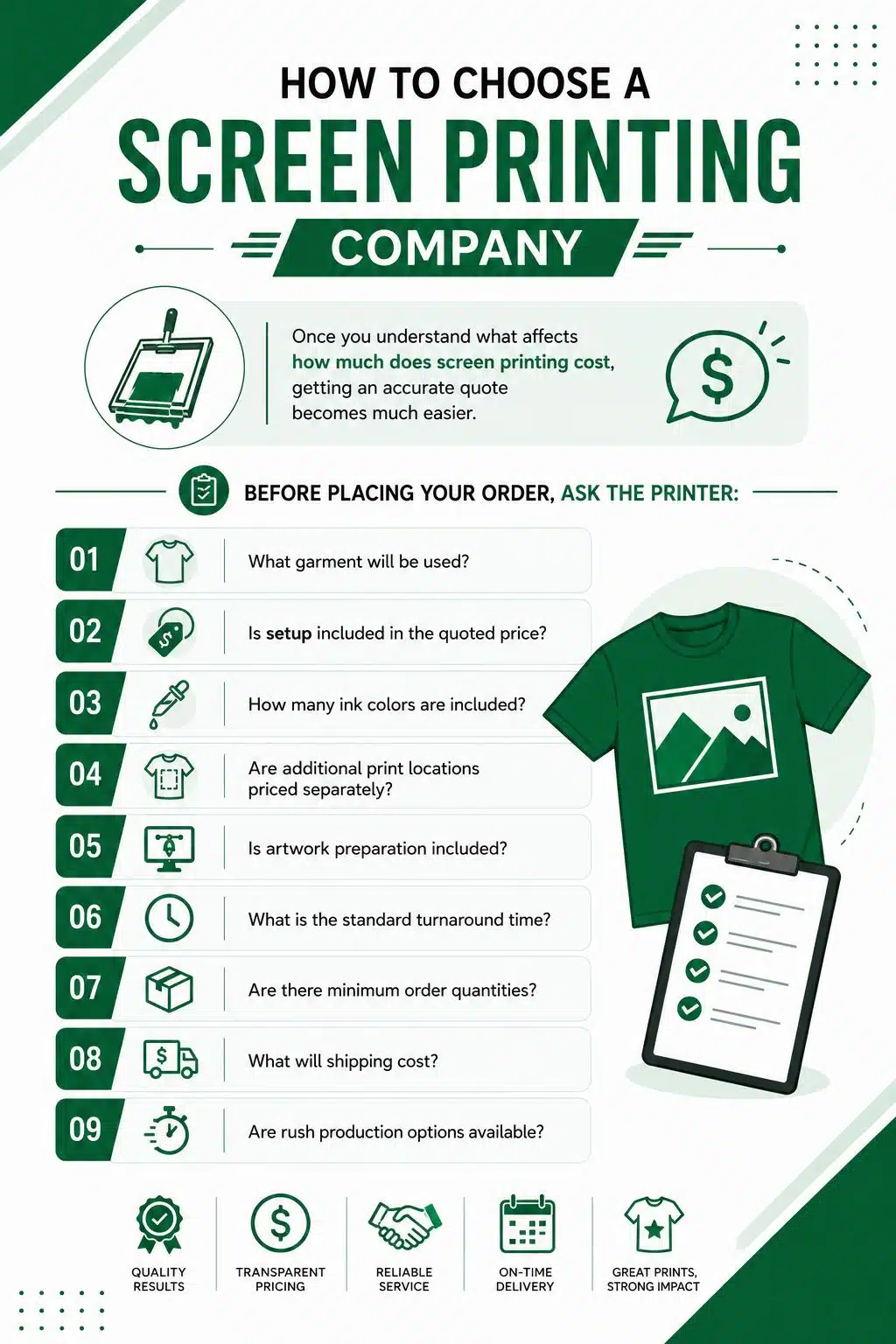
Once you understand what affects how much does screen printing cost, getting an accurate quote becomes much easier.
Before placing your order, ask the printer:
- What garment will be used?
- Is setup included in the quoted price?
- How many ink colors are included?
- Are additional print locations priced separately?
- Is artwork preparation included?
- What is the standard turnaround time?
- Are there minimum order quantities?
- What will shipping cost?
- Are rush production options available?
For businesses, organizations, or brands ordering apparel regularly, working with a provider that offers custom screen printing services can simplify repeat orders and maintain consistent branding.
If you have a recurring need for large apparel runs, contract screen printing may also be worth considering. This approach can help businesses establish consistent production specifications and streamline future orders.
Key Takeaways
- Larger orders usually cost less per shirt because setup costs are spread across more garments.
- More ink colors and print locations can increase the overall cost.
- Garment quality and type significantly affect the final shirt price.
- Screen printing is often most cost-effective for medium- to large-volume orders with the same design.
- Small or highly detailed orders may be better suited to DTF printing or other decoration methods.
- Compare the total quote, including setup, artwork, shipping, and rush fees—not just the advertised price per shirt.
Final Thoughts: Understanding Your Screen Printing Shirt Cost
So, how much does screen printing cost? It depends on much more than the shirt itself.
Quantity, garment selection, ink colors, artwork complexity, print locations, setup requirements, and turnaround time all contribute to your final price. The biggest savings generally come from ordering efficiently and choosing specifications that match your actual needs.
For larger orders with the same design, screen printing can provide excellent per-shirt value. For smaller or highly customized orders, compare alternative printing methods before making your decision.
Most importantly, request a complete quote rather than relying on a headline screen printing price per shirt. That gives you a clearer picture of what you’re actually paying and helps you choose the right provider for your project.
If you’re ready to produce branded apparel, getting a detailed quote for custom screen printing services is the easiest way to determine the actual cost for your specific order.
Frequently Asked Questions About Screen Printing Cost
How much does it cost to screen print a shirt?
The price varies depending on quantity, garment type, artwork, number of colors, print locations, and production requirements. Larger orders generally have a lower per-shirt cost.
How much does screen printing cost per shirt?
The screen printing cost per shirt can vary significantly. Small orders typically have higher unit costs, while larger orders can receive volume pricing.
Is screen printing cheaper than DTF?
It depends on the order. Screen printing can be more economical for larger runs with the same design, while DTF can be more flexible for small quantities and detailed, multicolor artwork.
What is the cheapest way to screen print shirts?
Ordering a larger quantity, limiting ink colors and print locations, selecting a cost-effective garment, and providing print-ready artwork can help reduce your total cost.
Does screen printing cost more for more colors?
It can. Additional colors may require additional screens, setup, and production work, which can increase the overall custom screen printing cost.
Is screen printing worth it for 10 shirts?
It depends on your design and budget. Because setup costs are spread across only a small number of shirts, screen printing may have a higher unit cost for a 10-shirt order. Comparing it with other printing methods is a good idea.
How many shirts should I order for the best screen printing price?
There is no universal quantity that guarantees the lowest price. Generally, larger orders have better unit economics, but you should balance the discount against how many shirts you actually need.
Does rush screen printing cost more?
It can. Expedited production may involve additional fees because the printer has to prioritize your order. If you have a tight deadline, ask about rush shirt printing before placing your order.