


On-demand merch has transformed how businesses sell branded products by eliminating one of the biggest financial burdens—inventory. For many growing companies, cash isn’t lost on marketing or production; it’s tied up in shelves full of products that may never sell.
Overstock, storage fees, and inaccurate demand forecasting quietly reduce profits every month. On-demand fulfillment offers a smarter alternative by producing merchandise only after an order is placed.
This approach minimizes financial risk, improves cash flow, and gives businesses the flexibility to launch new products, expand their catalog, and scale operations without investing heavily in inventory.
Key Takeaways
- On-demand merch eliminates the need to purchase inventory before receiving customer orders.
- Businesses only pay for products after a sale is made, improving cash flow.
- It significantly reduces warehousing, storage, and unsold inventory costs.
- Companies can test new products without making large upfront investments.
- On-demand fulfillment makes it easier to scale during seasonal demand and business growth.
- Choosing a reliable fulfillment partner ensures consistent quality, faster delivery, and a better customer experience.
What Is On-Demand Merch?
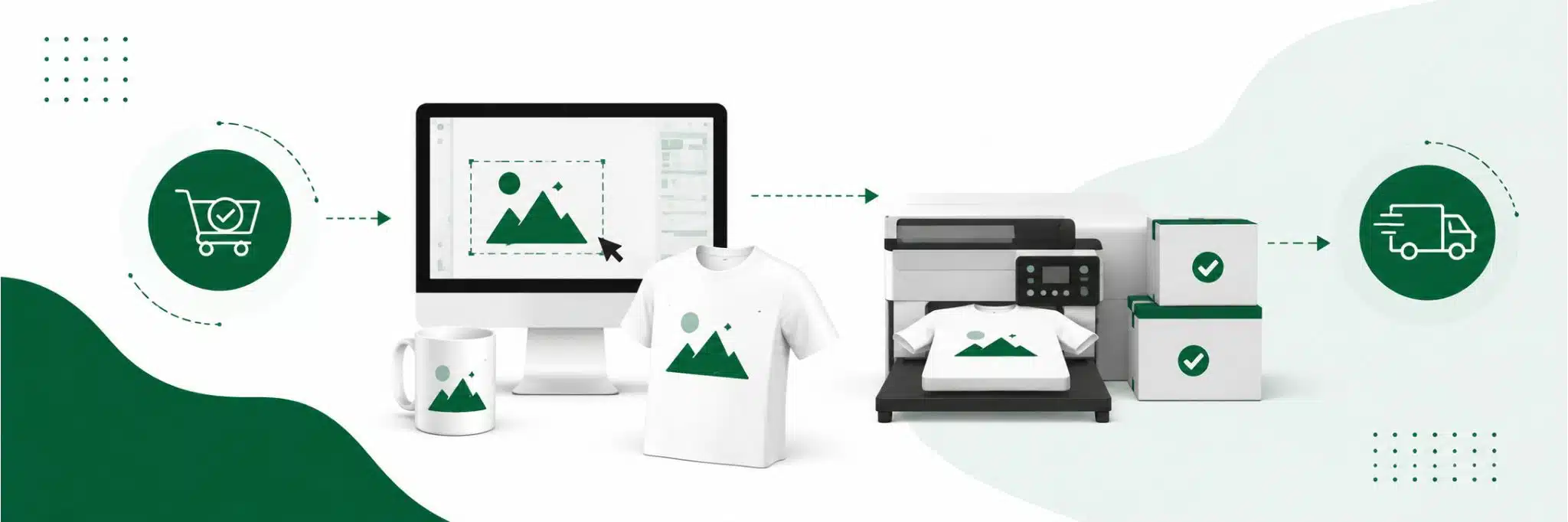
On-demand merch is a fulfillment model where products are manufactured, decorated, and shipped only after a customer places an order. Unlike traditional retail, businesses don’t have to purchase inventory in advance or predict how much stock they’ll sell. Instead, production begins only when demand exists.
This approach has become increasingly popular because it removes many of the financial risks associated with inventory management. Rather than filling a warehouse with products that may sit for months, businesses keep their operations lean while still offering a wide variety of merchandise.
Traditional inventory models require businesses to invest capital upfront, manage storage, and handle unsold products. In contrast, on-demand merch services allow companies to focus on marketing, customer acquisition, and business growth while production and fulfillment happen only when orders are received.
Why Inventory Costs Hurt Business Growth
Inventory costs extend far beyond simply purchasing products. Every unsold item represents money that cannot be invested elsewhere, slowing business growth and reducing profitability.
Warehousing expenses, storage fees, insurance, damaged products, and obsolete inventory all add hidden costs that accumulate over time. Businesses also face the constant challenge of balancing overstock and understock. Ordering too much ties up valuable cash, while ordering too little can result in missed sales opportunities and dissatisfied customers.
Demand forecasting is equally challenging. Seasonal trends, changing customer preferences, and unexpected market shifts often make purchasing decisions difficult, especially for small businesses.
Hidden Inventory Costs
Hidden Costs of Inventory Management
Understanding these common inventory expenses can help businesses improve cash flow and reduce unnecessary costs.
| 📦 Inventory Expense | 📈 Business Impact |
|---|---|
| 🏢 Warehousing | Monthly storage costs increase operating expenses and reduce overall profitability. |
| 📦 Overstock | Cash remains tied up in products that may never sell, limiting business flexibility. |
| ⚠️ Understock | Leads to missed sales opportunities and disappointed customers due to stock shortages. |
| 📉 Product Obsolescence | Unsold inventory gradually loses value, resulting in markdowns or write-offs. |
| 📊 Inventory Forecasting Errors | Poor demand forecasting leads to incorrect purchasing decisions and lower profitability. |
| 🚫 Damaged or Unsold Products | Creates direct financial losses and may incur additional disposal or liquidation costs. |
Reducing inventory-related expenses through print-on-demand or just-in-time production can improve cash flow, minimize waste, and help businesses respond more quickly to changing customer demand.
These ongoing expenses often reduce margins far more than business owners initially expect.
How On-Demand Merch Eliminates Inventory Costs
The biggest advantage of on-demand fulfillment is simple: businesses only produce what customers actually buy.
Instead of investing thousands of dollars in inventory, products are created after each purchase. This eliminates warehouse requirements, reduces storage costs, and removes the financial pressure of clearing unsold stock through heavy discounts.
For example, a startup clothing brand launching ten different t-shirt designs traditionally might purchase hundreds of garments before receiving a single order. With on-demand production, every shirt is printed only after a customer checks out, dramatically lowering financial risk while allowing the business to offer a much larger catalog.
As sales grow, businesses can expand into branded apparel, promotional merchandise, and customized products without increasing inventory investments. This flexibility allows companies to grow confidently while maintaining healthy cash flow and minimizing operational complexity.
Major Benefits of On-Demand Merch for Businesses
On-demand merch isn’t just about avoiding inventory—it creates a more agile and profitable business model. By producing items only after an order is placed, companies reduce financial risk, improve cash flow, and gain the flexibility to adapt to changing customer demand without worrying about unsold stock.
Lower Financial Risk
Traditional merchandising requires businesses to invest in inventory before generating revenue. If products don’t sell, that investment quickly becomes a loss. On-demand fulfillment removes this uncertainty by producing merchandise only after a purchase is confirmed. This allows businesses to launch new collections, seasonal products, or limited-edition items with significantly less financial exposure.
Better Cash Flow
Healthy cash flow is essential for business growth. Instead of spending thousands on inventory, businesses can allocate resources toward marketing, customer acquisition, product development, or expanding operations. Since production begins after payment is received, companies maintain stronger working capital while avoiding unnecessary inventory expenses.
Easier Product Testing
Consumer preferences change constantly, making product testing an important part of growth. On-demand fulfillment allows businesses to introduce new designs, colors, or product categories without committing to large production runs. If a design performs well, it can be scaled immediately. If it doesn’t, there’s no warehouse full of unsold inventory to clear.
Unlimited Product Expansion
Adding new products becomes much easier with an on-demand model. Businesses can expand from T-shirts into hoodies, hats, accessories, promotional items, and seasonal merchandise without increasing inventory costs. Combined with integrated online stores, companies can continuously refresh their catalog while maintaining efficient operations.
Simplified Order Fulfillment
Managing inventory, packing products, and shipping orders can consume valuable time. On-demand fulfillment simplifies these processes by integrating production directly into the order workflow. Businesses spend less time managing logistics and more time growing sales, improving customer experience, and building their brand.
Reduced Operational Complexity
Inventory management introduces countless operational challenges—from warehouse organization to stock forecasting and product replenishment. On-demand production removes much of this complexity, making it easier for startups and established businesses alike to operate efficiently while remaining flexible as demand changes.

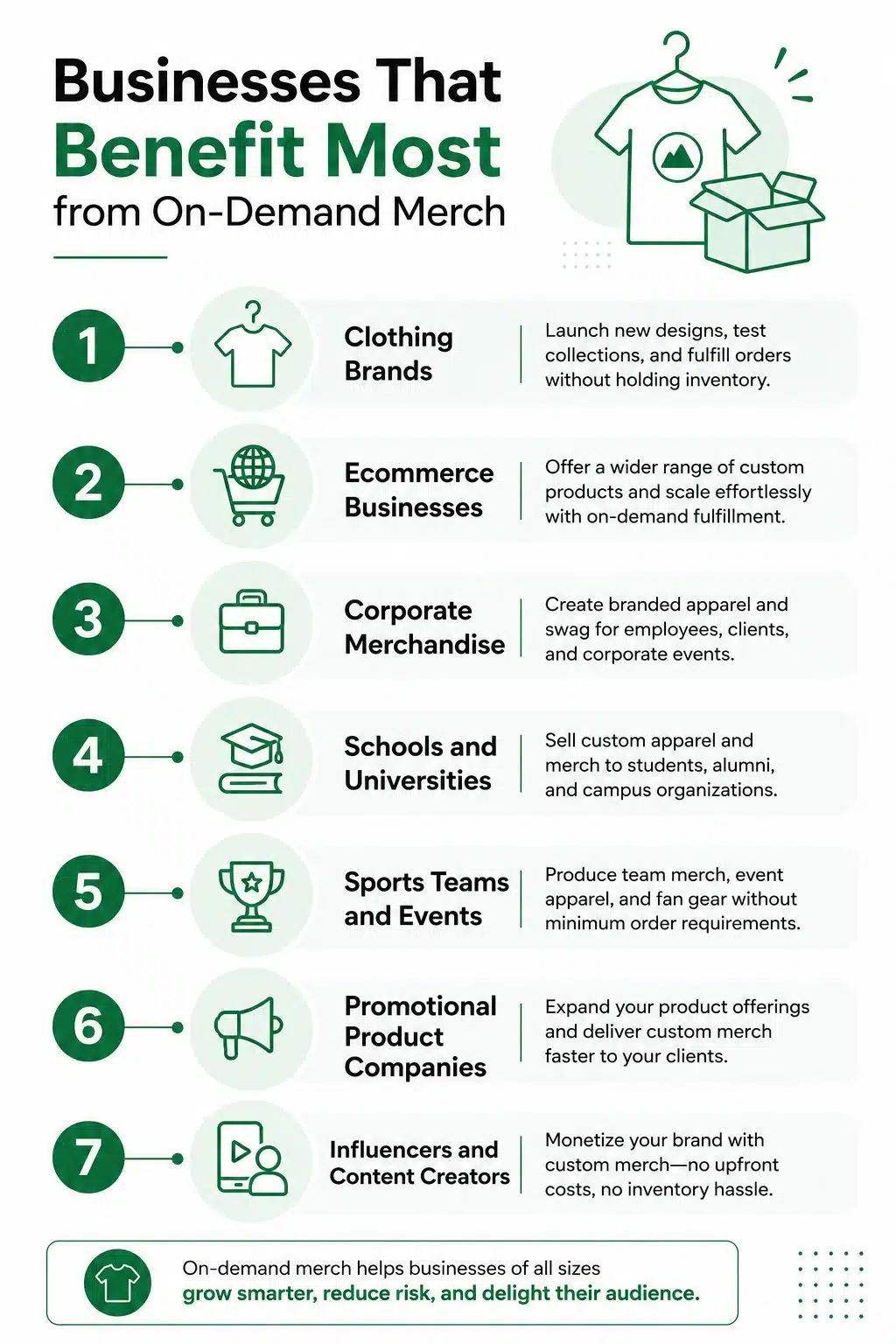
Businesses That Benefit Most from On-Demand Merch
Although almost any organization can benefit from on-demand fulfillment, certain industries see particularly strong advantages because they frequently manage changing product demand, seasonal campaigns, or customized merchandise.
Clothing Brands
Fashion businesses constantly introduce new collections and designs. On-demand production allows clothing brands to launch products without investing in large inventory orders, reducing financial risk while keeping collections fresh.
Ecommerce Businesses
Online stores often sell hundreds of products with unpredictable demand. Producing merchandise only after a purchase eliminates storage costs while allowing ecommerce brands to offer a much wider catalog.
Corporate Merchandise
Businesses ordering branded apparel for employees, recruiting events, or client giveaways can simplify merchandise management through company swag programs. Instead of storing promotional products year-round, companies can order exactly what they need when they need it.
Schools and Universities
Educational institutions regularly require apparel for clubs, fundraisers, graduations, and athletic programs. Using school spirit wear helps formal educational institutions offer customized merchandise without maintaining large inventories between events.
Sports Teams and Events
Sports organizations frequently update uniforms, fan apparel, and event merchandise throughout the season. On-demand fulfillment makes it easier to accommodate roster changes, tournaments, and limited-run merchandise.
Promotional Product Companies
Marketing agencies and promotional distributors often manage orders for multiple clients simultaneously. Producing merchandise on demand reduces inventory management while allowing rapid customization for different campaigns.
Influencers and Content Creators
Creators launching merchandise can validate demand without purchasing hundreds of products upfront. As audiences grow, their merchandise business can scale naturally alongside their community.
Products You Can Sell with On-Demand Merch
One of the biggest strengths of on-demand fulfillment is product variety. Businesses aren’t limited to one category—they can build complete merchandise collections while producing every item only after it’s ordered.
Popular on-demand products include:
- T-shirts using screen printing for bold, long-lasting graphics.
- Premium polos and professional apparel enhanced with embroidery services.
- Hoodies and sweatshirts for retail collections, schools, and corporate teams.
- Hats and headwear that strengthen brand visibility.
- Promotional giveaways through promo products such as drinkware, bags, and accessories.
- Marketing materials including stickers and banners for events and storefronts.
- Custom patches for uniforms, jackets, and branded apparel.
- Corporate uniforms and retail-quality branded apparel collections.
- High-quality DTF transfers for vibrant full-color garment decoration across multiple fabric types.
By combining multiple product categories within a single on-demand strategy, businesses can diversify revenue while maintaining lean operations and eliminating unnecessary inventory costs.
On-Demand Merch vs Traditional Inventory
While both models can help businesses sell branded merchandise, they differ significantly in cost, flexibility, and operational efficiency. Traditional inventory requires businesses to predict demand and purchase products in advance, whereas on-demand merch produces items only after an order is placed.
On-Demand Merch vs. Traditional Inventory
Compare the two business models to determine which best fits your budget, growth strategy, and operational needs.
| 📊 Factor | ✅ On-Demand Merch | 📦 Traditional Inventory |
|---|---|---|
| 💰 Upfront Cost | Low; pay only after an order is received. | High; inventory must be purchased in advance. |
| ⚠️ Inventory Risk | Minimal; no unsold stock. | High; overstock and dead inventory are common. |
| 🏢 Storage | No warehouse required. | Requires storage space and inventory management. |
| 💵 Cash Flow | Stronger since capital isn’t tied up in stock. | Reduced due to upfront purchasing costs. |
| 🎨 Product Variety | Easy to expand without additional inventory. | Limited by available storage and budget. |
| 📈 Scalability | Easily scales with customer demand. | Scaling requires larger inventory investments. |
| ♻️ Waste | Very low because products are made to order. | Higher due to obsolete or unsold products. |
| 🛍️ Order Flexibility | Supports one-off orders and personalized products. | Better suited for standardized bulk inventory. |
On-demand merch is ideal for startups and brands seeking low financial risk, flexible product offerings, and scalable growth. Traditional inventory remains a good option for businesses with predictable demand and high-volume production, where lower per-unit costs can offset the investment in inventory.
For businesses prioritizing flexibility, lower financial risk, and faster growth, on-demand fulfillment offers a much more efficient operating model.
How On-Demand Merch Supports Business Scaling
Growth often creates new operational challenges, especially when businesses rely on inventory. On-demand merch removes many of these barriers by allowing production to increase only as demand grows.
During holiday sales and seasonal promotions, businesses can fulfill larger order volumes without purchasing extra inventory months in advance. The same flexibility benefits product launches and limited-edition collections, where predicting demand is difficult. Instead of risking unsold products, brands can introduce new designs confidently and produce only what customers actually buy.
For companies running corporate campaigns or serving multiple office locations, on-demand fulfillment simplifies logistics while maintaining consistent branding. When demand spikes unexpectedly, bulk order solutions make larger production runs easier without disrupting normal operations. Businesses facing tight deadlines can also benefit from rush production services, helping meet event schedules, product launches, and promotional campaigns without sacrificing quality.
Common Mistakes Businesses Make When Switching to On-Demand
Moving to an on-demand model doesn’t automatically guarantee success. Many businesses make avoidable mistakes that reduce profitability and create unnecessary customer issues.
One of the most common errors is choosing the cheapest supplier instead of evaluating print quality and consistency. Poor decoration quality can quickly damage customer trust and increase costly reprints.
Another mistake is offering an oversized product catalog before understanding customer demand. Launching dozens of products without validating interest often creates unnecessary complexity instead of increasing sales.
Brand consistency is equally important. Weak branding, inconsistent artwork, or low-quality product photography can make even professionally printed merchandise appear less valuable.
Businesses also underestimate the importance of ecommerce integration. Without a smooth ordering system, fulfillment becomes slower and more error-prone. Finally, unrealistic delivery promises can create customer dissatisfaction even when production quality is excellent. Setting clear expectations helps build trust and encourages repeat purchases.
How to Choose the Right On-Demand Merch Partner
Your fulfillment partner directly influences customer satisfaction, operational efficiency, and long-term business growth. Looking beyond pricing often leads to better business outcomes.
Start by evaluating product quality across different apparel categories and decoration methods. A reliable partner should offer multiple decoration options—including screen printing, embroidery, DTF, and specialty applications—to support different branding needs through professional contract decoration services.
Turnaround time and fulfillment reliability are equally important. Consistent production schedules help businesses meet customer expectations while avoiding delays during busy seasons.
Strong customer support also matters. Responsive communication makes resolving artwork questions, production issues, and order changes much easier.
As your business grows, scalability becomes essential. Your fulfillment partner should comfortably handle both small custom orders and large corporate programs without sacrificing quality. Businesses serving government agencies, schools, or regulated organizations may also benefit from providers offering union contract services, ensuring compliance with project requirements.
Finally, look for partners that offer complementary services such as ecommerce integration, promotional products, and wide format printing. Working with a single experienced provider simplifies operations, reduces vendor management, and creates a more scalable merchandising strategy as your business expands.
Final Thought
On-demand merch gives businesses a practical way to reduce inventory costs while staying flexible as they grow. By producing products only after an order is placed, companies avoid warehousing expenses, improve cash flow, and expand their product offerings with minimal risk.
Whether you’re launching a clothing brand, managing corporate merchandise, or running an ecommerce business, the right fulfillment partner makes all the difference. Shirt.co helps businesses create branded apparel, fulfill orders on demand, build online stores, produce company swag, and scale confidently with screen printing, embroidery, DTF transfers, promotional products, and complete fulfillment services.
FAQs
What is on-demand merch?
On-demand merch is a fulfillment model where products are printed, decorated, and shipped only after a customer places an order, eliminating the need to maintain inventory.
Does on-demand merch eliminate inventory costs?
Yes. Since products are produced only after they’re sold, businesses avoid warehousing, storage fees, and losses from unsold inventory.
Is print-on-demand profitable for small businesses?
Yes. It reduces upfront investment, lowers financial risk, and allows businesses to focus on marketing and customer growth instead of inventory management.
Can companies use on-demand merch for employee swag?
Absolutely. Businesses can create branded apparel, welcome kits, event merchandise, and company swag without ordering large quantities upfront.
How do online stores work with on-demand fulfillment?
Orders placed through an online store are automatically sent to production, where products are decorated, packed, and shipped directly to customers.
Is on-demand merch good for startups?
Yes. Startups can launch products without purchasing inventory, making it easier to test designs and grow gradually.
What’s the difference between bulk ordering and on-demand merch?
Bulk ordering requires purchasing products before selling them, while on-demand merch produces items only after an order is received.
How long does on-demand fulfillment usually take?
Production times vary by product and decoration method, but most on-demand orders are fulfilled within a few business days before shipping.
What products can be sold through on-demand merch?
Businesses can offer T-shirts, hoodies, polos, hats, promotional products, patches, stickers, banners, and many other customized items.
How do I choose the right on-demand merch partner?
Look for consistent print quality, multiple decoration methods, reliable fulfillment, responsive support, ecommerce integration, and the ability to scale with your business.