



On-demand merchandise has become one of the smartest growth strategies for modern brands looking to expand without the financial burden of holding inventory. As customer expectations evolve and ecommerce continues to accelerate, businesses need merchandise programs that are flexible, scalable, and cost-efficient. Instead of investing thousands of dollars in products that may never sell, growing brands can produce items only after orders are placed.
This inventory-free model supports stronger branding, healthier cash flow, and faster product launches while reducing operational complexity. Whether you’re an emerging ecommerce company, a corporate business, or an established retailer, on-demand fulfillment provides the agility needed to grow sustainably without sacrificing quality or customer experience.
Key Takeaways
- On-demand merchandise eliminates inventory costs by producing products only after orders are placed.
- Growing brands can expand product catalogs without investing in warehouse space.
- Businesses improve cash flow while reducing financial risk and excess inventory.
- Ecommerce integrations automate ordering, production, and fulfillment.
- Merchandise programs scale easily across customers, employees, and multiple locations.
- Choosing an experienced fulfillment partner ensures consistent quality and long-term brand growth.
What Is On-Demand Merchandise?
On-demand merchandise is a fulfillment model where branded products are manufactured only after someone places an order. Unlike traditional merchandise programs that require businesses to estimate demand, purchase inventory upfront, and manage storage, on-demand production removes those operational hurdles entirely.
The process is simple:
- A customer or employee places an order.
- The product is decorated using the approved design.
- The finished item is packed and shipped directly to the recipient.
- No inventory sits unused in storage.
This model has transformed how businesses approach branded products because it aligns production directly with real demand. Instead of tying up capital in inventory, brands invest only after revenue has already been generated.
For many organizations, on-demand merchandise offers a more sustainable approach to growth. Companies can launch seasonal collections, introduce new branding, or expand into additional product categories without worrying about unsold inventory becoming obsolete.
Traditional Inventory vs. On-Demand Fulfillment
| 📦 Traditional Merchandise | ✅ On-Demand Merchandise |
|---|---|
| 💰 Inventory is purchased upfront before any sales occur. | 🛍️ Products are manufactured only after a customer places an order. |
| 🏢 Requires warehouse space and inventory management. | 📦 No inventory storage or warehouse is required. |
| ⚠️ Higher financial risk due to inventory investment. | 💵 Lower upfront investment and reduced financial risk. |
| 📊 Demand forecasting is essential before ordering. | 📈 Production is driven by actual customer demand. |
| 📉 Unsold inventory can result in markdowns or write-offs. | ♻️ Minimal product waste because items are made to order. |
| 🕒 Product updates are slower because existing inventory must be sold first. | 🎨 New designs can be launched or updated immediately without replacing inventory. |
On-demand merchandise offers greater flexibility, lower financial risk, and virtually no inventory waste, making it ideal for ecommerce brands, employee stores, and businesses that frequently introduce new products. Traditional merchandise is better suited for predictable, high-volume demand where bulk production can reduce the cost per unit.
This demand-driven production model has become especially valuable for businesses experiencing rapid growth, where inventory forecasting is often difficult and customer preferences change quickly.
Growing brands also benefit from improved flexibility. New product ideas can be tested with very little financial commitment, allowing businesses to validate demand before expanding their merchandise offerings.
Why On-Demand Merchandise Is Growing So Fast
The shift toward on-demand fulfillment isn’t simply a trend—it’s a response to fundamental changes in how businesses operate and how customers shop.
One of the biggest drivers is ecommerce growth. Consumers increasingly expect brands to offer wider product selections, faster updates, and personalized merchandise. Traditional inventory models struggle to keep pace because every new product requires additional investment, storage space, and inventory management.
Cash flow is another major consideration. Purchasing inventory months before generating revenue creates financial pressure, particularly for small and growing companies. On-demand fulfillment reverses that model by producing merchandise only after payment has been received, allowing businesses to preserve capital for marketing, product development, and expansion.
Another reason brands are embracing on-demand merch for growing brands is product flexibility. Companies no longer need to commit to thousands of units before determining whether a design will succeed. Instead, they can:
- Launch limited-edition collections.
- Test seasonal campaigns.
- Introduce new branding quickly.
- Expand into additional product categories.
- Respond to customer trends in real time.
Sustainability also plays an increasingly important role. Traditional inventory often results in unsold products that eventually become waste. By producing merchandise only when it’s needed, businesses significantly reduce overproduction while supporting more environmentally responsible operations.
Operational efficiency has improved as well. Modern fulfillment platforms automate production, packing, and shipping, allowing businesses to focus on growth rather than logistics. This creates more reliable branded merchandise fulfillment, especially for organizations managing customers across multiple locations.
For companies seeking on-demand merchandise for businesses, this model offers several long-term advantages:
- Lower inventory costs.
- Improved cash flow.
- Faster product launches.
- Better scalability.
- Simplified operations.
- Reduced financial risk.
The result is a merchandise strategy that grows alongside the business instead of becoming a logistical challenge.
Why On-Demand Merchandise Is the Smart Choice for Growing Brands
Growth creates opportunities—but it also introduces complexity. As brands attract more customers, launch additional products, and expand into new markets, traditional inventory systems often become difficult to manage.
On-demand fulfillment removes many of these barriers by giving businesses the flexibility to grow without proportionally increasing operational costs.
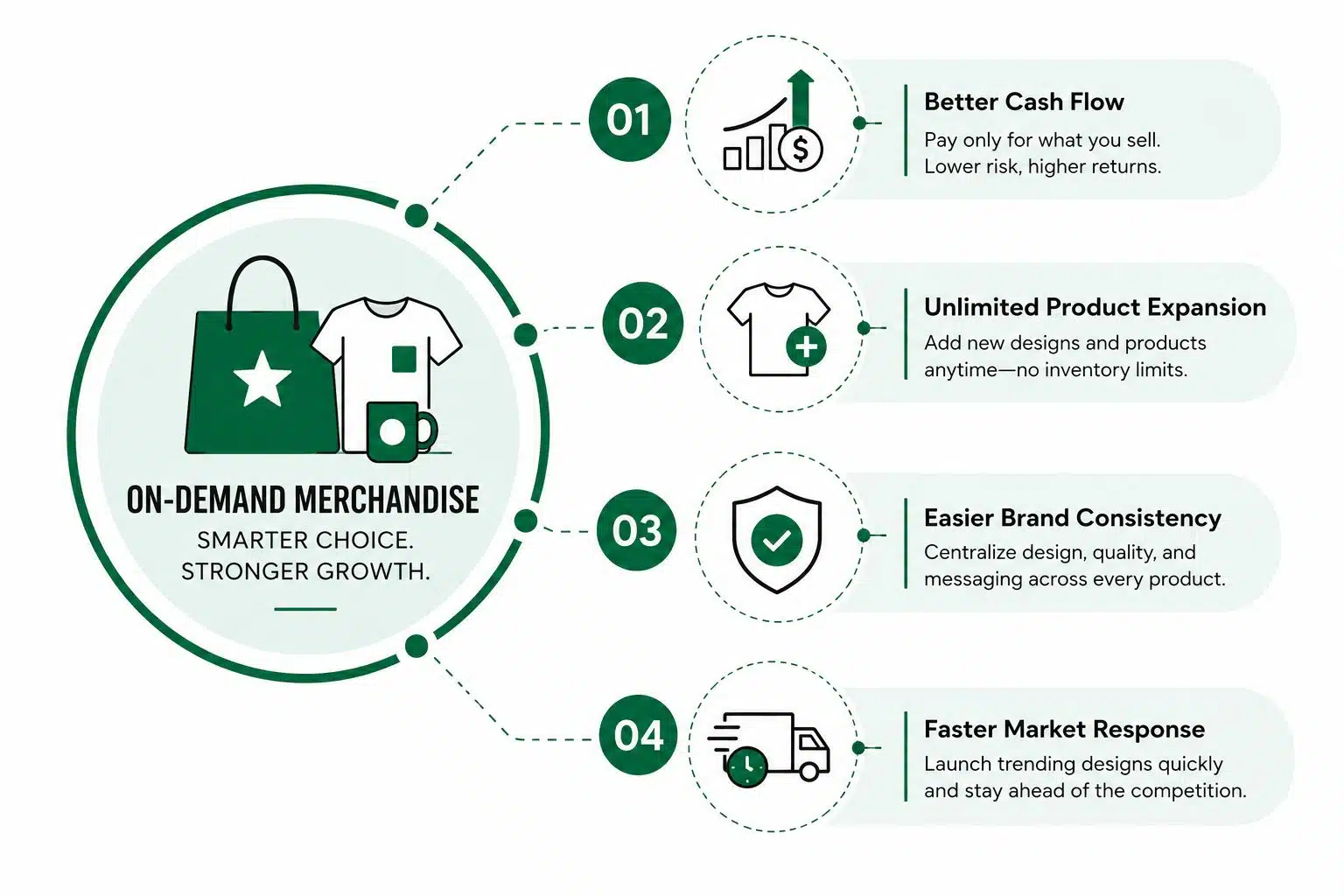
1. Better Cash Flow
Healthy cash flow is essential for any growing business. Instead of investing capital in inventory that may take months to sell, brands can allocate resources toward advertising, customer acquisition, and product development.
Revenue is generated before production begins, reducing financial risk while supporting sustainable growth.
2. Unlimited Product Expansion
Traditional inventory forces businesses to carefully limit product selection because every new SKU requires storage space and upfront purchasing.
With print-on-demand merchandise, companies can introduce:
- New apparel styles
- Seasonal collections
- Limited-edition products
- Customer-requested designs
- Regional merchandise
without significantly increasing operating expenses.
3. Easier Brand Consistency
As businesses grow, maintaining a consistent visual identity becomes increasingly important. On-demand fulfillment helps standardize logos, colors, decoration methods, and product quality across every order.
Whether serving customers, employees, or partners, businesses can confidently distribute custom branded merchandise that reinforces their brand identity.
4. Faster Market Response
Customer preferences evolve quickly. On-demand production allows brands to respond to market trends almost immediately instead of waiting until existing inventory sells through.
Businesses can:
- Update branding.
- Launch collaborations.
- Create event-specific merchandise.
- Test new concepts.
- Retire underperforming designs.
without the financial burden associated with traditional inventory.
This combination of flexibility, efficiency, and scalability explains why on-demand fulfillment has become the preferred merchandise strategy for many modern brands.
Why On-Demand Merchandise Scales Better Than Traditional Inventory
As brands grow, managing merchandise becomes more complex. New products, seasonal campaigns, multiple locations, and changing customer preferences can quickly make traditional inventory expensive and difficult to maintain. This is where on-demand merchandise offers a significant advantage.
Instead of investing in large inventory orders months in advance, businesses can produce merchandise only when it’s needed. This approach improves cash flow, reduces storage costs, and makes it easier to respond to market demand without carrying excess stock.
Growing companies also benefit from:
- Launching new products without inventory risk.
- Expanding product catalogs without increasing warehouse space.
- Supporting customers across multiple regions through distributed fulfillment.
- Updating designs or branding without worrying about unsold inventory.
- Running seasonal or limited-edition campaigns with minimal financial risk.
For businesses looking to create custom merchandise for companies, on-demand production provides the flexibility to scale operations while maintaining consistent brand quality.
Products Most Industries Customize
One of the biggest advantages of on-demand fulfillment is the ability to offer a wide variety of branded products without maintaining inventory. Different industries customize different merchandise based on their audience, employees, or marketing objectives.
Employee Merchandise
Employee apparel helps reinforce company culture while creating a consistent brand image.
Popular options include:
- T-shirts
- Hoodies
- Hats
- Polo shirts
- Tote bags
Many organizations combine these items with professionally produced branded apparel to create onboarding kits, employee recognition gifts, and everyday workwear.
Promotional Products
Promotional merchandise continues to deliver long-term marketing value because customers use these items repeatedly.
Popular products include:
- Tumblers
- Water bottles
- Drinkware
- Stickers
- Office accessories
- Tech accessories
Businesses often expand their marketing campaigns with custom promotional products that complement apparel and improve brand visibility.
Retail Merchandise
Retail brands frequently use on-demand production to test new products before committing to large inventory investments.
Common retail items include:
- Apparel
- Accessories
- Limited-edition collections
- Seasonal merchandise
Because products are fulfilled after purchase, brands can experiment with designs while minimizing financial risk.
Event Merchandise
Conferences, company retreats, fundraisers, and promotional events all require branded products that may only be needed for a short period.
Frequently customized event merchandise includes:
- Giveaway items
- Welcome kits
- Conference apparel
- Event-exclusive products
On-demand fulfillment allows organizations to produce only the quantities they actually need, reducing leftover inventory after the event.
Bulk Orders vs On-Demand Fulfillment
While on-demand fulfillment works well for many growing brands, traditional bulk ordering still has advantages in specific situations. Understanding when to use each approach helps businesses maximize efficiency and control costs.
| 📊 Factor | 📦 Bulk Orders | ✅ On-Demand |
|---|---|---|
| 💰 Upfront Cost | Higher investment required before production. | Lower upfront cost; pay as orders are placed. |
| 📦 Inventory | Inventory must be purchased and managed. | No inventory required. |
| 🏢 Storage | Warehouse or storage space is necessary. | No storage needed. |
| ♻️ Waste | Possible due to unsold or obsolete inventory. | Minimal because products are made to order. |
| 💵 Cash Flow | Reduced as capital is tied up in inventory. | Improved with lower upfront spending. |
| 🎨 Product Updates | Slower since existing inventory must be used first. | Immediate; new designs can be launched anytime. |
| 📈 Scalability | Moderate; scaling requires larger inventory purchases. | High; production scales automatically with demand. |
Bulk orders are ideal for large, predictable production runs where lower per-unit costs matter most. On-demand production offers greater flexibility, stronger cash flow, zero inventory management, and the ability to scale quickly without significant upfront investment.
When Bulk Ordering Makes Sense
Bulk production is often the better choice when businesses:
- Need thousands of identical items.
- Have predictable demand throughout the year.
- Require merchandise for one large event.
- Want the lowest possible cost per unit.
Large-scale production through bulk orders can provide excellent value when inventory turnover is predictable.
When On-Demand Fulfillment Works Best
On-demand production is ideal when businesses:
- Launch new products regularly.
- Serve ecommerce customers.
- Personalize merchandise.
- Operate multiple locations.
- Experience seasonal demand.
- Want to eliminate warehouse costs.
Hybrid Merchandise Strategies
Many successful brands combine both approaches.
For example:
- Evergreen products may be produced in bulk.
- Seasonal collections can be fulfilled on demand.
- Employee apparel can be ordered individually throughout the year.
- Promotional campaigns can mix stocked items with print-on-demand products.
This hybrid strategy gives businesses flexibility while maintaining cost efficiency.
Common Mistakes Businesses Make When Launching Merchandise Programs
Even with a modern fulfillment model, businesses often make avoidable mistakes that reduce profitability and create operational challenges.
Some of the most common include:
- Ordering inventory before validating demand, resulting in excess stock.
- Launching too many products at once, making inventory and branding difficult to manage.
- Inconsistent branding across different products and suppliers.
- Ignoring fulfillment speed, leading to delayed customer deliveries.
- Choosing suppliers based only on price, rather than quality and reliability.
- Operating without a centralized merchandise strategy, causing duplicate products and inconsistent messaging.
- Poor ecommerce integration, creating manual order processing and fulfillment delays.
Avoiding these issues helps brands build scalable merchandise programs that support long-term growth instead of creating unnecessary operational complexity.
How to Choose the Right On-Demand Merchandise Partner
Not every fulfillment provider offers the same level of quality, flexibility, or support. Choosing the right partner can significantly influence customer satisfaction and long-term brand success.
When evaluating providers, consider the following:
Product Quality
Customers associate merchandise quality directly with your brand. Reliable partners should deliver consistent print quality, durable materials, and professional finishing.
Decoration Capabilities
As your product catalog grows, you may need multiple decoration methods.
Look for providers experienced in:
- Screen printing
- Embroidery
- Direct-to-film printing
- Promotional product decoration
Having multiple capabilities under one roof simplifies production and improves consistency.
Fulfillment Reliability
Timely production and shipping become increasingly important as order volume grows.
Evaluate:
- Average turnaround time
- Order accuracy
- Shipping performance
- Production capacity during busy seasons
Customer Support
Growing brands inevitably encounter questions, artwork revisions, or special requests.
Strong customer support helps resolve issues quickly and keeps projects moving.
Scalability
Your merchandise partner should be able to support growth without sacrificing quality.
Whether you’re fulfilling dozens or thousands of orders each month, scalable business merchandise fulfillment ensures operations continue running smoothly.
Brand Consistency
Maintaining consistent colors, print quality, and logo placement across every order strengthens customer trust and reinforces brand recognition.
Ecommerce Integration
Brands selling online should prioritize providers that support seamless order automation through ecommerce platforms.
This reduces manual work while improving the customer experience.
Production Experience
An experienced partner understands how to manage artwork, production scheduling, fulfillment logistics, and quality control across different product categories.
Many businesses also benefit from providers offering contract decoration services, allowing agencies, retailers, and enterprise organizations to expand production without investing in additional equipment.
Ultimately, the best partner supports both today’s needs and tomorrow’s growth, making it easier to deliver high-quality on-demand branded merchandise at scale.
Bulk Orders vs. On-Demand Merchandise: Which Is Better for Growing Brands?
Both bulk ordering and on-demand merchandise have a place in a successful merchandising strategy. The right choice depends on your sales volume, inventory capacity, campaign goals, and cash flow.
For fast-growing businesses, on-demand merchandise provides the flexibility to launch products without committing to large inventory investments. Established brands with predictable demand, however, may benefit from ordering in bulk for lower unit costs.
| 📊 Factor | 📦 Bulk Orders | ✅ On-Demand Merchandise |
|---|---|---|
| 💰 Upfront Investment | High initial investment is required before products are sold. | Low upfront cost since products are made only after purchase. |
| 📦 Inventory Required | Yes; inventory must be purchased and managed. | No inventory is required. |
| 🏢 Storage Costs | Warehouse space and ongoing storage expenses are necessary. | No storage costs because products are fulfilled on demand. |
| ⏱️ Production Timing | Products are manufactured before any sales occur. | Production begins only after a customer places an order. |
| ⚠️ Risk of Unsold Stock | High risk of excess inventory and markdowns. | Minimal risk because products are created only when purchased. |
| 🎨 Product Updates | Slower since existing inventory must be cleared first. | Immediate; launch or update designs whenever needed. |
| 💵 Cash Flow | Capital is tied up in inventory until products sell. | Pay as orders are fulfilled, helping preserve working capital. |
| 🚀 Best For | High-volume evergreen products with predictable demand. | Growing brands, product launches, seasonal collections, and ecommerce stores. |
Bulk ordering is best when demand is stable and high enough to justify inventory costs. On-demand merchandise is the smarter choice for businesses that prioritize flexibility, lower financial risk, healthier cash flow, and the ability to launch new products without investing in inventory.
A hybrid approach often delivers the best results. Many brands use on-demand merchandise to validate demand for new products, seasonal collections, and limited editions while reserving bulk orders for proven bestsellers with consistent sales.
This strategy minimizes financial risk while ensuring inventory is available only where it makes business sense.
Common Mistakes Growing Brands Make with Merchandise Programs
Launching a merchandise program is easier than ever, but many brands still make avoidable mistakes that limit profitability and create operational headaches.
Some of the most common issues include:
- Ordering large quantities before validating customer demand.
- Launching too many product variations at once.
- Using inconsistent logos, colors, and branding across products.
- Choosing suppliers based solely on the lowest price.
- Ignoring fulfillment speed and customer delivery expectations.
- Failing to integrate merchandise with ecommerce platforms.
- Overlooking customer service and return workflows.
Beyond these tactical mistakes, many businesses underestimate how quickly inventory becomes outdated. Rebranding, seasonal campaigns, employee turnover, or changing customer preferences can leave shelves full of products that no longer reflect the business.
Growing brands are often better served by an inventory-free model that allows them to launch, test, adjust, and scale without carrying unnecessary financial risk.
How to Choose the Right On-Demand Merchandise Partner
Not all fulfillment providers offer the same level of quality, scalability, or customer support. Choosing the right partner can determine whether your merchandise program becomes a long-term growth engine or an operational burden.
When evaluating providers, consider the following factors:
Consistent Product Quality
Every order represents your brand. Look for suppliers with reliable production standards, premium apparel options, and thorough quality control processes.
Multiple Decoration Capabilities
As your catalog grows, you may need different decoration methods for different products. A partner that offers services like screen printing, embroidery, and specialty decoration can support future expansion without requiring multiple vendors.
Reliable Fulfillment
Fast, accurate production and shipping are essential for customer satisfaction. Ask about average turnaround times, order tracking, and fulfillment accuracy.
Ecommerce Integration
The best providers simplify order management by integrating directly with your online store, allowing orders to flow automatically into production.
Scalability
Your fulfillment partner should be capable of handling:
- Product catalog expansion
- Seasonal spikes
- National shipping
- Multi-location fulfillment
- Corporate merchandise programs
Customer Support
Responsive communication becomes especially important during product launches, large campaigns, or custom branding projects.
Production Experience
Experienced providers understand branding consistency, color management, artwork preparation, and long-term merchandising strategies better than low-cost print providers.
Brands that require specialized decoration or high-volume customization may also benefit from working with a provider that offers contract decoration services, allowing businesses to maintain consistent quality while expanding production capacity.
Ultimately, the best merchandise partner isn’t simply the cheapest—it’s the one that supports your long-term business growth with dependable production, scalable fulfillment, and consistent branding.
To Wrap Up
For growing companies, on-demand merchandise offers a smarter path to scaling branded products without the financial burden of inventory. It enables businesses to launch faster, maintain consistent branding, improve cash flow, and respond quickly to changing customer demand. Whether you’re building an ecommerce store, expanding employee apparel, creating company swag, or producing promotional campaigns, an inventory-free fulfillment model provides flexibility traditional merchandising can’t match. With expert production, premium branded apparel, promotional products, screen printing, contract decoration, and scalable fulfillment, Shirt.co helps brands grow confidently through every stage of business.
FAQs
What is on-demand merchandise?
On-demand merchandise is a fulfillment model where products are manufactured only after a customer places an order, eliminating the need to hold inventory.
Why is on-demand merchandise good for growing brands?
It reduces upfront investment, minimizes inventory risk, improves cash flow, and allows businesses to launch products quickly without forecasting demand.
How does on-demand merchandise reduce inventory costs?
Because products are produced after purchase, businesses avoid warehousing, unsold inventory, storage expenses, and product obsolescence.
Is on-demand merchandise suitable for corporate companies?
Yes. Many businesses use on-demand fulfillment for employee onboarding, corporate apparel, conference merchandise, client gifts, and company swag programs.
Can ecommerce brands use on-demand fulfillment?
Absolutely. Ecommerce stores can integrate on-demand fulfillment directly with their online platforms, automating production and shipping after each order.
What products work best for on-demand merchandise?
Popular options include T-shirts, hoodies, polos, hats, tote bags, drinkware, promotional products, and branded accessories.
When should businesses choose bulk orders instead of on-demand?
Bulk ordering is often better for evergreen products with predictable demand, while on-demand works best for new launches, seasonal collections, and variable sales.
What are company swag programs?
Company swag programs provide branded merchandise for employees, clients, recruiting, onboarding, and promotional events while maintaining consistent brand identity.
Can promotional products be fulfilled on demand?
Yes. Many promotional items, including drinkware, accessories, and branded gifts, can be produced and shipped as orders are placed.
How do I choose the best on-demand merchandise supplier?
Look for consistent quality, multiple decoration options, ecommerce integration, reliable fulfillment, responsive customer support, scalable production capabilities, and proven experience with branded merchandise.