


Private label screen printing allows print shops, apparel businesses, agencies, and e-commerce brands to offer professional printing without managing every stage of production themselves. Instead, they partner with an experienced production provider that handles the printing while the customer-facing business continues operating under its own brand.
This approach can help businesses increase production capacity, reduce equipment costs, and take on larger orders without building a complete in-house printing operation.
For businesses looking to expand beyond apparel printing, related services such as custom sticker printing services can also provide additional revenue opportunities.
What Is Private Label Screen Printing?
Private label screen printing is an outsourced production model in which one company manufactures printed apparel for another business, while the reseller presents the finished product under its own brand.
For example, a local print shop may receive an order for 500 custom T-shirts. Instead of producing all 500 garments in-house, the shop can send the artwork, garment specifications, quantities, and other production requirements to a private-label printing partner.
The production partner handles the physical printing and finishing. Depending on the agreement, the completed order can be returned to the print shop or shipped directly to its customer.
The end customer continues dealing with the original print shop, allowing that business to maintain control over its branding and customer relationship.
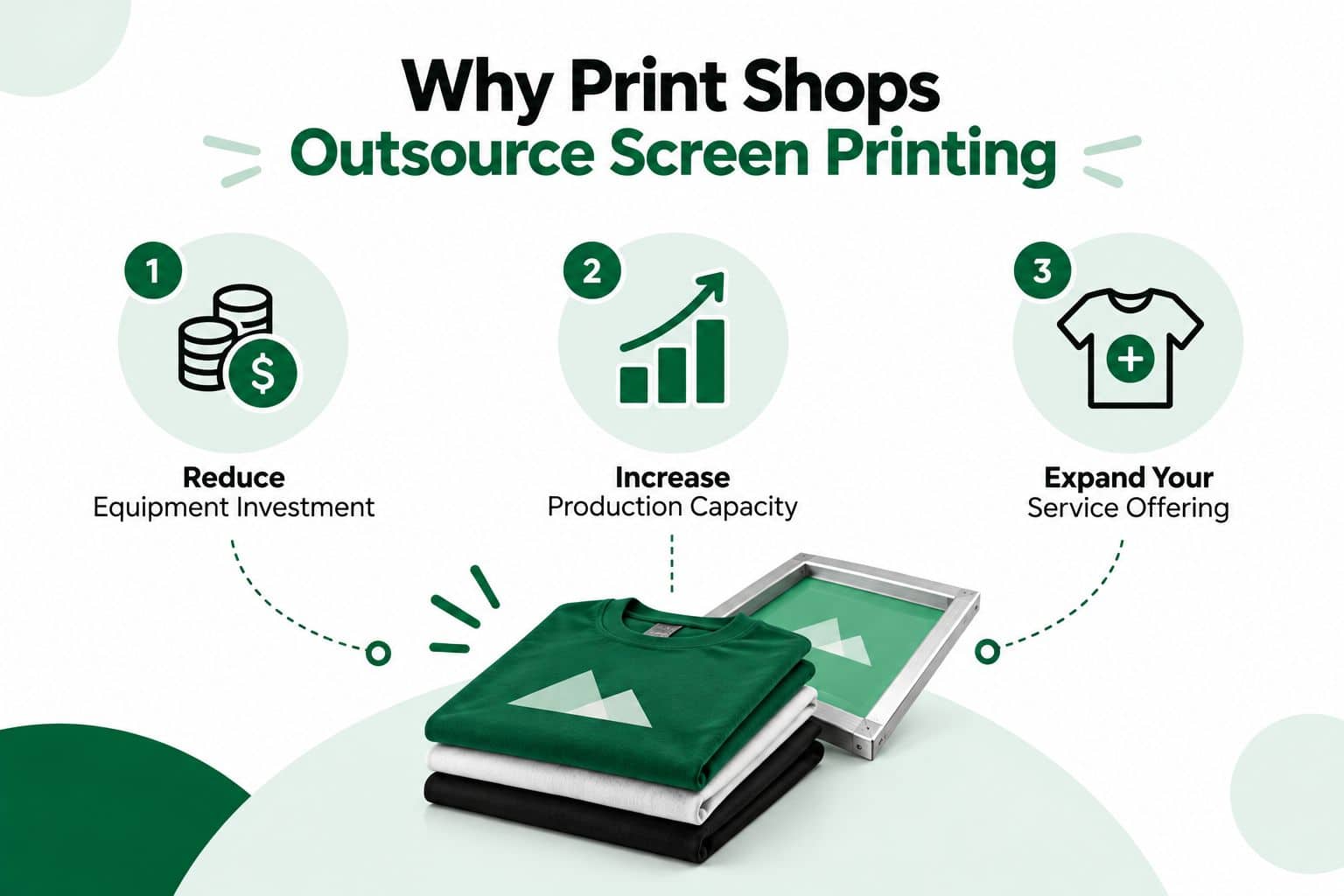
Why Print Shops Outsource Screen Printing
Screen printing requires specialized equipment, production space, trained employees, and ongoing maintenance. For smaller businesses, investing in additional presses and production equipment may not make financial sense when demand fluctuates.
Outsourcing provides an alternative.
1. Reduce Equipment Investment
A print shop doesn’t necessarily need to purchase additional screen-printing equipment simply to accommodate occasional large orders.
By working with a private-label production partner, the business can access professional printing capacity without making the same upfront investment in presses, dryers, exposure equipment, screens, and other infrastructure.
Businesses that regularly handle high-volume orders can also use bulk printing services to support larger production requirements.
2. Increase Production Capacity
One of the biggest advantages of outsourcing is the ability to accept orders that exceed your normal in-house capacity.
For example, a shop that normally handles smaller orders may receive a request for 2,000 printed shirts with a short deadline. Rather than turning down the customer, it can outsource production to a partner with greater capacity.
This allows the print shop to continue generating sales without adding permanent equipment or employees.
3. Expand Your Service Offering
Outsourcing also allows businesses to offer more products without becoming specialists in every production method.
A company that primarily sells printed T-shirts could expand into patches, embroidery, promotional products, and other branded merchandise.
For example, businesses can offer premium patches online alongside their apparel printing services. This gives customers more ways to customize uniforms, merchandise, team apparel, and promotional clothing.
How Private Label Screen Printing Works
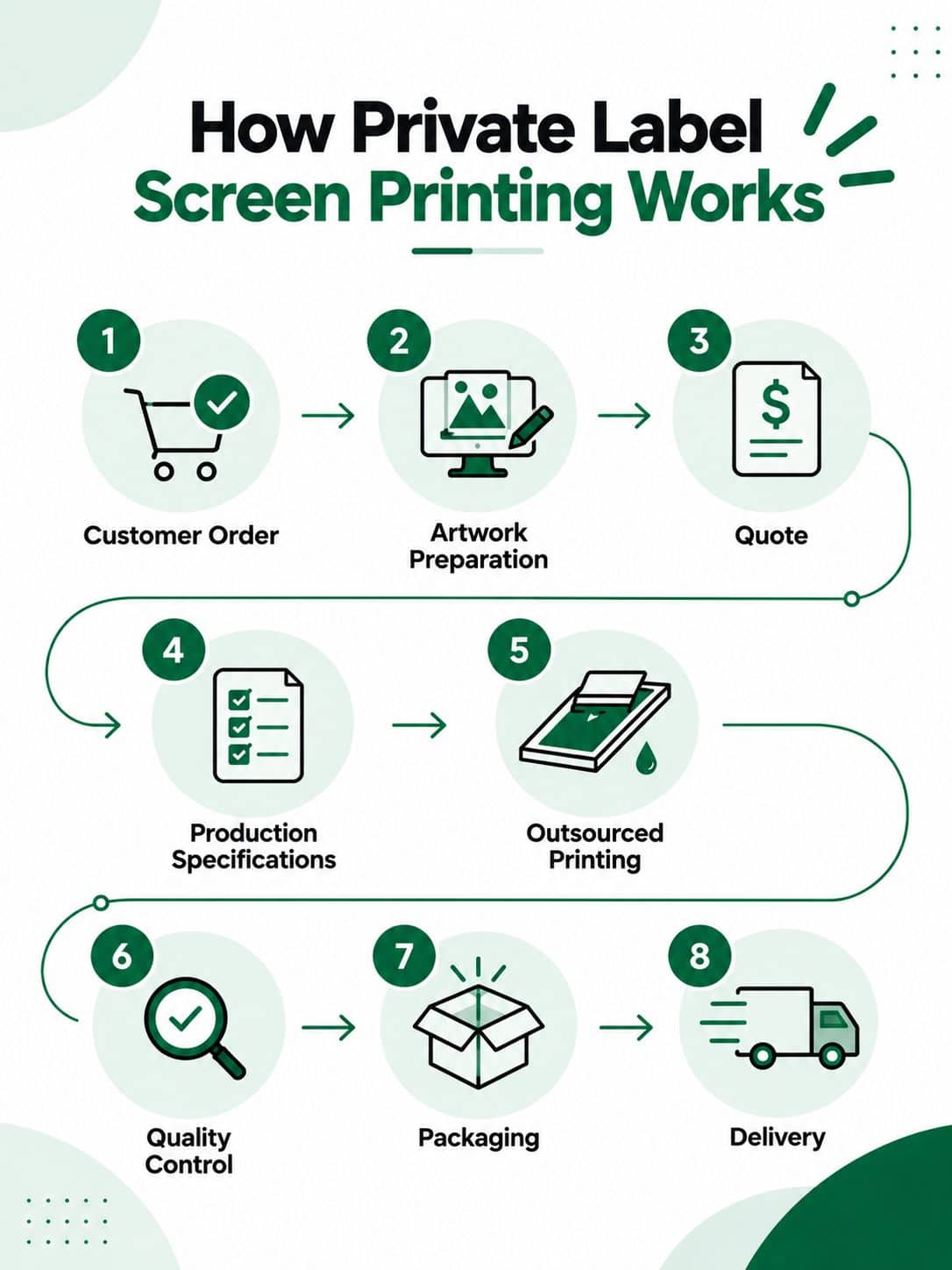
A typical private-label workflow follows several stages:
Customer order → Artwork preparation → Quote → Production specifications → Outsourced printing → Quality control → Packaging → Delivery
Step 1: Receive the Customer Order
The print shop first collects the information required to produce the order, including:
- Garment type
- Sizes
- Quantities
- Artwork
- Print locations
- Ink colors
- Delivery requirements
- Packaging instructions
Clear specifications are important because the outsourced printer will use this information to manufacture the order according to the reseller’s requirements.
Step 2: Prepare the Artwork
The artwork is reviewed and prepared for production. Depending on the design, this can involve color separation, sizing, placement adjustments, and other prepress work.
The goal is to make sure the artwork is production-ready before the order reaches the printing stage.
Step 3: Send the Order to the Production Partner
Once the specifications are confirmed, the reseller sends the order to its private-label screen-printing partner.
The partner may handle screen preparation, ink setup, garment loading, printing, curing, inspection, folding, and packaging.
This is where professional screen printing services can help businesses maintain consistent results without having to manage the entire production process themselves.
Step 4: Quality Control
Quality control is especially important in private-label production because the finished product represents the reseller’s brand.
Orders should be checked for:
- Correct artwork
- Accurate print placement
- Consistent colors
- Proper ink coverage
- Registration
- Correct garment sizes
- Quantity accuracy
- Printing defects
A reliable quality-control process reduces the risk of customer complaints, replacements, and missed deadlines.
Step 5: Packaging and Shipping
Depending on the arrangement, the production partner can return the finished order to the reseller or ship it directly to the reseller’s customer.
For private-label work, businesses may request neutral packaging, branded packing materials, custom labels, or other requirements that keep the production partner behind the scenes.
Private Label vs. Traditional Contract Printing
Private label and contract printing are closely related, but the branding arrangement can differ.
With traditional contract printing, the customer may be aware that another company is producing the garments. Private-label production places greater emphasis on keeping the manufacturing partner behind the scenes while the reseller remains the primary customer-facing brand.
This can be particularly valuable for print shops, apparel companies, agencies, and e-commerce businesses that want to build long-term customer relationships.
For organizations with specific labor or production requirements, union contract services may also be relevant when selecting a production partner.
What to Look for in a Private-Label Screen-Printing Partner
Choosing the right production partner is critical because the quality of outsourced work ultimately reflects on your business.
Production Quality
Look for consistent printing, accurate registration, reliable color reproduction, proper curing, and documented quality-control procedures.
Production Capacity
Make sure the supplier can handle both your regular workload and occasional high-volume orders.
Turnaround Time
Ask exactly how turnaround time is calculated. Some suppliers begin the production clock after artwork approval, while others may start after receiving garments or payment.
Minimum Order Quantities
Check minimum order requirements before sending work to a production partner. A supplier that specializes in very large orders may not be suitable for small or mid-sized jobs.
Pricing
Don’t compare suppliers based solely on the advertised per-shirt printing price.
Consider the complete production cost, including:
- Setup charges
- Screens
- Garments
- Special inks
- Artwork
- Packaging
- Shipping
- Rush fees
- Additional finishing
Your selling price should account for all of these costs while leaving enough margin to cover customer service, sales, administration, and other overhead.
Protecting Your Brand and Customer Relationships
One of the major advantages of private-label production is that the reseller maintains ownership of the customer relationship.
Before working with a production partner, establish clear expectations regarding:
- Customer confidentiality
- Branding
- Packaging
- Shipping
- Customer communication
- Artwork ownership
- Non-solicitation
- Order information
A written agreement can help both parties understand their responsibilities and reduce misunderstandings.
Adding More Products Through Outsourcing
Private-label production doesn’t have to stop at screen-printed apparel.
Once a business has an established customer base, it can expand its catalog with complementary products.
For example, printed apparel can be combined with custom embroidery services for polos, jackets, hats, uniforms, and other garments where a stitched finish is preferred.
Businesses can also offer custom printed promo products to customers looking for branded merchandise beyond clothing.
This approach allows a print shop to become a broader promotional-products provider without necessarily producing every item itself.
Is Private Label Screen Printing Profitable?
Private-label screen printing can be profitable when the reseller maintains a sufficient margin between its selling price and total production cost.
For example, a business may charge a customer $15 per printed shirt while paying a production partner $9 per shirt. The remaining $6 is not automatically profit because the business may still need to pay for artwork, customer service, payment processing, shipping, marketing, and other operating expenses.
The important calculation is the true landed cost.
A successful private-label model uses outsourcing to increase sales and production capacity without increasing fixed costs at the same rate.
Common Challenges of Private Label Screen Printing
Although outsourcing provides significant advantages, it also introduces potential challenges.
These can include:
- Reduced direct control over production
- Communication delays
- Shipping issues
- Quality inconsistencies
- Rush-order limitations
- Minimum order quantities
- Margin pressure
- Dependence on an external supplier
These risks can be reduced by testing suppliers with sample orders, documenting production requirements, setting quality standards, and maintaining clear communication.
How to Build a Successful Private-Label Model
A successful private-label operation should be treated as an extension of your own production department.
Start by identifying a reliable production partner and testing the relationship with smaller orders. Establish clear artwork specifications, approval procedures, pricing, turnaround expectations, packaging requirements, and quality standards.
Once the workflow is proven, you can gradually outsource more production.
The goal isn’t simply to find the cheapest printer. The objective is to build a reliable production system that allows your business to sell more while maintaining consistent quality and protecting its brand.
Final Thoughts
Private-label screen printing gives print shops and apparel businesses a practical way to scale production without making major investments in additional equipment and infrastructure.
By outsourcing manufacturing while keeping sales, branding, and customer service in-house, businesses can accept larger orders, expand their product catalog, and serve more customers.
The most successful partnerships are built around three key factors: consistent quality, dependable turnaround times, and clear communication.
When those elements are in place, a private-label printing partner can effectively operate as a behind-the-scenes production department, allowing the print shop to focus on customers, sales, and long-term brand growth.
Frequently Asked Questions
1. What is private label screen printing?
Private label screen printing is a business-to-business service where a print shop or production company prints apparel for another business, while the reseller sells the finished products under its own brand. The production partner can handle printing, curing, quality control, packaging, and fulfillment behind the scenes.
2. How does private label screen printing work?
The reseller typically provides the artwork, garment specifications, quantities, and delivery requirements. The private-label printer then handles screen preparation, printing, curing, quality control, and shipping. Depending on the agreement, the order can be returned to the reseller or blind-shipped directly to the reseller’s customer.
3. Why should print shops outsource screen printing?
Print shops outsource screen printing to increase production capacity, reduce equipment and labor costs, handle large or overflow orders, and offer additional services without expanding their in-house production facility. Contract printing can allow businesses to focus more on sales, customer relationships, and brand growth.
4. Can private label screen printers ship orders directly to customers?
Yes. Many private-label and contract screen printers offer blind shipping, where the production partner’s branding is removed from the shipment so the reseller remains the customer-facing brand. Some providers can also support custom packaging, labeling, folding, and other fulfillment requirements.
5. How do you choose the right private label screen printing partner?
Look for a partner with consistent print quality, reliable turnaround times, suitable production capacity, transparent pricing, clear quality-control procedures, and private-label or blind-shipping capabilities. Before committing to large volumes, test the printer with sample or smaller orders and confirm setup fees, minimum quantities, artwork requirements, and other production charges.