

Custom on-demand merchandise has made it easier than ever for businesses, creators, and organizations to launch branded products without investing in inventory. Instead of purchasing hundreds of items upfront, products are only produced after a customer places an order.
This model reduces financial risk while making it simple for ecommerce stores, clothing brands, schools, nonprofits, and companies to expand their product offerings.
Whether you’re starting a new merchandise business or adding branded products to an existing one, on-demand fulfillment provides a scalable way to grow while keeping operations efficient and inventory costs under control.
Key Takeaways
- Custom on-demand merchandise eliminates inventory costs.
- Products are created only after customers place orders.
- Businesses can launch quickly with minimal upfront investment.
- Online stores automate selling and fulfillment.
- Multiple decoration methods support different product types.
- Choosing the right fulfillment partner improves quality and scalability.
What Is Custom On-Demand Merchandise?
Custom on-demand merchandise is a fulfillment model where products are customized and produced only after an order is placed. Unlike traditional merchandise programs that require businesses to purchase inventory in advance, on-demand production allows companies to offer a wide range of products without maintaining warehouse space.
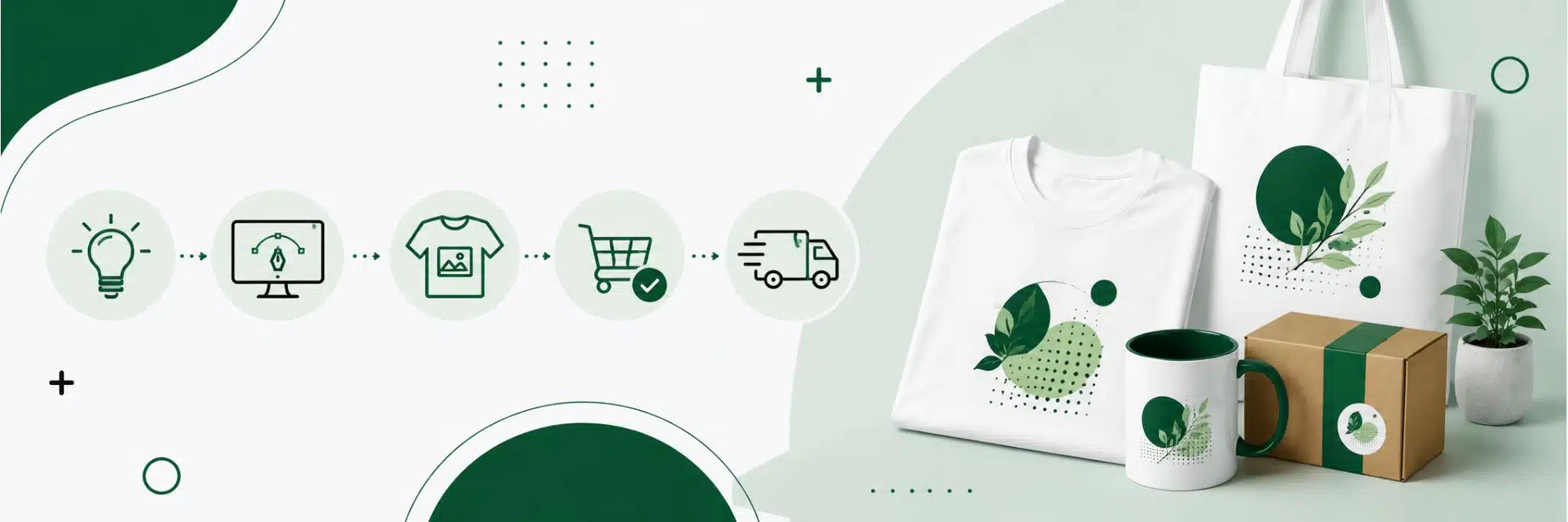
The process is straightforward. Customers place orders through an online store, the merchandise is decorated using the selected printing method, packed, and shipped directly to the customer. Businesses don’t need to forecast inventory or worry about unsold products sitting on shelves.
This approach differs significantly from traditional merchandising, where businesses invest capital upfront and hope products sell. By using on-demand merch services, organizations reduce financial risk while offering greater product flexibility and faster product launches.
Why Custom On-Demand Merchandise Is Growing So Fast
The rapid growth of ecommerce has fundamentally changed how businesses sell merchandise. Consumers expect more product choices, faster launches, and personalized shopping experiences, making traditional inventory models less practical for many organizations.
Custom on-demand merchandise solves several common business challenges. Lower startup costs allow entrepreneurs to launch products without significant investment, while producing items only after they’re sold improves cash flow and minimizes financial risk. Businesses can also introduce new collections quickly, test customer demand, and discontinue slow-selling products without losing money on leftover inventory.
Another major advantage is sustainability. Producing merchandise only after purchase reduces excess inventory and unnecessary waste, making on-demand fulfillment both a financially and environmentally smarter business model.
Who Can Sell Custom On-Demand Merchandise?
One of the greatest strengths of custom on-demand merchandise is its versatility. Nearly any organization that wants to offer branded products can benefit from this fulfillment model.
Clothing brands use it to launch new collections without purchasing inventory. Small businesses create branded merchandise to strengthen customer loyalty, while ecommerce stores continuously expand their product catalogs without increasing storage costs. Content creators and influencers use merchandise to monetize their audiences without managing fulfillment themselves.
Schools, sports teams, and nonprofits also benefit by offering apparel and fundraising products without maintaining inventory. Corporate organizations frequently use on-demand fulfillment for employee apparel, recruiting programs, and company swag while educational institutions successfully manage school spirit wear programs throughout the year.
Choosing the Right Products
A successful merchandise program starts with offering products your audience actually wants. On-demand fulfillment makes expanding your product catalog much easier because you don’t have to purchase inventory before launching.
Popular merchandise options include:
- Custom T-shirts
- Hoodies and sweatshirts
- Polo shirts
- Hats and caps
- Drinkware
- Stickers
- Event banners
- Promotional giveaways
Many businesses begin with apparel before expanding into additional branded products. Premium branded apparel helps strengthen brand identity, while customized promotional products increase visibility during events, trade shows, and marketing campaigns. Marketing materials such as stickers and banners further support product launches, retail promotions, and brand awareness initiatives without requiring businesses to manage additional inventory.
Choosing the Best Decoration Method
Selecting the right decoration method is just as important as choosing the right product. Different techniques produce different finishes, durability levels, and price points, so matching the decoration method to your merchandise helps create a better customer experience.
- Screen printing is ideal for high-volume orders featuring bold graphics and limited colors. It’s cost-effective for large runs and produces durable prints.
- Embroidery delivers a premium, textured finish that’s perfect for polos, jackets, hats, uniforms, and corporate apparel.
- DTF transfers work well for detailed, full-color artwork, gradients, and smaller production runs across a wide variety of fabrics.
- Custom patches provide a unique dimensional look that’s especially popular for hats, varsity jackets, uniforms, and lifestyle apparel.
Offering multiple decoration methods allows businesses to serve different customer needs while expanding their merchandise catalog without compromising quality.
Building an Online Store
An online store serves as the foundation of any successful custom on-demand merchandise business. Instead of collecting orders manually through emails or spreadsheets, customers can browse products, select sizes, upload artwork where needed, and complete purchases through a streamlined ecommerce experience.
Integrated ordering workflows automate much of the fulfillment process. Once an order is placed, production begins automatically, reducing manual data entry while improving order accuracy. Customers benefit from a smoother shopping experience, while businesses save time managing orders.
Professional online stores also integrate with popular ecommerce platforms, making it easier to manage inventory-free merchandise programs while supporting future business growth.
Managing Orders Without Inventory
One of the biggest advantages of custom on-demand merchandise is eliminating inventory management entirely. Products are only produced after customers or employees submit an order, removing the need for warehouses, stock forecasting, or excess inventory.
Businesses no longer have to purchase apparel months in advance or guess product demand. Employees can order company apparel individually, customers receive products directly after purchase, and organizations avoid maintaining storage space filled with unsold merchandise.
This fulfillment model also reduces waste by producing only what’s needed while simplifying shipping through direct-to-customer delivery instead of routing products through a central warehouse.
Scaling Your Merchandise Business
As demand increases, custom on-demand merchandise makes expansion much easier because businesses aren’t limited by inventory capacity. Seasonal collections, holiday campaigns, limited-edition products, and promotional launches can all be introduced without significant upfront investment.
Corporate merchandise programs also become easier to manage across multiple office locations, while growing ecommerce brands can continuously expand their product catalogs without increasing warehouse costs.
When businesses require larger production runs for trade shows, employee apparel, or promotional campaigns, bulk orders provide an efficient solution. Organizations facing tight deadlines can also rely on rush services to meet important launch dates or event schedules without sacrificing production quality.
Common Mistakes to Avoid
Even with an on-demand business model, some mistakes can slow growth and reduce profitability.
Some of the most common include:
- Launching too many products before understanding customer demand.
- Creating weak or inconsistent branding across merchandise collections.
- Choosing the cheapest supplier instead of evaluating quality, fulfillment reliability, and customer support.
- Uploading low-quality artwork, resulting in poor print results and customer dissatisfaction.
- Ignoring fulfillment experience, including shipping speed and order accuracy.
- Skipping product validation, which often leads to investing time in products customers don’t actually want.
Starting with a focused product selection, strong branding, and a dependable fulfillment partner creates a much stronger foundation for long-term business success.
How to Choose the Right Merchandise Partner
Your merchandise partner directly impacts customer satisfaction, brand perception, and your ability to scale. While pricing matters, long-term success depends on choosing a provider that consistently delivers quality products, reliable fulfillment, and responsive support.
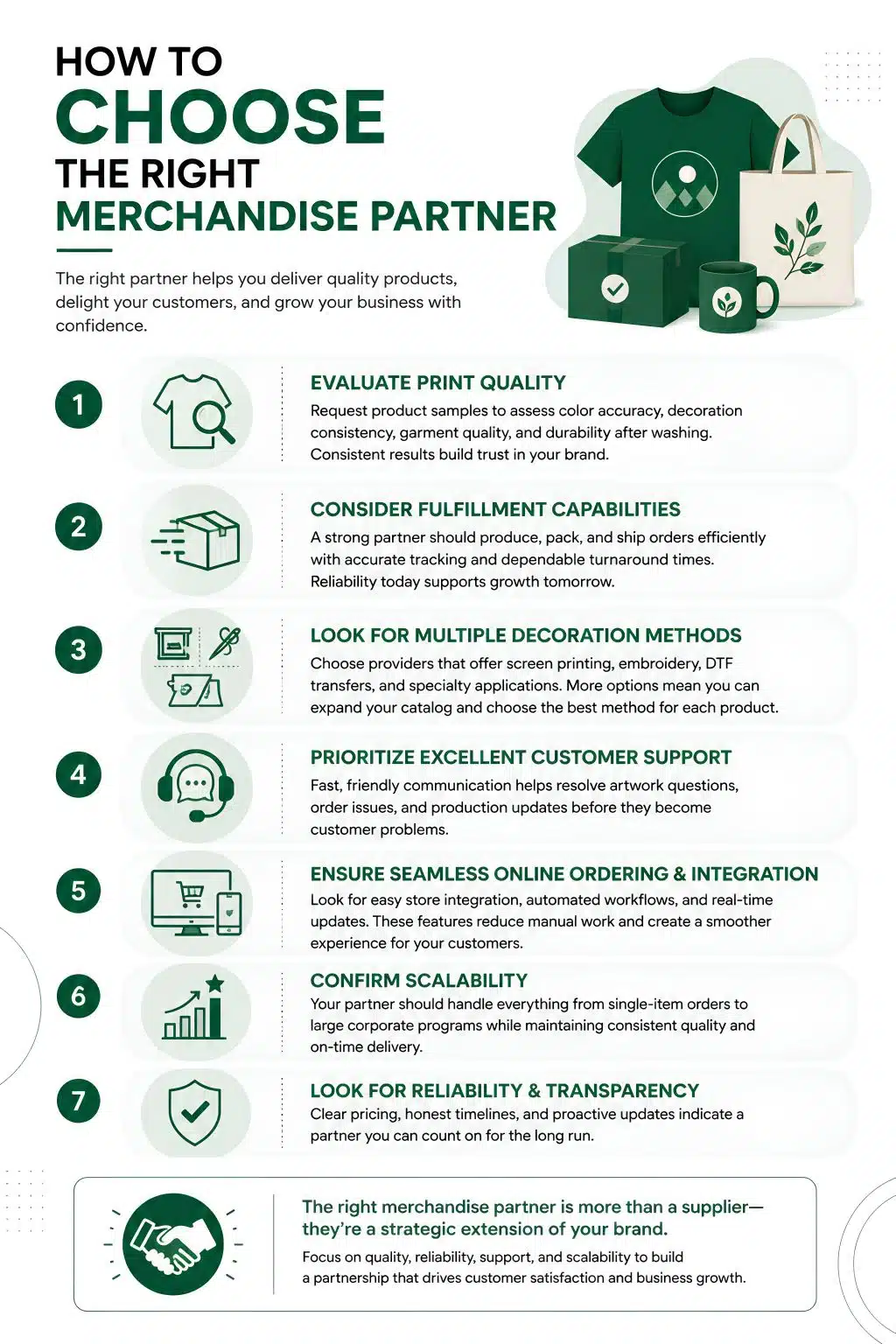
- Start by evaluating print quality. Request product samples to assess color accuracy, decoration consistency, garment quality, and durability after washing. Whether you offer apparel for customers or employee uniforms, consistent results build trust in your brand.
- Next, consider fulfillment capabilities. A strong partner should produce, pack, and ship orders efficiently while maintaining accurate order tracking and dependable turnaround times. Reliable fulfillment becomes especially important as order volume grows.
- Look for providers that support multiple decoration methods, including screen printing, embroidery, DTF transfers, and specialty applications. Having several production options allows you to expand your product catalog while selecting the most appropriate decoration method for each product.
- Excellent customer support is equally valuable. Fast communication helps resolve artwork questions, order issues, and production updates before they become customer problems.
- For ecommerce businesses, seamless online ordering and store integration should also be a priority. Automated workflows reduce manual administration while improving the overall customer experience.
- As your business expands, your fulfillment partner should demonstrate true scalability, supporting everything from single-item orders to large corporate programs without sacrificing consistency or turnaround times.
Finally, evaluate their experience serving enterprise clients. Providers offering contract decoration services often have the production infrastructure required for large branded merchandise programs, while organizations requiring labor-compliant manufacturing may benefit from union contract services. Companies needing trade show displays, retail signage, or marketing materials can also benefit from integrated wide format printing, allowing multiple branding needs to be managed through a single production partner.
To Wrap Up
Custom on-demand merchandise gives businesses a practical way to launch, grow, and manage branded products without investing in inventory. Whether you’re building an ecommerce brand, creating employee apparel, or expanding corporate merchandise programs, producing items only after orders are placed improves cash flow while reducing operational complexity.
Shirt.co supports this growth with complete on-demand fulfillment, online stores, screen printing, embroidery, DTF decoration, promotional products, branded apparel, and scalable production services. By partnering with an experienced merchandise provider, businesses can focus on growing their brand while delivering high-quality products and an outstanding customer experience.
FAQs
What is custom on-demand merchandise?
Custom on-demand merchandise is a fulfillment model where products are customized and produced only after customers place an order, eliminating the need for inventory.
How does on-demand fulfillment work?
Orders are submitted through an online store, sent directly into production, decorated, packed, and shipped without businesses storing products themselves.
Is on-demand merchandise profitable?
Yes. It lowers upfront costs, improves cash flow, reduces waste, and allows businesses to expand product offerings without inventory risk.
Can I start without inventory?
Absolutely. One of the biggest advantages of custom on-demand merchandise is launching a business without purchasing inventory in advance.
What products can I sell?
Popular products include T-shirts, hoodies, polos, jackets, hats, drinkware, promotional products, patches, stickers, banners, and accessories.
Which decoration method is best?
It depends on the product and design. Screen printing is ideal for larger runs, embroidery creates a premium finish, DTF supports detailed full-color artwork, and patches offer a unique textured appearance.
Can businesses create employee merchandise?
Yes. Many organizations use on-demand fulfillment for onboarding kits, uniforms, company swag, conferences, and employee recognition programs.
Can schools use on-demand merchandise?
Yes. Schools, universities, athletic departments, clubs, and nonprofits commonly use on-demand fulfillment for spirit wear, fundraising, and event apparel.
How do online merchandise stores work?
Customers browse products, place orders, and fulfillment begins automatically. Merchandise is produced and shipped directly without businesses managing inventory.
When should I use bulk orders instead?
Bulk ordering is most effective when product quantities, sizes, and delivery schedules are known in advance, such as large conferences, annual employee uniforms, or promotional campaigns.