

Small businesses are constantly looking for affordable ways to increase visibility, build trust, and create a stronger connection with customers. From employee uniforms to promotional merchandise, custom apparel helps businesses stay visible long after an ad campaign ends.
That is why custom screen printing for small businesses continues to be one of the most popular branding solutions today. Whether you run a local coffee shop, gym, landscaping company, startup clothing brand, or retail store, professionally printed apparel can strengthen your image while creating long-term marketing value.
Unlike short-term advertising campaigns, custom apparel works every day. Employees wearing branded shirts create a more professional appearance, while customers wearing your merchandise help promote your business naturally in public spaces, events, and social settings.
In this guide, you will learn how custom screen printing works, why it remains cost-effective for growing businesses, how to choose the right apparel, and what to consider before placing an order.
Why Custom Screen Printing for Small Businesses Still Works
Branded apparel offers much more than just uniforms. For many companies, it becomes part of their identity and customer experience.
Increased Brand Recognition
One of the biggest advantages of custom screen printing is visibility. Every printed shirt, hoodie, or hat acts as a walking advertisement for your business. Unlike paid ads that stop generating impressions once the budget ends, printed apparel can continue promoting your brand for years.
Small businesses often use custom apparel for:
- Employee uniforms
- Event merchandise
- Customer giveaways
- Retail merchandise
- Trade shows and community events
- Promotional campaigns
Consistent branding across apparel also helps customers remember your business more easily.
Professional Appearance
Uniforms help businesses appear more organized and trustworthy. Restaurants, retail stores, fitness studios, and service companies often rely on small business apparel printing to create a cleaner, more professional customer experience.
Employees wearing matching apparel:
- Improve brand consistency
- Make staff easier to identify
- Strengthen customer confidence
- Create a more unified team appearance
Affordable Long-Term Marketing
Compared to recurring advertising costs, screen printing offers excellent long-term value. Bulk apparel orders significantly reduce cost per item, making screen printing one of the most affordable branding methods for growing companies.
For example:
- A social media ad may only run for several days
- A printed hoodie may promote your business for several years
This long-term exposure makes custom business merchandise a practical investment for startups and local businesses.
How Custom Screen Printing Works From Start to Finish
Understanding the printing process helps businesses make better decisions when choosing apparel, artwork, and order quantities.
What Is Screen Printing?
Screen printing is a printing method where ink is pushed through a mesh screen onto fabric. Each color in the design typically requires its own screen, which is why simpler designs are often more cost-effective.
The process creates bold, durable prints that hold up well after repeated washing and daily wear.
Because of its durability and vibrant color output, screen printing remains one of the most widely used methods for:
- T-shirts
- Hoodies
- Tote bags
- Uniforms
- Promotional apparel
- Event merchandise
The Screen Printing Process Step by Step
1. Artwork Preparation
Every project starts with artwork setup. The design is digitally prepared and separated into individual color layers.
The best file formats for screen printing include:
- AI
- EPS
- SVG
- High-resolution PDF files
High-quality artwork is important because blurry or low-resolution files can reduce print clarity.
For best results:
- Use bold graphics
- Keep text readable
- Avoid overly detailed designs
- Limit unnecessary color complexity
2. Screen Creation
Once the artwork is finalized, the printer creates screens for each color in the design. A mesh screen is coated with light-sensitive emulsion and exposed under UV light.
The exposed screen creates a stencil that allows ink to pass through only in specific areas.
3. Ink Application
Ink is applied using a squeegee that pushes the ink through the screen and onto the garment below.
Each color is printed individually and layered carefully for accurate alignment.
4. Heat Curing
After printing, garments move through a curing process where heat permanently sets the ink into the fabric.
Proper curing is extremely important because under-cured ink can crack, peel, or wash out over time.
5. Final Quality Inspection
Before packaging, professional printers inspect:
- Color consistency
- Print alignment
- Ink coverage
- Garment defects
Reliable quality control helps ensure every order maintains consistent branding standards.
Why Screen Printing Remains Popular for Small Businesses
Despite the growth of digital printing methods, screen printing continues to dominate the apparel industry for several reasons.
Durable Prints
Screen printing creates thick, vibrant ink layers that last through repeated washing and daily wear. This durability makes it ideal for uniforms, promotional merchandise, and work apparel.
Cost Efficiency for Bulk Orders
As order quantities increase, the cost per item drops significantly. This makes custom screen printing for small businesses especially valuable for larger team orders, events, and merchandise collections.
Vibrant Colors
Screen printing produces rich, highly opaque colors that stand out on both light and dark garments.
Versatility
Businesses can print on a wide range of products, including:
- Shirts
- Sweatshirts
- Hats
- Tote bags
- Aprons
- Workwear
This flexibility allows companies to create complete branded merchandise collections.
Choosing the Right Apparel for Your Business
The type of garment you choose affects both print quality and customer perception.
T-Shirts
T-shirts remain the most popular option because they are affordable, versatile, and easy to distribute.
They work well for:
- Staff uniforms
- Promotional giveaways
- Retail merchandise
- Event apparel
Hoodies and Sweatshirts
Hoodies create a more premium merchandise option and are especially popular with gyms, lifestyle brands, and streetwear startups.
Polo Shirts
Polos provide a more professional appearance for businesses that interact directly with customers.
Tote Bags and Accessories
Tote bags offer affordable branding with long-term visibility since customers often reuse them regularly.
In the next section, we will explore how to choose the right printing method, reduce production costs, improve design quality, and select reliable screen printing services for long-term business growth.
Custom Screen Printing for Small Businesses vs Other Printing Methods
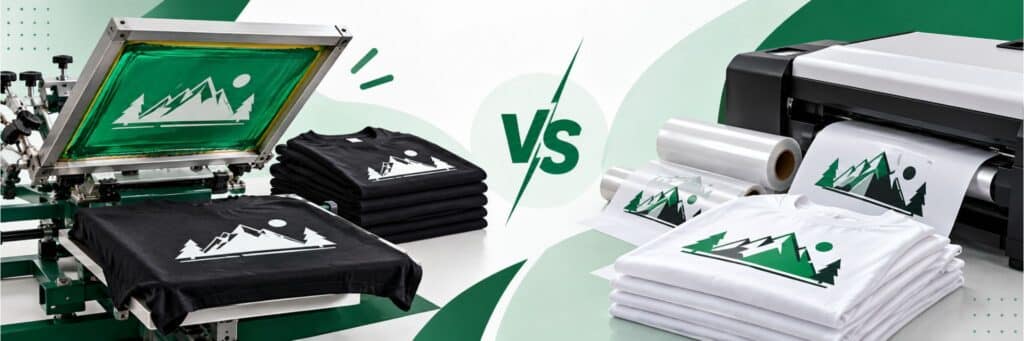
Choosing the right printing method is one of the most important decisions for any apparel project. While screen printing remains the industry standard for bulk orders, other methods like DTG and DTF printing also offer advantages depending on your goals, design complexity, and order size.
Understanding these differences helps businesses avoid unnecessary production costs while improving print quality and long-term durability.
Traditional Screen Printing
Traditional screen printing is best known for producing vibrant, durable prints at scale. Because each color requires its own screen setup, this method becomes more cost-effective as order quantities increase.
Best Uses for Screen Printing
- Employee uniforms
- Promotional apparel
- Event merchandise
- Bulk t-shirt orders
- Simple logo-based graphics
- Long-term branded apparel
Advantages of Screen Printing
- Lower cost per shirt for large orders
- Bold and vibrant colors
- Long-lasting durability
- Professional finish
- Excellent opacity on dark garments
Limitations
- Setup fees for small runs
- Less efficient for highly detailed artwork
- More expensive for multi-color designs
For many businesses, screen printing offers the best balance between quality, durability, and affordability.
Direct-to-Garment (DTG) Printing
DTG printing works similarly to an inkjet printer but prints directly onto fabric.
Best Uses for DTG
- Small orders
- Full-color artwork
- Detailed illustrations
- Print-on-demand apparel
Advantages
- No screen setup required
- Unlimited color capability
- Excellent detail reproduction
- Fast for one-off orders
Limitations
- Higher cost per item
- Less durable than screen printing
- Slower production for bulk quantities
DTG is often ideal for startups testing new designs before committing to large inventory orders.
Direct-to-Film (DTF) Printing
DTF printing has become increasingly popular because it allows businesses to print designs onto transfer film and apply them to garments later using heat.
Best Uses for DTF
- Small production runs
- On-demand printing
- Multi-material printing
- Complex graphics
Advantages
- Works on many fabric types
- Minimal setup requirements
- Good for detailed artwork
- Flexible production workflow
Limitations
- Print feel can feel heavier
- Durability varies by production quality
- Less cost-efficient for very large runs
For businesses handling frequent small orders, DTF can offer flexibility without large setup costs.
Heat Transfer Printing
Heat transfer printing uses heat and pressure to apply graphics to garments.
Best Uses
- Names and numbers
- Sports uniforms
- Small custom projects
- Quick turnaround orders
Although useful in some situations, heat transfer methods generally do not offer the same durability as professional screen printing.
Which Printing Method Is Best for Small Businesses?
The right method depends on:
- Order quantity
- Artwork complexity
- Budget
- Production timeline
- Fabric type
Screen Printing Is Best For:
- Bulk apparel orders
- Durable branding
- Simple graphics
- Long-term merchandise programs
DTG and DTF Are Best For:
- Small runs
- Highly detailed designs
- Test merchandise
- Print-on-demand operations
For many growing brands, combining methods can create the most flexible production strategy.
Design Tips That Improve Screen Printing Results
Great artwork can significantly improve the final appearance of printed apparel. Businesses often focus heavily on garment selection while overlooking design optimization, which can lead to poor print clarity or higher production costs.
Keep Designs Simple
Simple designs usually print cleaner and remain more readable from a distance.
Strong screen printing designs often include:
- Bold shapes
- Thick outlines
- Readable typography
- Limited color palettes
Overly complex artwork may increase setup costs while reducing print consistency.
Use High-Quality Artwork Files
Professional screen printing services usually recommend vector-based artwork because vectors maintain sharp edges at any size.
Recommended File Formats
- AI
- EPS
- SVG
- High-resolution PDF
If raster images are used, files should typically be:
- At least 300 DPI
- Sized correctly before submission
- Free from compression artifacts
Low-resolution graphics often produce blurry or pixelated prints.
Choose Colors Carefully
Color contrast plays a major role in readability and visual impact.
Best Practices
- Use light ink on dark garments
- Use dark ink on light garments
- Avoid low-contrast color combinations
- Stay consistent with brand colors
Limiting designs to one to four colors can also help reduce production costs.
Think About Print Placement
Strategic print placement affects both visibility and professionalism.
Popular Print Locations
- Center chest
- Left chest logo
- Full back print
- Sleeve prints
- Upper back neck area
Employee uniforms often use smaller chest logos, while promotional merchandise may feature larger graphic designs.
Common Design Mistakes Small Businesses Should Avoid
Even high-quality garments can look unprofessional if the artwork is poorly prepared.
Using Low-Resolution Images
Poor-quality files create blurry edges and uneven print details.
Overcomplicating Artwork
Too many colors and intricate gradients can increase setup time and production costs.
Choosing Tiny Text
Small text may become unreadable once printed on fabric.
Ignoring Garment Color
Ink colors may appear differently depending on garment fabric and material.
Skipping Test Proofs
Approving a sample proof before production helps identify alignment or color issues early.
Understanding Pricing for Custom Screen Printing for Small Businesses
One reason businesses choose screen printing is scalability. As quantities increase, production becomes significantly more affordable.
However, several factors influence total pricing.
Number of Garments
Larger orders lower the cost per shirt because setup expenses are distributed across more pieces.
Number of Ink Colors
Each additional color usually requires:
- A separate screen
- Extra setup time
- Additional labor
Simpler designs often reduce overall costs.
Garment Type
Premium apparel costs more than standard cotton t-shirts. Hoodies, jackets, and performance fabrics also increase pricing.
Print Locations
Additional print areas increase labor and setup costs.
For example:
- Front print only = lower cost
- Front + back + sleeve prints = higher cost
Specialty Inks
Premium finishes such as:
- Puff ink
- Metallic ink
- Glow-in-the-dark ink
- Water-based ink
may increase production costs.
In the next section, we will cover how to choose reliable screen printing services, avoid expensive ordering mistakes, explore eco-friendly printing options, and maximize long-term value from custom business merchandise.
How to Choose Reliable Screen Printing Services for Your Business
Selecting the right printing partner is one of the most important steps in building a successful branded apparel strategy. Even with strong designs and quality garments, the wrong provider can lead to inconsistent prints, delayed timelines, and unnecessary costs.
A reliable provider of screen printing services ensures your brand looks professional every time, whether you’re ordering 24 shirts or 2,000 units.
What to Look for in a Screen Printing Partner
Strong Portfolio and Consistent Quality
Before placing an order, always review previous work.
A professional printer should have:
- Clean, sharp print samples
- Consistent color reproduction
- Experience across multiple garment types
- Clear examples of both simple and complex designs
Consistency matters more than one-off good results. Small businesses should prioritize printers that can maintain quality across repeated orders.
Reliable Turnaround Times
Production timelines can directly affect marketing campaigns, events, and product launches.
Typical screen printing timelines include:
- Standard orders: several days to 2 weeks
- Large bulk orders: 2–4 weeks depending on complexity
- Rush orders: additional fees may apply
Always confirm turnaround expectations before approving artwork.
Support With Artwork and Setup
Many small businesses do not have print-ready files. A good printing partner should help with:
- Artwork cleanup
- Color separation
- File formatting for print accuracy
- Proof approval before production
This support is especially important for screen printing for startups, where branding is still evolving.
Flexible Order Sizes
Some printers focus only on large bulk orders, while others specialize in small business needs.
Look for providers that can handle:
- Small test batches
- Medium-sized team orders
- Large promotional runs
- Reorders with consistent quality
This flexibility helps businesses scale without switching vendors.
Questions to Ask Before Placing an Order
To avoid unexpected issues, small businesses should always ask key questions:
- What is your minimum order quantity?
- Do you offer sample prints or digital proofs?
- Can you match previous order colors exactly?
- What file formats do you require?
- Do you help with design adjustments?
- What is your reprint or mistake policy?
Clear communication at this stage prevents costly errors later.
Why Professional Screen Printing Services Matter
Working with experienced printers reduces risk and improves long-term brand consistency.
Benefits include:
- More accurate color matching
- Better fabric and ink recommendations
- Reduced production errors
- Higher durability prints
- Scalable ordering for future growth
For growing companies, consistency across all custom business merchandise is essential for building trust and recognition.
Common Mistakes Small Businesses Should Avoid
Even strong branding strategies can fail due to avoidable ordering mistakes.
Ordering Too Few Items
Small orders often have higher per-unit costs because setup fees are spread across fewer garments. Planning ahead helps reduce long-term expenses.
Choosing Low-Quality Apparel
Cheap garments may save money initially but can negatively impact brand perception. Customers associate apparel quality with brand quality.
Ignoring Future Reorders
Not all blank apparel styles remain available long-term. Choosing widely available garments ensures consistency for future restocks.
Skipping Proof Approval
Digital mockups are essential.
Always review:
- Spelling
- Color accuracy
- Placement
- Size scaling
One small error can affect an entire batch.
Eco-Friendly Trends in Custom Screen Printing
Modern customers are increasingly aware of sustainability. Many businesses now prefer environmentally responsible printing options.
Sustainable Apparel Options
- Organic cotton garments
- Recycled polyester blends
- Ethically sourced fabrics
Eco-Friendly Ink Choices
- Water-based inks (softer and more breathable)
- Low-impact plastisol alternatives
- PVC-free ink systems
Sustainable printing not only benefits the environment but also strengthens brand reputation with eco-conscious customers.
Screen Printing for Different Industries
Custom apparel is not limited to retail brands. Many industries use small business apparel printing as part of their daily operations.
Restaurants and Cafés
- Staff uniforms
- Aprons and caps
- Branded merchandise for customers
Construction and Landscaping
- Durable workwear
- Safety-friendly visibility apparel
- Company identification uniforms
Fitness and Wellness Brands
- Gym apparel
- Trainer uniforms
- Retail fitness merchandise
Nonprofits and Events
- Volunteer shirts
- Fundraising apparel
- Awareness campaign merchandise
Each industry uses screen printing differently, but the goal remains the same: visibility, professionalism, and recognition.
Tips for First-Time Orders
If you are ordering custom apparel for the first time, start simple.
Best Practices
- Begin with one or two color designs
- Order slightly extra inventory for future use
- Test fabric types before large production runs
- Confirm sizing breakdowns in advance
- Approve artwork carefully before production
Starting small helps reduce risk while you refine your branding strategy.
Final Thoughts
Custom screen printing for small businesses remains one of the most effective and affordable ways to build brand identity, increase visibility, and create professional merchandise. From employee uniforms to retail products, screen printing delivers long-lasting value that extends far beyond a single marketing campaign.
Success comes down to three key factors:
- Strong, simple design choices
- High-quality garments
- A reliable printing partner
When done correctly, custom apparel becomes more than just clothing—it becomes a powerful branding tool that continuously promotes your business in the real world.
For small businesses ready to scale, investing in consistent, high-quality printing is not just a design decision—it is a long-term growth strategy.
FAQs
1. What is custom screen printing for small businesses?
Custom screen printing is a printing method where ink is pressed through a mesh screen onto apparel to create durable, high-quality branded clothing for small businesses, including uniforms, merchandise, and promotional items.
2. How much does custom screen printing cost for small businesses?
Costs depend on quantity, number of colors, garment type, and print locations. Larger bulk orders reduce the cost per item, making screen printing more affordable for startups and growing businesses.
3. What is the minimum order for screen printing?
Most screen printing services require a minimum order of 12–24 pieces. Some providers may offer smaller test runs, but bulk orders are more cost-effective.
4. How long does screen printing last on clothing?
Screen printed designs are highly durable and can last for years when properly washed and cared for, thanks to heat-curing and high-quality ink adhesion.
5. What file type is best for screen printing?
Vector files such as AI, EPS, SVG, or high-resolution PDFs (300 DPI) are ideal because they maintain sharp edges and ensure accurate printing results.