



So, you have got a custom t-shirt printing idea, but don’t know how to start? Custom t-shirt printing in 2026 offers immense opportunities for creators, brands, and businesses. Whether you are exploring how to start a t-shirt business in 2026 or simply want to design unique apparel, today’s tools and printing technologies make it easier to turn ideas into wearable products.
From advanced printing techniques to sustainable fabrics and on-demand platforms, the options are more flexible and accessible. However, need the right direction to make prudent investments and start your business successfully. This guide on custom t-shirt printing helps you make the right decision.
From exploring the best t-shirt printing methods, key industry trends, to practical steps to bring your designs to life with confidence and clarity, this guide covers all you need to start. Let’s get started!
What Custom T-shirt Printing Actually Means
Custom t-shirt printing in 2026 refers to the process of creating personalized designs on t-shirts using modern printing technologies that turn digital artwork into wearable clothing. It allows individuals, brands, and businesses to print logos, graphics, or text that reflect their identity, creativity, or marketing message.
With the growth of print-on-demand systems, it has become easier to design and sell apparel without holding inventory or managing large upfront costs. This shift has made t-shirt customization more accessible for beginners and entrepreneurs exploring fashion or merchandise businesses.
Today, the industry is supported by flexible production models and advanced tools that simplify design, printing, and fulfillment. The demand for custom t-shirts arises for many reasons, such as when companies are looking for promo products to promote their brand.
The increasing demand for on-demand merch is also a significant driver for a boost in the custom t-shirt printing business. The U.S. custom t-shirt printing market is experiencing strong and consistent growth, driven by increasing demand for personalized apparel and brand-focused merchandise.
According to Grand View Research, the market was valued at approximately USD 857.5 million in 2023 and is projected to reach around USD 1.84 billion by 2030, growing at a CAGR of 11.8%
Understanding the Nuts and Bolts of Custom T-shirt Printing
Custom t-shirt printing is the foundation of the modern apparel customization industry that turn plain shirts into branded apparel. Understanding the basics of custom t-shirt printing involves knowing how it works, what methods to use, and where to begin.
From choosing the right printing method, fabric, and design approach to selecting a reliable fulfillment partner, custom t-shirt printing involves multiple moving parts.
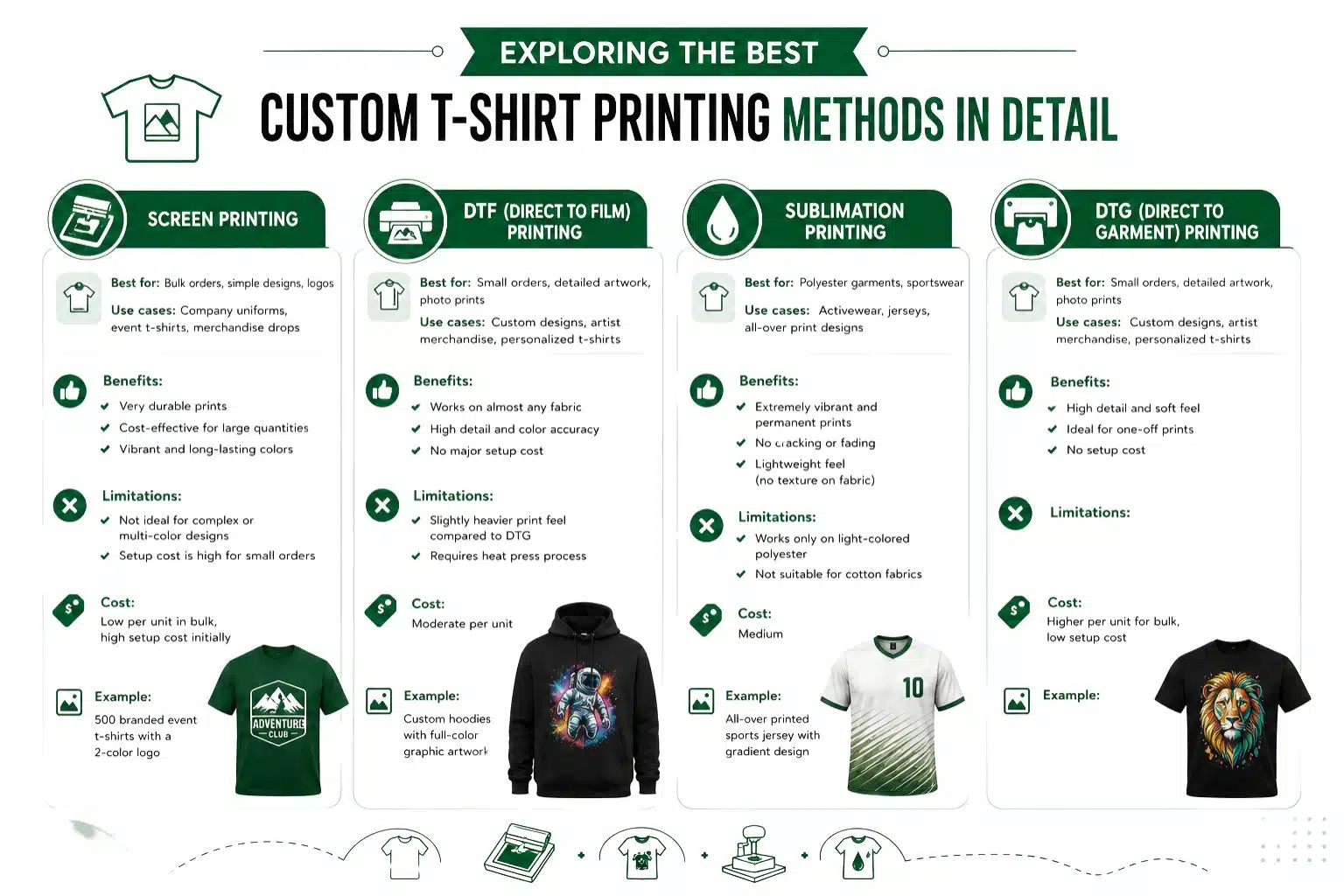
The best printing methods used for customized t-shirt printing in 2026 are:
- Screen printing
- DTF (Direct to Film) printing
- Sublimation printing
- DTG (Direct to Garment) printing
Each method offers different levels of detail, cost efficiency, and durability. Mastering these fundamentals ensures better print quality, fewer production errors, and stronger customer satisfaction in your custom t-shirt printing journey.
Whether you are looking to produce branded apparel or custom t-shirts for an event, these methods are suitable to meet your goals. You can opt for bulk orders from a reliable printing partner for scaling your apparel business effectively.
Exploring the Best Custom T-shirt Printing Methods in Detail
Choosing the right method for custom t-shirt printing plays a major role in print quality, cost efficiency, and overall product durability. Each printing technique works differently and is best suited for specific design types, order sizes, and fabric choices. Below is a simple breakdown of the most widely used methods in the apparel industry, helping you decide what fits your needs best.
Screen Printing
Screen printing is one of the oldest and most reliable methods in apparel production. It uses stencils (screens) to apply layers of ink onto fabric. In this method, ink is pushed through screens onto a fabric with force to apply the design. It is suitable for high-volume orders as printing bulk becomes cost-effective. Businesses can choose contact screen printing services to produce custom t-shirts in bulk with significant discounts per print.
Best for: Bulk orders, simple designs, logos
Use cases: Company uniforms, event t-shirts, merchandise drops
Benefits:
- Very durable prints
- Cost-effective for large quantities
- Vibrant and long-lasting colors
Limitations:
- Not ideal for complex or multi-color designs
- Setup cost is high for small orders
Cost: Low per unit in bulk, high setup cost initially
Example: 500 branded event t-shirts with a 2-color logo
Learn more about screen printing: screen printing guide
DTF (Direct to Film) Printing
DTF printing is a modern method where designs are printed on a special PET film and then transferred to fabric using heat. DTF has opened business opportunities even for small creators or custom apparel shops, as many printers serve with a low minimum or no minimum order. Quick setup makes it easy to start a custom apparel business. With the right printing partner, you can also order custom DTF transfers that are ready-to-press transfers that you can just print and ship to customers without heavy investments in equipment and materials.
Best for: Complex designs, small to medium orders
Use cases: Streetwear brands, custom merchandise, multi-color graphics
Benefits:
- Works on almost any fabric
- High detail and color accuracy
- No major setup cost
Limitations:
- Slightly heavier print feel compared to DTG
- Requires heat press process
Cost: Moderate per unit
Example: Custom hoodies with full-color graphic artwork
Sublimation Printing
Sublimation printing uses heat to turn ink into gas, which bonds directly with polyester fabric. This printing method is highly effective for polyester garments, as the special ink that turns into a gas deeply embeds into the fabric of a garment. So, the prints are highly durable and fade-resistant.
Best for: Polyester garments, sportswear
Use cases: Activewear, jerseys, all-over print designs
Benefits:
- Extremely vibrant and permanent prints
- No cracking or fading
- Lightweight feel (no texture on fabric)
Limitations:
- Works only on light-colored polyester
- Not suitable for cotton fabrics
Cost: Medium
Example: All-over printed sports jersey with gradient design
Check out the comparison of sublimation vs screen printing to see how they differ and which one is better.
DTG (Direct to Garment) Printing
DTG printing works like an inkjet printer for fabric, directly applying ink onto cotton garments. So, instead of using a medium like transfer paper or a sheet, the ink is directly applied to the apparel’s fabric and bonds with it. It is a faster method than DTF, screen printing, or sublimation, as ink gets directly from the printer to the fabric.
Best for: Small orders, detailed artwork, photo prints
Use cases: Custom designs, artist merchandise, personalized t-shirts
Benefits:
- High detail and soft feel
- Ideal for one-off prints
- No setup cost
Limitations:
- Slower for bulk production
- Works best on 100% cotton
Cost: Higher per unit for bulk, low setup cost
Example: Single custom t-shirt with detailed artwork or photo print
Apparel Printing Methods Comparison
Compare the most popular custom apparel printing methods to choose the best option for your project.
| Printing Method | Best For | Print Quality | Cost Efficiency | Fabric Compatibility | Ideal Order Size |
|---|---|---|---|---|---|
| 🎨 Screen Printing | Bulk orders, simple designs | ⭐⭐⭐⭐☆ High (Bold Colors) |
⭐⭐⭐⭐⭐ | Cotton & Blends | Large |
| 🖨️ DTF Printing | Detailed, multi-color designs | ⭐⭐⭐⭐⭐ Very High |
⭐⭐⭐☆☆ | Almost All Fabrics | Small to Medium |
| 🌈 Sublimation | Sportswear, all-over prints | ⭐⭐⭐⭐⭐ Very Vibrant |
⭐⭐⭐☆☆ | Polyester Only | Medium |
| 🖼️ DTG Printing | Custom, small orders | ⭐⭐⭐⭐⭐ Photo Quality |
⭐⭐☆☆☆ | Cotton Only | Small |
Screen printing is the most cost-effective choice for large orders, DTF printing offers excellent versatility across almost all fabrics, sublimation delivers vibrant permanent prints on polyester, and DTG printing is ideal for photo-quality artwork and one-off custom apparel.
Final Takeaway
Each custom t-shirt printing method has its own strengths. Screen printing is best for bulk efficiency, DTF offers flexibility, sublimation is ideal for polyester sportswear, and DTG is perfect for detailed small orders. Choosing the right method depends on your design, fabric, and order size, making it important to evaluate your goals before production.
Step-by-Step Guide to Creating Successful Custom T-Shirts
Whether you’re launching a clothing brand, creating merchandise, or learning how to design a shirt for print on demand, the process involves more than simply uploading artwork and hitting print. The best results come from combining strong design ideas, the right tools, suitable fabrics, and production methods that align with your goals. Here’s a practical step-by-step approach to help you create custom t-shirts people actually want to wear.
Step 1: Start with a Clear Purpose and Design Direction
Before opening any design software, determine why you’re creating the shirt and who will wear it.
Many beginners jump straight into designing without understanding their audience. However, successful custom t-shirt printing projects begin with a clear purpose.
Ask yourself:
- Is this for a brand, event, team, or business?
- Who is the target audience?
- What style fits their preferences?
- What message should the design communicate?
Find Design Inspiration Strategically
When looking for design inspiration for custom t-shirts, don’t simply copy trends. Study what works and identify patterns.
Good sources of inspiration include:
- Streetwear brands
- Social media communities
- Sports teams
- Vintage apparel
- Music and entertainment culture
- Typography trends
- Nature and travel themes
The strongest t-shirt designs often communicate a single idea clearly rather than trying to include too many elements.
Quick Design Validation Test
Before moving forward, ask:
- Can someone understand the design in 3 seconds?
- Would someone wear it more than once?
- Does it look good both online and in person?
If the answer is yes, you’re ready for the next step.
Step 2: Create Print-Ready Artwork
A great idea can still fail if the artwork isn’t prepared correctly.
One of the biggest reasons for poor print quality is low-resolution artwork.
Use Professional T-Shirt Design Tools
Choosing the right t-shirt design tools depends on your experience level.
Popular options include:
- Canva
- Adobe Illustrator
- Adobe Photoshop
- Photopea
- Kittl
- CorelDRAW
- Affinity Designer
Vector-based tools are particularly useful because designs can be resized without losing quality.
Prepare High-Quality Files
Professional printers typically require:
- High-resolution t-shirt design files (300 DPI)
- Transparent backgrounds
- Correct color profiles
- Large canvas dimensions
- Vector files when possible
Avoid These Common Design Mistakes
- Using screenshots
- Stretching small images
- Overcrowding the design
- Tiny unreadable text
- Poor color contrast
Using high-resolution images for printing ensures sharper details, cleaner edges, and more professional results.
Step 3: Choose the Right Printing Method
Different designs perform better with different printing technologies.
For example:
- Large bulk orders often benefit from screen printing.
- Detailed artwork works well with DTF or DTG.
- Sportswear typically pairs well with sublimation.
The wrong printing method can increase costs or reduce durability.
When selecting a print method, consider:
- Order quantity
- Number of colors
- Fabric type
- Budget
- Design complexity
Businesses with specialized decoration requirements often combine printing with embroidery, patches, or other finishing techniques through professional contract decoration services to create more premium apparel collections.
Step 4: Select the Best Fabric for Your Design
Fabric selection directly affects comfort, appearance, and print performance. Understanding 100% cotton vs polyester blends is essential before production.
100% Cotton
Best for:
- DTG printing
- Soft retail-quality shirts
- Fashion brands
Advantages:
- Soft feel
- Excellent print absorption
- Natural fibers
Limitations:
- Can shrink if not pre-treated
- May wrinkle more easily
Polyester
Best for:
- Sublimation printing
- Athletic apparel
- Performance wear
Advantages:
- Durable
- Moisture-wicking
- Lightweight
Limitations:
- Less suitable for certain print methods
Cotton-Poly Blends
Many apparel brands consider these the best fabric blends for custom printing because they combine comfort and durability.
Advantages:
- Reduced shrinkage
- Better shape retention
- Comfortable everyday wear
Choosing the right fabric can significantly improve both print longevity and customer satisfaction.
Step 5: Add Finishing Touches That Increase Perceived Value
Many successful apparel brands go beyond basic printing.
Consider adding:
- Custom neck labels
- Sleeve prints
- Woven tags
- Packaging inserts
- Decorative patches
Small details can make a shirt feel more premium and memorable. For example, custom patches can add texture and brand identity without relying solely on printed graphics.
Step 6: Order Samples Before Full Production
One of the most overlooked steps in custom t-shirt printing is sample testing.
Always review a sample before placing a large order.
Check:
- Print quality
- Color accuracy
- Fabric feel
- Sizing consistency
- Wash durability
- Design placement
Testing samples helps identify issues before they become expensive mistakes.
Step 7: Think Beyond the First Sale
The best custom t-shirts aren’t just visually appealing—they’re products people want to wear repeatedly.
Ask yourself:
- Is the design timeless or trend-dependent?
- Will the print remain durable after washing?
- Does the shirt feel comfortable enough for regular wear?
- Does it represent the brand consistently?
Creating a successful custom t-shirt is about balancing design, production quality, fabric choice, and customer experience. When all of these elements work together, you create more than a printed garment—you create a product that people are excited to wear, share, and buy again.
How to Price Custom T-Shirts for Profit and Growth
Many new apparel brands focus heavily on design and printing but overlook pricing strategy. The reality is that even a great-looking shirt can fail as a business if it’s priced incorrectly. The goal is not simply to cover costs—it’s to create enough margin to support marketing, operations, future product launches, and business growth.
Understand Your True Cost Per Shirt
Before setting a selling price, calculate every expense involved in production.
For example, a custom t-shirt might include:
Custom T-Shirt Cost Breakdown
A sample cost estimate for producing and delivering one custom printed T-shirt.
| 💲 Cost Component | Estimated Cost |
|---|---|
| 👕 Blank T-Shirt | $7.00 |
| 🎨 Printing | $5.00 |
| 📦 Packaging | $1.00 |
| 🚚 Shipping | $4.00 |
| 💳 Transaction Fees | $1.00 |
| ✅ Total Cost | $18.00 |
To determine a profitable selling price, add your desired profit margin on top of the total production cost. Many apparel brands aim for a retail price that is 2× to 3× the total cost, depending on their market and brand positioning.
Many first-time sellers only consider the shirt and printing costs, forgetting expenses like packaging, payment processing, returns, and shipping.
Use a Margin-Based Pricing Approach
A common mistake is pricing a shirt at $22 because it costs $18 to produce. That leaves very little room for profit.
Instead, many successful apparel brands aim for a gross margin of 50% to 70%.
For example:
- Production Cost: $18
- Retail Price: $35
- Gross Profit: $17
This extra margin helps cover advertising, influencer partnerships, website costs, and unexpected expenses.
Case Study: Two Different Pricing Strategies
Imagine two new clothing brands selling similar graphic tees.
Brand A
- Production Cost: $18
- Selling Price: $22
- Profit Per Shirt: $4
After selling 100 shirts, Brand A earns only $400 before marketing expenses.
Brand B
- Production Cost: $18
- Selling Price: $35
- Profit Per Shirt: $17
After selling the same 100 shirts, Brand B generates $1,700 in profit.
Both brands sell the same number of shirts, but one has significantly more resources to reinvest in growth.
Increase Revenue Without Raising Prices
If customers hesitate at higher prices, consider increasing order value instead.
Effective strategies include:
- Offering “Buy 2, Save 10%” bundles
- Creating matching apparel collections
- Providing free shipping above a certain order value
- Selling limited-edition designs at premium pricing
- Including add-ons such as hats, tote bags, or stickers
For example, increasing the average order value from $35 to $50 across 200 monthly orders generates an additional $3,000 in monthly revenue without attracting a single new customer.
Price According to Your Brand Positioning
Not every custom t-shirt should be priced the same.
A basic promotional t-shirt may sell for $15–$25, while premium streetwear, artist collaborations, or limited-edition releases often command $40–$80 or more. Customers are often willing to pay higher prices when they perceive greater value through quality materials, unique designs, strong branding, or exclusivity.
The most successful custom t-shirt businesses don’t compete solely on price. They create products that customers believe are worth paying more for.
How to Choose the Right Print Partner for Custom T-Shirt Printing
The success of your custom t-shirt printing project depends not only on your design but also on the print partner you choose. A reliable print and fulfillment partner can help you maintain consistent quality, meet deadlines, and deliver a better customer experience. On the other hand, choosing the wrong provider can lead to print defects, delayed shipments, and unhappy customers.
Look Beyond Price
While cost is important, the cheapest option is not always the best. Compare providers based on print quality, production capabilities, turnaround times, and customer support. A slightly higher price may be worth it if it results in better products and fewer issues.
Evaluate Printing Capabilities
Not every print shop offers the same services. Make sure your partner supports the printing methods you need, whether that’s screen printing, DTF, DTG, sublimation, embroidery, or specialty decoration techniques. This flexibility becomes especially valuable as your product line grows.
Ask for Samples
Before committing to a large order, request samples. Examine print quality, color accuracy, fabric feel, and durability after washing. A sample order often reveals more than any sales presentation.
Assess Fulfillment and Scalability
If you’re selling online, consider whether the provider offers fulfillment services. A strong fulfillment partner can handle inventory management, packing, and shipping, allowing you to focus on marketing and growing your brand. Make sure they can also scale production as demand increases.
Check Communication and Support
Reliable communication is critical when deadlines matter. Look for a print partner that provides clear updates, responsive support, and dedicated account management whenever possible.
Verify Experience and Reputation
Review testimonials, case studies, and customer feedback. An experienced print service provider is more likely to have established quality-control processes and the expertise to handle complex orders.
The right print and fulfillment partner should feel like an extension of your business—helping you deliver consistent quality, reliable service, and a better experience for every customer.
To Wrap Up
Custom t-shirt printing has never been more accessible, whether you’re launching a clothing brand, creating promotional merchandise, or selling through a print-on-demand store. The key to success lies in understanding your audience, choosing the right printing method, selecting quality garments, and working with a reliable production partner.
As printing technologies continue to evolve, businesses and creators have more options than ever to produce high-quality apparel without massive upfront investments. By combining strong design, smart pricing, and dependable fulfillment, you can create custom t-shirts that not only look great but also support long-term business growth and customer loyalty.
Frequently Asked Questions
1. What file format is best for custom t-shirt printing?
Vector files such as AI, EPS, SVG, and PDF are generally preferred because they can be scaled without losing quality. For raster artwork, use PNG files with transparent backgrounds and a minimum resolution of 300 DPI to ensure sharp, professional prints.
2. Can I sell custom t-shirts without holding inventory?
Yes. Print-on-demand platforms allow you to sell custom t-shirts without purchasing inventory upfront. Products are printed only after an order is placed, reducing startup costs and eliminating the need for warehousing or stock management.
3. How long does a custom printed t-shirt typically last?
A high-quality custom printed t-shirt can last 50–100 washes or more, depending on the printing method, fabric quality, washing habits, and drying conditions. Proper care, such as washing inside out in cold water, can significantly extend print life.
4. Are eco-friendly options available for custom t-shirt printing?
Yes. Organic cotton, recycled polyester, water-based inks, and sustainable packaging is available. Eco-friendly custom apparel is increasingly popular among consumers and can help brands appeal to environmentally conscious buyers.
5. What is the biggest mistake people make when ordering custom t-shirts?
One of the most common mistakes is focusing only on price while overlooking garment quality, print durability, and fulfillment reliability. A cheaper shirt may reduce costs initially, but poor print quality and customer dissatisfaction often create bigger expenses in the long run.