

What is the minimum order for screen printing? This is the question you want an answer to when looking for custom screen printing services. Whether you’re ordering shirts for a sports team, school fundraiser, corporate apparel program, promotional merchandise, or an ecommerce brand, understanding minimum quantities can help you control costs and avoid unnecessary inventory.
Unlike digital printing methods, screen printing involves setup costs that remain the same regardless of how many garments you print. That’s why production efficiency, pricing, and order volume are closely connected. This guide explains how minimum order quantities work, when screen printing becomes the most economical option, and how to choose the right order size for your specific needs. This answers your question of how many shirts you need for screen printing.
Key Takeaways
- Most professional screen printers recommend a minimum order of 12–24 shirts for cost efficiency.
- Minimum order quantities exist because setup time and screen preparation create fixed production costs.
- Larger orders significantly reduce the cost per shirt by spreading setup expenses across more garments.
- Small orders are still possible, but alternative decoration methods like DTF may offer better value.
- Your ideal order size depends on your budget, event type, inventory strategy, and future demand.
- Planning ahead and consolidating orders helps maximize savings and production efficiency.
Minimum Order for Screen Printing: Why It Exists
If you’ve ever wondered why print shops ask for a screen printing minimum quantity, the answer comes down to production economics rather than convenience. Unlike print-on-demand methods, every screen printing project begins with a detailed setup process that takes nearly the same amount of time whether you’re printing 10 shirts or 500.
Before a single garment reaches the press, production teams must prepare artwork, separate colors, coat and expose screens, mix inks, register each screen, and test print for accuracy. These steps require skilled labor and specialized equipment, creating fixed costs that don’t change with the order size. That’s why producing only a handful of shirts often results in a much higher cost per garment.
Professional screen printing services streamline these processes using commercial equipment and standardized workflows, allowing businesses to achieve consistent print quality while lowering unit costs on larger orders.
Why minimums exist
Several production steps contribute to minimum order requirements:
- Artwork preparation and file setup
- Screen coating, exposure, and reclaiming
- Ink mixing and color matching
- Press registration and calibration
- Test printing and quality checks
- Cleaning equipment after production
Because these activities take time regardless of quantity, printers typically recommend minimum orders that make the project financially practical for both the customer and the production team.
How Many Shirts are Needed Screen Printing
One of the biggest misconceptions is that every printer follows the same minimum order policy. In reality, there isn’t a universal rule. The answer to how many shirts do I need for screen printing depends on the equipment, production workflow, and business model of the print provider.
Many commercial print shops recommend ordering at least 12 to 24 shirts, since this quantity helps offset setup costs while keeping pricing competitive. Some companies specialize in high-volume production and may require even larger orders, while others accept smaller runs but charge additional setup fees to compensate for the extra labor.
Modern production facilities have also become more flexible. Some offer no official minimum order, but customers should understand that ordering fewer garments usually means paying substantially more per shirt because setup expenses are spread across a much smaller production run.
Factors that influence minimum order quantities
Print shops often adjust their recommendations based on:
- Number of ink colors in the design
- Garment style and fabric
- Number of print locations
- Production schedule
- Equipment efficiency
- Overall order complexity
For example, a simple one-color logo printed on standard cotton T-shirts may be economical at lower quantities than a six-color front-and-back design requiring multiple screens and longer setup times.
Typical Screen Printing Minimum Quantity by Order Type
Although every shop is different, most commercial printers follow similar quantity ranges based on the intended use of the apparel. Understanding these ranges makes it easier to estimate screen printing shirt quantities before requesting a quote.
Recommended Shirt Quantities by Order Type
Use this guide to estimate the ideal order size for different apparel projects and business needs.
| 📦 Order Type | 👕 Typical Quantity |
|---|---|
| 🧪 Sample Orders | 1–11 shirts |
| 🏪 Small Business Orders | 12–24 shirts |
| 🎉 Events & Fundraisers | 25–50 shirts |
| 🏆 Sports Teams | 50–100 shirts |
| 🏢 Corporate Apparel | 100+ shirts |
| 🏭 Wholesale Production | 250+ shirts |
Ordering larger quantities typically reduces the cost per shirt because setup costs are spread across more garments. Small runs are perfect for testing designs, while orders of 50–250+ shirts offer the best value for sports teams, corporate apparel, retail brands, fundraising campaigns, and wholesale production.
These aren’t strict rules but practical guidelines that reflect how production costs are distributed.
For example:
- A startup launching branded merchandise may begin with 24 shirts to test demand.
- A local restaurant ordering employee uniforms might choose 75–100 pieces to cover new hires and replacements.
- Large promotional campaigns often exceed several hundred garments because bulk production dramatically lowers the cost per unit.
Planning quantities around actual business needs instead of ordering the absolute minimum usually delivers much better long-term value.
Why Larger Orders Cost Less Per Shirt
The biggest advantage of bulk screen printing for shirts is simple economics. The expensive part of screen printing isn’t applying ink to each garment—it’s preparing everything before production begins.
Once screens are created and presses are running, printing additional shirts requires relatively little extra time. As a result, setup expenses become a much smaller percentage of the overall project, reducing the average cost per garment. Hence, bulk orders are most cost-efficient.
Why bulk production lowers costs
Larger production runs improve efficiency because they allow printers to:
- Spread setup costs across more garments.
- Reduce machine idle time.
- Purchase blanks in larger quantities.
- Minimize ink waste.
- Increase labor productivity.
- Improve shipping efficiency.
This economy of scale is why businesses planning long-term merchandise programs, employee uniforms, or promotional campaigns usually benefit from ordering more shirts upfront instead of placing multiple small orders throughout the year.
Example pricing comparison
Estimated Cost Per Shirt by Order Size
Larger orders typically result in a lower cost per shirt because setup and production costs are distributed across more garments.
| 📦 Order Size | 💲 Estimated Cost Per Shirt* |
|---|---|
| 👕 12 Shirts | $18–24 |
| 👕 24 Shirts | $12–17 |
| 👕 50 Shirts | $8–12 |
| 👕 100 Shirts | $6–9 |
| 🏭 250+ Shirts | $4–7 |
The price per shirt decreases as your order size increases. Orders of 100–250+ shirts generally offer the best value because setup costs, labor, and production expenses are spread across more garments, making screen printing one of the most cost-effective options for bulk apparel.*Note: Prices are estimates and may vary based on garment type, ink colors, print locations, artwork complexity, and supplier pricing.
*Approximate U.S. pricing for a basic one-color front print on standard cotton T-shirts.
Actual costs vary depending on garment brand, artwork complexity, print locations, ink colors, and supplier.
For most organizations, increasing the order size by even a few dozen garments often reduces the overall cost enough to offset the expense of ordering additional inventory, making bulk production one of the most effective ways to maximize return on investment.
Screen Printing Minimum Order vs Cost Per Shirt
Many buyers focus on the total invoice, but the real metric that determines value is the cost per shirt. Because screen printing has fixed setup expenses, every additional garment reduces the average production cost. This is why a 100-shirt order is often only marginally more expensive overall than a 50-shirt order but substantially cheaper on a per-unit basis.
For businesses planning repeat orders, understanding the relationship between setup costs and production volume is essential. Ordering too few garments may seem budget-friendly initially, but it often results in higher long-term expenses due to repeated setup charges and additional shipping costs.
Fixed vs Variable Costs
Every screen printing project combines two types of expenses:
Fixed Costs
- Artwork preparation
- Screen creation
- Ink mixing
- Press setup
- Test printing
- Quality inspection
Variable Costs
- Blank garments
- Ink consumption
- Labor during production
- Packaging
- Shipping
- Additional print locations
Since fixed costs remain almost identical regardless of order size, increasing the quantity significantly lowers the average price per garment.
Example Cost Breakdown
Estimated Total Screen Printing Cost by Order Size
Compare estimated project costs and average price per shirt to see how ordering in bulk can significantly reduce your cost per garment.
| 📦 Order Quantity | 💵 Approx. Total Cost | 👕 Average Cost Per Shirt |
|---|---|---|
| 12 Shirts | $240 | $20.00 |
| 24 Shirts | $360 | $15.00 |
| 50 Shirts | $550 | $11.00 |
| 100 Shirts | $850 | $8.50 |
| 250 Shirts | $1,625 | $6.50 |
As order quantities increase, the average cost per shirt drops significantly because setup charges and production costs are spread across more garments. Businesses, schools, sports teams, and event organizers can achieve the greatest savings with orders of 100 shirts or more.*Note: These figures are estimated averages. Final pricing may vary depending on garment style, print size, number of ink colors, decoration method, and supplier rates.
Illustrative example based on a basic one-color front print. Actual pricing varies depending on garment quality, artwork complexity, print locations, and supplier.
For businesses ordering uniforms, branded apparel, or retail merchandise, increasing production volume usually produces the strongest return on investment.
Screen Printing for Small Orders
Although screen printing for small orders is possible, it isn’t always the most economical solution. Because setup expenses remain constant, printing only a handful of shirts often results in a much higher cost per garment than larger production runs.
That doesn’t mean small orders should never use screen printing. Certain projects still benefit from the durability, vibrant colors, and professional finish that traditional screen printing provides, especially when artwork is simple and future reorders are expected.
Screen printing works well for small orders when:
- You plan to reorder the same design later.
- The artwork uses only one or two ink colors.
- Consistency across future production runs is important.
- The garments represent premium retail merchandise.
- Long-term durability is a priority.
However, if you only need a few shirts with highly detailed artwork or multiple colors, digital decoration methods may offer better value.
For businesses producing short runs, ready-to-press DTF transfers provide an excellent alternative because they eliminate expensive screen setup while still delivering durable, vibrant graphics.
Choosing the Right Custom Screen Printing Order Size
Determining the ideal custom screen printing order size depends on how the apparel will be used. Ordering too few garments often leads to higher costs and frequent reorders, while ordering too many ties up cash in excess inventory.
Instead of focusing only on today’s needs, successful businesses consider future demand, seasonal sales, staff growth, and promotional campaigns before deciding on production volume.
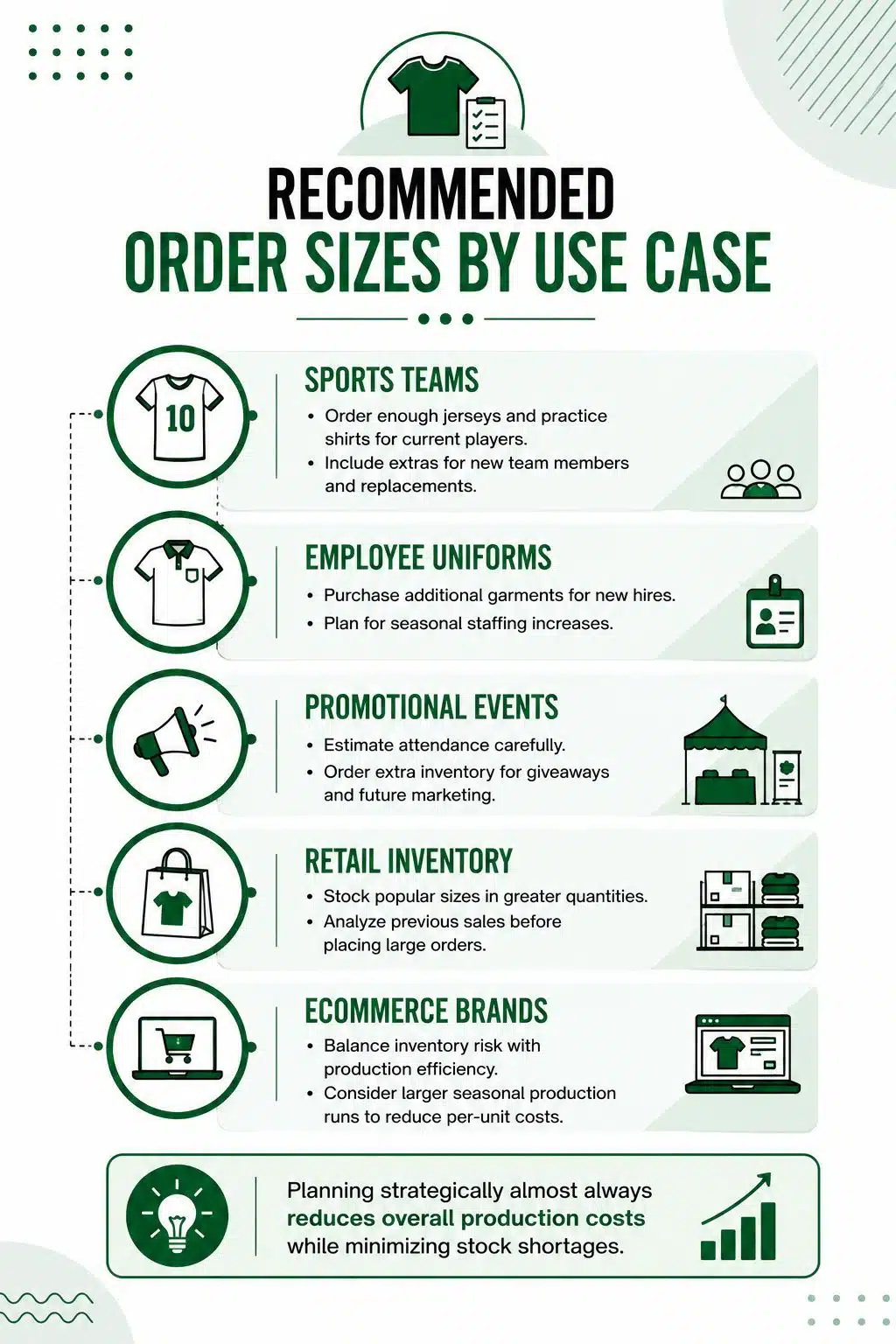
Recommended order sizes by use case
Sports Teams
- Order enough jerseys and practice shirts for current players.
- Include extras for new team members and replacements.
Employee Uniforms
- Purchase additional garments for new hires.
- Plan for seasonal staffing increases.
Promotional Events
- Estimate attendance carefully.
- Order extra inventory for giveaways and future marketing.
Retail Inventory
- Stock popular sizes in greater quantities.
- Analyze previous sales before placing large orders.
Ecommerce Brands
- Balance inventory risk with production efficiency.
- Consider larger seasonal production runs to reduce per-unit costs.
Planning strategically almost always reduces overall production costs while minimizing stock shortages.
Factors That Affect Minimum Order for Screen Printing
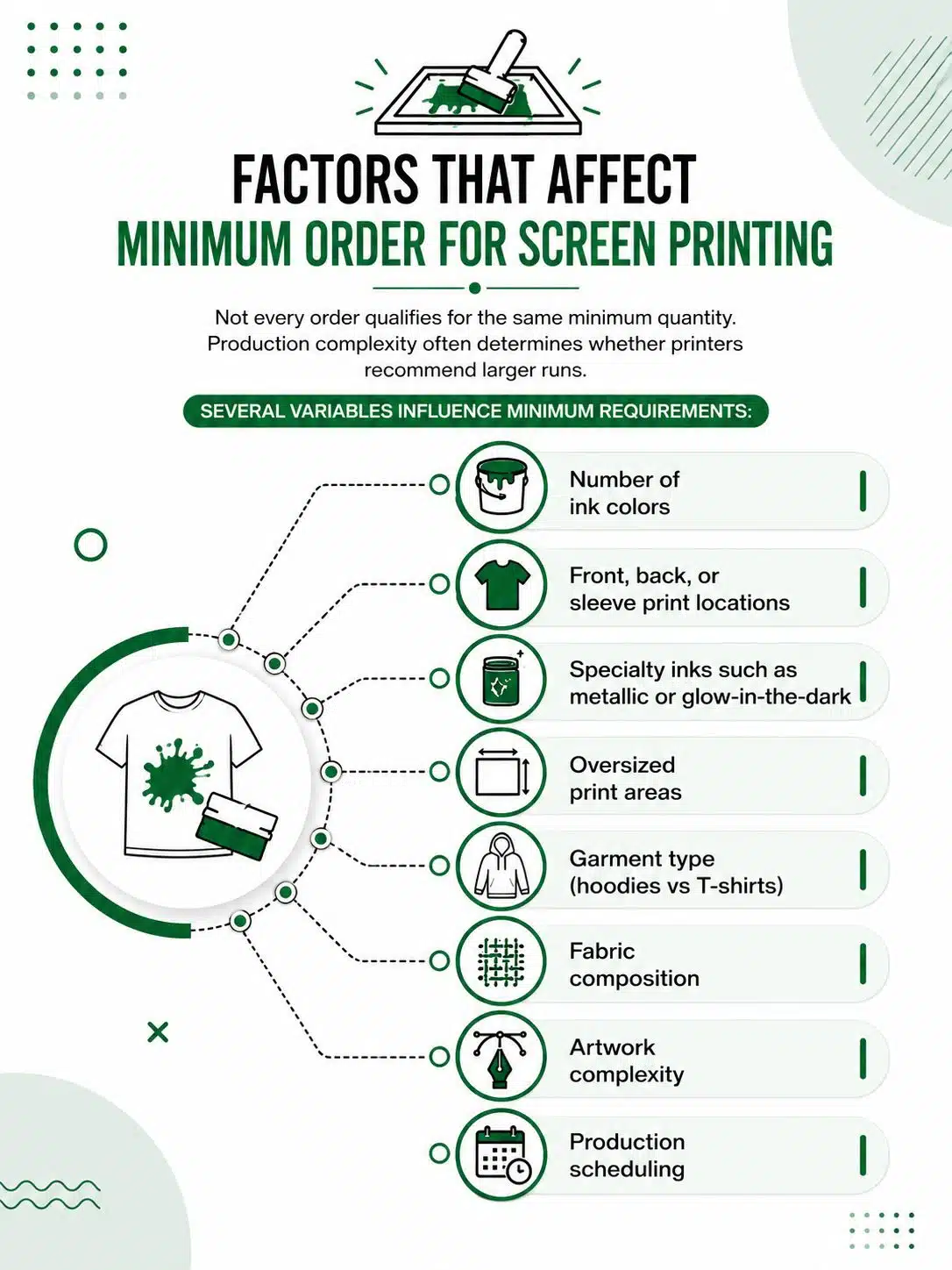
Not every order qualifies for the same minimum quantity. Production complexity often determines whether printers recommend larger runs.
Several variables influence minimum requirements:
- Number of ink colors
- Front, back, or sleeve print locations
- Specialty inks such as metallic or glow-in-the-dark
- Oversized print areas
- Garment type (hoodies vs T-shirts)
- Fabric composition
- Artwork complexity
- Production scheduling
For example, a one-color logo printed on cotton T-shirts may have a relatively low minimum, while a six-color design printed on hoodies with sleeve graphics may require substantially larger production quantities to remain economical.
Understanding these variables helps buyers choose the right production strategy before requesting quotes, ultimately saving both time and money.
When Bulk Screen Printing Makes Sense
For organizations ordering apparel at scale, bulk screen printing for shirts provide the lowest cost per garment and the highest production efficiency. Once setup costs are spread across dozens or hundreds of garments, screen printing becomes one of the most economical decoration methods available.
Bulk production also improves consistency. Every shirt is printed using the same screens, ink mixtures, and production settings, ensuring uniform colors and logo placement across the entire order. This consistency is especially important for companies building a recognizable brand.
The greatest savings typically occur when businesses consolidate multiple smaller orders into one larger production run. Instead of paying setup charges several times throughout the year, one bulk order often delivers better pricing and simplifies inventory management.
Bulk screen printing is ideal for:
- Corporate employee uniforms
- School spirit wear
- Athletic teams and leagues
- Retail clothing collections
- Trade show giveaways
- Promotional marketing campaigns
- Franchise businesses
- Annual company events
Businesses producing hundreds of garments each year usually benefit from planning inventory in advance rather than placing frequent small orders.
Ordering Too Many vs Too Few Shirts
Finding the right order quantity requires balancing production efficiency with inventory management. While larger runs reduce cost per shirt, excessive inventory ties up cash and storage space. On the other hand, ordering too few garments often results in expensive reorders and inconsistent production batches.
Businesses should evaluate expected demand, replacement needs, seasonal fluctuations, and future hiring before deciding on quantities.
Risks of ordering too many
- Higher upfront investment
- Storage costs
- Unsold inventory
- Design changes before inventory sells
- Seasonal products becoming outdated
Risks of ordering too few
- Paying setup charges repeatedly
- Higher shipping expenses
- Production delays for reorders
- Inconsistent inventory availability
- Potential color variation between separate print runs
The most successful brands forecast demand several months ahead and combine multiple needs into fewer, larger production orders whenever possible.
Why Businesses Choose Shirt.co
Choosing a printing partner involves more than comparing prices. Businesses need dependable production, consistent quality, and reliable turnaround times to protect their brand reputation. Shirt.co works with organizations of every size by offering commercial-scale apparel decoration supported by experienced production teams.
Professional artwork preparation, color consistency, and strict quality control help eliminate many of the production issues that can occur with inexperienced suppliers. Whether businesses require branded uniforms or retail merchandise, consistency remains the priority.
We offer a wide range of custom apparel services including contract decoration, union printing services, company merchandise, and school spirit with expertise in screen printing, DTF, and embroidery. You can choose us for on-demand merch for custom printed products like t-shirts, mugs, phone cases, etc.
Is Screen Printing the Right Choice for Your Order?
The ideal production method depends on your order size, artwork, budget, and long-term goals.
Screen printing is usually best for:
- Large production runs
- Team uniforms
- Corporate apparel
- Retail clothing brands
- Promotional campaigns
- School merchandise
- Long-term inventory
Consider DTF or embroidery when:
- You need only a few garments
- Artwork contains many colors
- Personalization is required
- Variable names or numbers are needed
- Small batch production is more economical
Understanding your production goals before ordering helps maximize both quality and profitability.
To Wrap Up
Understanding the minimum order for screen printing helps businesses make smarter purchasing decisions while controlling production costs. Order quantity influences setup expenses, labor efficiency, inventory planning, and long-term profitability. Although larger orders typically provide the lowest cost per shirt, the ideal quantity depends on your budget, storage capacity, and projected demand.
By carefully evaluating production volume and decoration needs, organizations can maximize value while minimizing waste. Working with experienced partners like Shirt.co also ensures consistent quality, reliable turnaround, and professional support for businesses seeking scalable commercial screen printing solutions.
FAQs
What is screen printing minimum order?
Most commercial screen printers recommend minimum orders of 12 to 24 shirts, although some providers offer smaller runs at a higher per-shirt cost due to setup expenses.
How many shirts do I need for screen printing?
The ideal quantity depends on your purpose. Team uniforms may require 20–50 shirts, while retail brands often order 100 or more to reduce unit costs.
Why do screen printers have minimum quantities?
Minimums help cover fixed production expenses such as artwork preparation, screen creation, ink setup, and press calibration, which remain nearly the same regardless of order size.
Is screen printing economical for small orders?
It can be, but digital methods like DTF are often more cost-effective for very small quantities because they don’t require traditional screen setup.
How much cheaper are bulk screen printed shirts?
As order size increases, the cost per shirt typically decreases significantly because setup costs are spread across more garments.
Can I combine different shirt sizes in one order?
Yes. Most commercial printers allow mixed sizes as long as the artwork, garment style, and print specifications remain the same.
What factors affect screen printing minimum quantity?
Artwork complexity, number of ink colors, garment type, specialty inks, print locations, and production scheduling all influence minimum order recommendations.
Is embroidery better for small quantities?
Embroidery is often an excellent option for smaller orders featuring simple logos, uniforms, or premium branded apparel.
What industries benefit most from bulk screen printing?
Sports teams, schools, apparel brands, promotional companies, ecommerce businesses, and corporate apparel programs benefit the most from bulk production.
Where can I order professional custom screen printed shirts?
Businesses looking for commercial-quality apparel production can work with experienced providers offering professional screen printing services, bulk ordering, artwork assistance, and scalable fulfillment.