


Today, screen printing is one of the most popular printing methods used for customizing t-shirts, hoodies, and other apparel. It is among the top choices for businesses looking for an efficient and cost-effective printing solution for bulk production.
However, one of the most common questions buyers ask is: How much does screen printing cost? The answer to screen printing cost depends on several factors, including the number of garments, print size, number of ink colors, garment type, and setup requirements.
While screen printing offers one of the lowest costs per piece for large orders, understanding the pricing structure can help you plan your budget more effectively.
In this guide, we’ll break down the average screen printing costs in 2026, explain the factors that influence pricing, and show you how to get the best value for your custom apparel project.
Why is Screen Printing Popular in Apparel Printing?
Screen printing has remained one of the most trusted apparel decoration methods because it delivers consistent quality, vibrant colors, and cost-effective production for large orders. Whether businesses need branded uniforms, promotional merchandise, event apparel, or retail clothing, screen printing provides durable prints that can withstand frequent washing and daily wear.
Its popularity is also driven by affordability. While there are setup costs involved, the price per garment decreases significantly as order quantities increase, making it an ideal solution for bulk production. This is one reason why understanding screen printing pricing is important for businesses planning custom apparel projects.
The industry continues to grow as demand for customized clothing rises worldwide. In fact, the global screen printing market size stood at USD 64.4 million in 2025, highlighting the continued relevance of this printing method across multiple industries.
Other reasons for its popularity include:
- Produces vibrant and long-lasting prints.
- Ideal for bulk apparel orders.
- Works on a wide range of garment types.
- Offers excellent color accuracy and consistency.
- Provides one of the lowest per-unit costs for high-volume printing.
For businesses seeking quality, durability, and value, screen printing remains a leading choice in apparel customization.
What is Screen Printing Cost?
Screen printing cost refers to the total expense involved in printing a design onto apparel using the screen printing process. The final price depends on several factors, including garment type, order quantity, number of print colors, print locations, setup fees, and turnaround time.
If you’re wondering “how much does screen printing cost in USA”, the average cost ranges from $6 to $20+ per shirt, depending on the project requirements. Bulk orders typically receive significantly lower per-unit pricing because setup costs are distributed across more garments.
Average Screen Printing Prices in the USA
Estimated Screen Printing Cost Per Shirt
Pricing typically decreases as order quantity increases.
| Order Quantity | 🎨 1-Color Print | 🎨🎨 2-Color Print | 🌈 4-Color Print |
|---|---|---|---|
| 12 Shirts | $12–$18/shirt | $14–$20/shirt | $16–$25/shirt |
| 24 Shirts | $9–$14/shirt | $11–$16/shirt | $13–$20/shirt |
| 50 Shirts | $7–$11/shirt | $8–$13/shirt | $10–$16/shirt |
| 100 Shirts | $6–$9/shirt | $7–$11/shirt | $8–$14/shirt |
| 500+ Shirts | $4–$7/shirt | $5–$8/shirt | $6–$10/shirt |
Larger orders significantly reduce the cost per shirt because setup expenses are spread across more garments, making bulk screen printing the most cost-effective option.
Example Cost Estimates
Example 1: Small Business Order
- 24 cotton t-shirts
- 1-color front logo
- Estimated screen printing cost: $216–$336 total
Example 2: Company Event
- 100 t-shirts
- 2-color front print
- Estimated screen printing prices: $700–$1,100 total
Example 3: Promotional Campaign
- 500 shirts
- 4-color design
- Estimated cost: $3,000–$5,000 total
For most businesses, screen printing remains one of the most affordable apparel decoration methods, especially for bulk orders where economies of scale significantly lower overall screen printing prices.
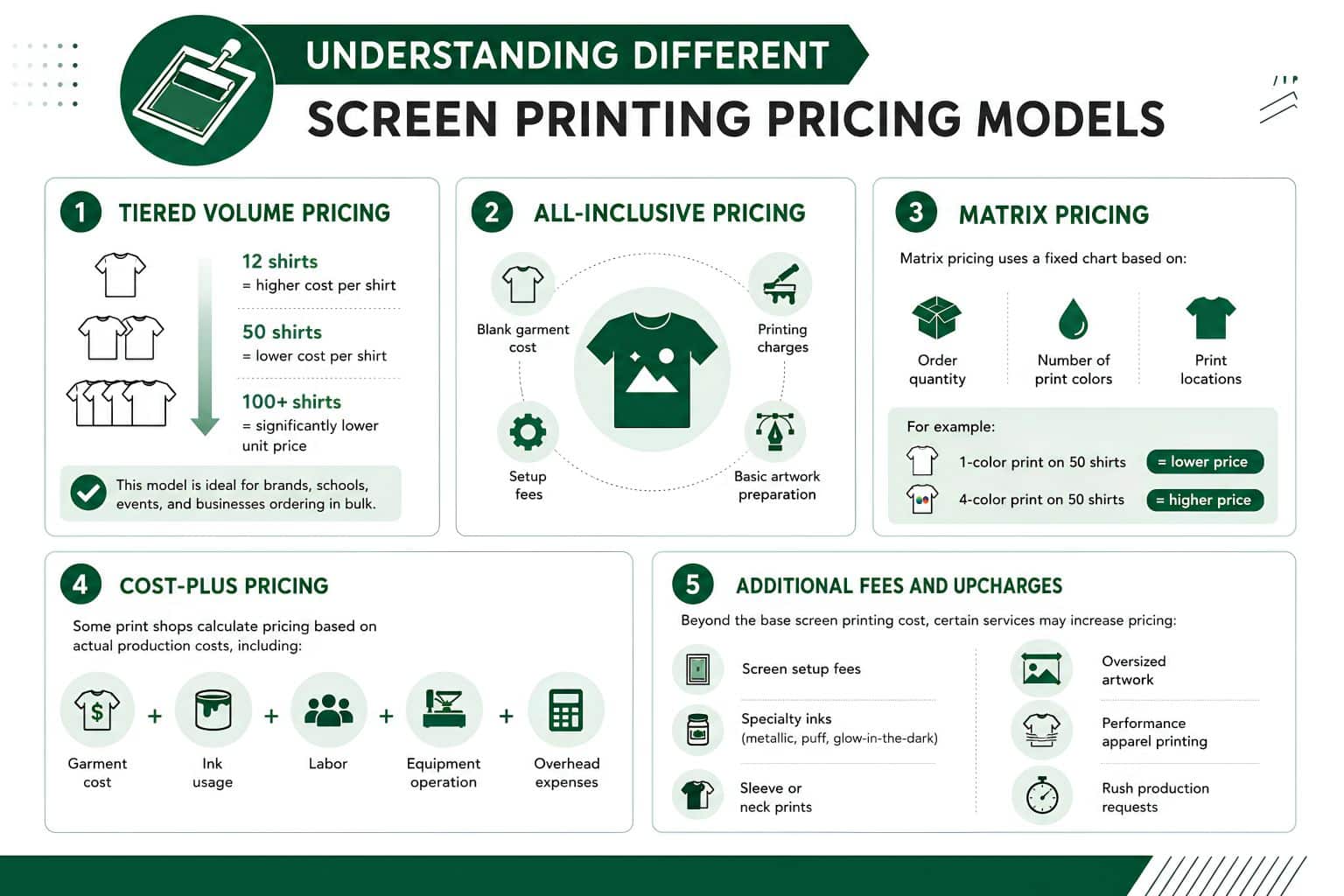
Understanding Different Screen Printing Pricing Models
Screen printing pricing is not always calculated the same way. Most print shops use a combination of order quantity, design complexity, garment type, and setup requirements to determine the final price. Understanding these pricing models can help businesses estimate their screen printing cost more accurately and choose the most cost-effective option for their project.
1. Tiered Volume Pricing
This is the most common screen printing pricing model. The more shirts you order, the lower the price per piece becomes because setup costs are spread across a larger quantity.
- 12 shirts = higher cost per shirt
- 50 shirts = lower cost per shirt
- 100+ shirts = significantly lower unit price
This model is ideal for brands, schools, events, and businesses ordering in bulk.
2. All-Inclusive Pricing
Some printers provide a single price that includes:
- Blank garment cost
- Printing charges
- Setup fees
- Basic artwork preparation
This pricing structure simplifies quoting and makes budgeting easier since there are no hidden costs.
For large production runs, many businesses use professional contract printing services like Contract Screen Printing to streamline costs and production.
3. Matrix Pricing
Matrix pricing uses a fixed chart based on:
- Order quantity
- Number of print colors
- Print locations
For example:
- 1-color print on 50 shirts = lower price
- 4-color print on 50 shirts = higher price
This method allows printers to quickly answer questions like “How much does screen printing cost per shirt?” without calculating every project individually.
4. Cost-Plus Pricing
Some print shops calculate pricing based on actual production costs, including:
- Garment cost
- Ink usage
- Labor
- Equipment operation
- Overhead expenses
A profit margin is then added to determine the final selling price. This model is often used for custom or specialized orders.
Businesses combining multiple decoration methods often work with providers offering Contract Decoration Services for more flexible production options.
5. Additional Fees and Upcharges
Beyond the base screen printing cost, certain services may increase pricing:
- Screen setup fees
- Specialty inks (metallic, puff, glow-in-the-dark)
- Sleeve or neck prints
- Oversized artwork
- Performance apparel printing
- Rush production requests
When deadlines are tight, companies may also use Rush Printing Services, which typically include expedited production fees.
Understanding these pricing models helps businesses compare quotes more effectively and determine the most economical solution for their apparel printing needs.
Other Methods for Calculating Screen Printing Cost
Beyond standard volume-based pricing, many print shops use additional methods to determine the cost of screen printing for t shirts. These pricing structures help businesses estimate project expenses more accurately based on garment type, design complexity, turnaround requirements, and order size. Understanding different screen printing rates can help you choose the most cost-effective solution for your apparel project.
1. Per-Shirt Pricing
Per-shirt pricing is one of the simplest and most common methods used in the industry. A fixed price is assigned to each garment based on factors such as print size, number of colors, and total quantity ordered.
- Easy to understand and budget for
- Popular for corporate apparel and promotional products
- Lower unit costs for larger orders
- Frequently used when comparing screen printing pricing across vendors
Businesses ordering branded uniforms, team apparel, or promotional merchandise often prefer this model because it offers predictable costs.
If you’re looking for professionally printed company apparel, explore custom branded apparel solutions from Shirt.Co.
2. Setup Fee Plus Production Cost
Many screen printers separate setup expenses from production costs. A one-time fee covers artwork preparation, screen creation, and press setup before printing begins.
- Common for custom designs
- Setup costs are spread across larger orders
- More economical for repeat orders
- Provides transparent project pricing
This model is especially beneficial for businesses that reorder the same design multiple times throughout the year.
3. Color-Based Pricing
The number of colors in your artwork significantly affects production costs. Each color requires its own screen and setup process.
- One-color prints are the most affordable
- Multi-color graphics increase labor and materials
- Ideal for logos, illustrations, and branded merchandise
- A major factor affecting overall screen printing rates
Complex artwork with multiple colors typically requires additional setup time, increasing the total project cost.
4. On-Demand Printing Pricing
Some apparel providers offer on-demand production, where items are printed only when ordered rather than produced in bulk.
- No large inventory requirements
- Suitable for ecommerce stores and creators
- Higher per-item pricing than bulk production
- Reduces storage and fulfillment costs
For brands selling custom merchandise online, on-demand merch services can be a flexible alternative to traditional bulk printing.
5. Bulk Order Pricing
Bulk production remains one of the most cost-efficient methods for reducing the cost of screen printing t shirts. As order quantities increase, setup and labor expenses are distributed across more garments.
- Lowest cost per unit
- Ideal for schools, events, and organizations
- Better profit margins for resellers
- Preferred option for large-scale apparel campaigns
Businesses planning large apparel runs can often save significantly through dedicated bulk order programs.
By understanding these pricing models, businesses can evaluate screen printing pricing more effectively and select the option that best aligns with their budget, order size, and production goals.
Key Factors Affecting Screen Printing Costs
The final screen printing cost depends on much more than just the number of shirts you order. From garment selection to print complexity, several variables influence overall screen printing pricing and determine how much you pay per piece. Understanding these factors can help businesses optimize budgets while still achieving high-quality results.
1. Order Volume
One of the biggest factors affecting screen printing costs is order quantity. Screen printing requires setup time before production begins, and those setup expenses are spread across the entire order.
- Small orders generally have higher per-shirt costs.
- Large orders significantly reduce unit pricing.
- Bulk production improves efficiency and lowers labor costs.
For example, printing 25 shirts may cost $10–$15 per shirt, while printing 500 shirts could reduce the cost to $4–$7 per shirt. Businesses operating branded merchandise stores often leverage bulk production to improve margins and reduce overall costs. Learn more about custom online merchandise solutions at online stores.
2. Number of Print Colors
Each color in a screen-printed design requires its own screen, setup process, and production step. This directly impacts screen printing rates.
- One-color logos are the most economical.
- Multi-color graphics require additional screens.
- Complex artwork increases setup and production time.
For example, a simple one-color company logo will cost considerably less than a four-color promotional design. The more colors involved, the higher the overall screen printing pricing.
3. Garment Quality
The type of apparel selected also plays a major role in pricing.
- Basic cotton t-shirts offer the lowest production cost.
- Premium ringspun cotton increases garment expenses.
- Performance wear and specialty fabrics cost more to print.
Businesses ordering premium uniforms, promotional apparel, or custom company swag often choose higher-quality garments to improve comfort, durability, and brand perception. Explore branded merchandise options through company swag solutions.
4. Print Locations
The location of the print affects labor requirements and production complexity.
- Front chest prints are typically included in base pricing.
- Back prints often add additional charges.
- Sleeve, pocket, and neck prints require extra setup.
For example, a shirt with a front logo and full-back design will cost more than a shirt with only a front print. Multiple print locations increase production time and influence overall screen printing rates.
5. Setup Fees
Before printing begins, screens must be created and aligned for production.
- Most shops charge setup fees per screen.
- Typical fees range from $20–$50 per color.
- Setup costs remain the same regardless of order size.
This is why larger orders are generally more cost-effective, as setup fees are distributed across more garments.
6. Rush Production
Tight deadlines often increase pricing because printers must prioritize your project over standard production schedules.
- Faster turnaround requires additional labor.
- Overtime production may be necessary.
- Material sourcing can become more expensive.
Rush orders are common for trade shows, marketing campaigns, and promotional giveaways. Businesses frequently use custom promo products to support events where timing is critical.
7. Union Printing Requirements
Some organizations, government agencies, and labor unions require union-made apparel or union printing services.
- Specialized production standards may apply.
- Certified union facilities can carry higher operating costs.
- Compliance requirements may increase project pricing.
If your organization requires certified production, consider working with providers offering union services to ensure compliance.
By understanding these factors, businesses can better estimate screen printing costs, compare vendors more effectively, and make informed decisions when ordering branded apparel, promotional merchandise, uniforms, and large-scale marketing products.
Screen Printing Price Calculator: Steps to Determine the Estimates
Calculating the cost of screen printing involves more than multiplying the number of shirts by a fixed rate. Most print shops consider garment cost, screen setup, number of print colors, print locations, and order quantity when determining final screen printing pricing.
By understanding these variables, you can estimate project costs before requesting a quote.
Step 1: Determine the Garment Cost
Start with the blank apparel cost.
Typical Blank Garment Costs
Blank garment prices vary depending on fabric quality, brand, and style.
| 👕 Garment Type | 💲 Typical Blank Cost |
|---|---|
| Basic Cotton T-Shirt | $2–$5 |
| Premium T-Shirt | $6–$12 |
| Hoodie | $12–$25 |
| Polo Shirt | $8–$20 |
Choosing higher-quality blank garments improves comfort, durability, and print quality, but it also increases the overall cost of your custom apparel order.
For example, if you order 100 basic cotton t-shirts at $4 each, your garment cost is:
100 × $4 = $400
Step 2: Calculate Screen Setup Fees
Each ink color requires a separate screen.
Screen Printing Setup Fees by Number of Colors
Each additional ink color typically requires its own screen, increasing setup costs.
| 🎨 Number of Colors | 💲 Estimated Setup Fee |
|---|---|
| 1 Color | $20–$50 |
| 2 Colors | $40–$100 |
| 3 Colors | $60–$150 |
| 4 Colors | $80–$200 |
Setup fees are usually one-time charges per design. Larger print runs help spread these costs across more garments, reducing the average cost per item.
If your logo uses 2 colors and the printer charges $35 per screen:
2 × $35 = $70 setup fee
Step 3: Add Printing Charges
Most printers charge per print based on quantity.
Screen Printing Price Chart
Bulk Screen Printing Price Guide
The more shirts you order, the lower your cost per garment.
| 📦 Quantity | 🎨 1 Color Print | 🎨🎨 2 Color Print | 🌈 4 Color Print |
|---|---|---|---|
| 24 Shirts | $8–$12/shirt | $10–$14/shirt | $13–$18/shirt |
| 50 Shirts | $6–$9/shirt | $7–$11/shirt | $10–$14/shirt |
| 100 Shirts | $4–$7/shirt | $5–$8/shirt | $7–$11/shirt |
| 250 Shirts | $3–$5/shirt | $4–$6/shirt | $5–$8/shirt |
| 500+ Shirts | $2–$4/shirt | $3–$5/shirt | $4–$7/shirt |
Ordering 250 or more shirts can significantly reduce your per-shirt cost, making bulk screen printing the most economical option for businesses, events, schools, and promotional campaigns.
Average market estimates in the United States. Actual prices vary by garment type and supplier.
Step 4: Include Additional Print Locations
Extra print placements increase production costs.
- Front print: Usually included in base pricing
- Back print: Add $1–$3 per shirt
- Sleeve print: Add $1–$2 per sleeve
- Pocket print: Add $0.50–$2 per shirt
Step 5: Factor in Rush or Specialty Charges
Additional costs may apply for:
- Rush production
- Metallic inks
- Puff printing
- Oversized prints
- Performance fabrics
These charges can increase total screen printing pricing by 10–50%.
Example Screen Printing Cost Calculation
Order: 100 t-shirts with a 2-color front logo
Example Screen Printing Project Cost Breakdown
Estimated pricing for an order of 100 custom printed shirts.
| 💲 Cost Component | Estimated Amount |
|---|---|
| Blank Shirts (100 × $4) | $400 |
| Screen Setup (2 Screens) | $70 |
| Printing Cost (100 × $6) | $600 |
| Total Project Cost | $1,070 |
This estimate illustrates how a typical 100-shirt order is priced. Actual costs may vary depending on garment quality, print size, ink colors, design complexity, and your print provider.
Cost per shirt: $1,070 ÷ 100 = $10.70 per shirt
Quick Formula
Total Screen Printing Cost = Garment Cost + Setup Fees + Printing Charges + Additional Services
Using this method gives a realistic estimate of screen printing pricing before requesting quotes from suppliers and helps businesses compare vendors more accurately.
To Wrap Up
Screen printing remains one of the most cost-effective and scalable apparel decoration methods available in 2026. While the final screen printing cost depends on factors such as order volume, number of colors, garment quality, print locations, and setup fees, understanding these variables makes budgeting much easier.
Larger orders typically benefit from lower per-unit pricing, making screen printing ideal for businesses, events, schools, and promotional campaigns. By using a reliable screen printing price calculator and comparing screen printing pricing models, you can accurately estimate project costs and choose the most economical solution without sacrificing print quality, durability, or production efficiency.
FAQs
1. How much does screen printing cost per shirt, and what affects the price?
The average screen printing cost per shirt ranges from $5 to $15, depending on factors such as order quantity, garment quality, number of print colors, print locations, setup fees, and production timelines. Larger orders typically reduce the per-shirt cost because setup expenses are distributed across more garments.
2. Why is screen printing cheaper for bulk orders?
Screen printing becomes more affordable as order quantities increase because the setup process remains largely the same regardless of volume. When producing hundreds of shirts instead of a few dozen, setup and labor costs are spread across more items, significantly lowering overall screen printing pricing and per-unit costs.
3. How do setup fees and print colors impact screen printing costs?
Most print shops charge $20–$50 per screen, and each ink color requires a separate screen. This means multi-color designs increase setup fees, labor, and production time. A simple one-color logo is usually much less expensive than a detailed four-color graphic print.
4. Is screen printing more cost-effective than DTG printing?
For bulk apparel orders, screen printing is generally more cost-effective than DTG printing because the cost per garment decreases with higher quantities. DTG printing is often preferred for small orders or on-demand production, while screen printing delivers better value for large-scale projects.
5. How can businesses estimate screen printing costs before placing an order?
Businesses can estimate screen printing rates by calculating garment costs, setup fees, number of print colors, print locations, and any specialty services such as rush production or premium inks. Using a screen printing price calculator and requesting detailed quotes helps determine the most accurate project cost before production begins.