



Print on demand (POD) has become one of the most accessible ways to build an online business without investing in inventory or managing fulfillment. You keep away from the headaches of managing everything, and a trusted printing partner like Shirt.co takes care of it for you.
Whether you’re an entrepreneur, designer, or content creator, learning how to make money with print on demand starts with choosing the right products, creating designs customers actually want, and building a scalable sales strategy.
This guide breaks down six practical steps that can help you make money with print on demand, from selecting profitable niches to marketing your products effectively. If you’re exploring on-demand merchandise solutions or expanding into custom promotional products, these strategies will help you build a sustainable and profitable business.
Key Takeaways
- Print on demand is a low-risk business model that allows entrepreneurs to sell custom products without holding inventory or managing shipping, making it ideal for beginners and growing brands.
- Choosing a profitable niche is the foundation of success. Focus on a specific audience with clear interests rather than trying to appeal to everyone.
- High-quality, original designs drive sales. Products that solve a need, express identity, or follow current trends are more likely to generate repeat purchases.
- Selecting reliable print-on-demand partners is essential. Consistent print quality, product variety, fast fulfillment, and dependable customer service directly impact customer satisfaction and long-term profitability.
Explaining Print on Demand (POD) in an Easy Way
A print-on-demand business is a simple way to sell custom products without keeping inventory. Your products are printed only when someone places an order, so you don’t have to buy stock in advance. For example, if a customer orders a T-shirt with your design, the supplier prints it, packs it, and ships it directly to the customer. You focus on creating and selling, while the printing and delivery are handled for you.
Pros and Cons of Print on Demand
Print-on-Demand: Pros vs. Cons
Compare the key advantages and disadvantages before starting a print-on-demand business.
| ✅ Pros | ⚠️ Cons |
|---|---|
| 💰 Low startup cost since you don’t need to buy inventory upfront. | 📉 Profit margins are generally lower than bulk manufacturing. |
| 📦 No inventory management or storage is required. | 🚚 Less control over production quality and shipping times. |
| 🧪 Easy to test new products and designs with minimal financial risk. | ⏳ Longer fulfillment times compared to stocking products yourself. |
| 🎨 Wide variety of customizable products can be offered. | 💲 Product costs are usually higher on a per-item basis. |
| 📈 Scales easily as your business grows without large investments. | 📢 Success depends heavily on effective marketing and niche selection. |
Print-on-demand is an excellent business model for entrepreneurs who want to launch with minimal upfront investment. While it offers flexibility and low financial risk, long-term success depends on strong branding, quality designs, effective marketing, and choosing a reliable fulfillment partner.
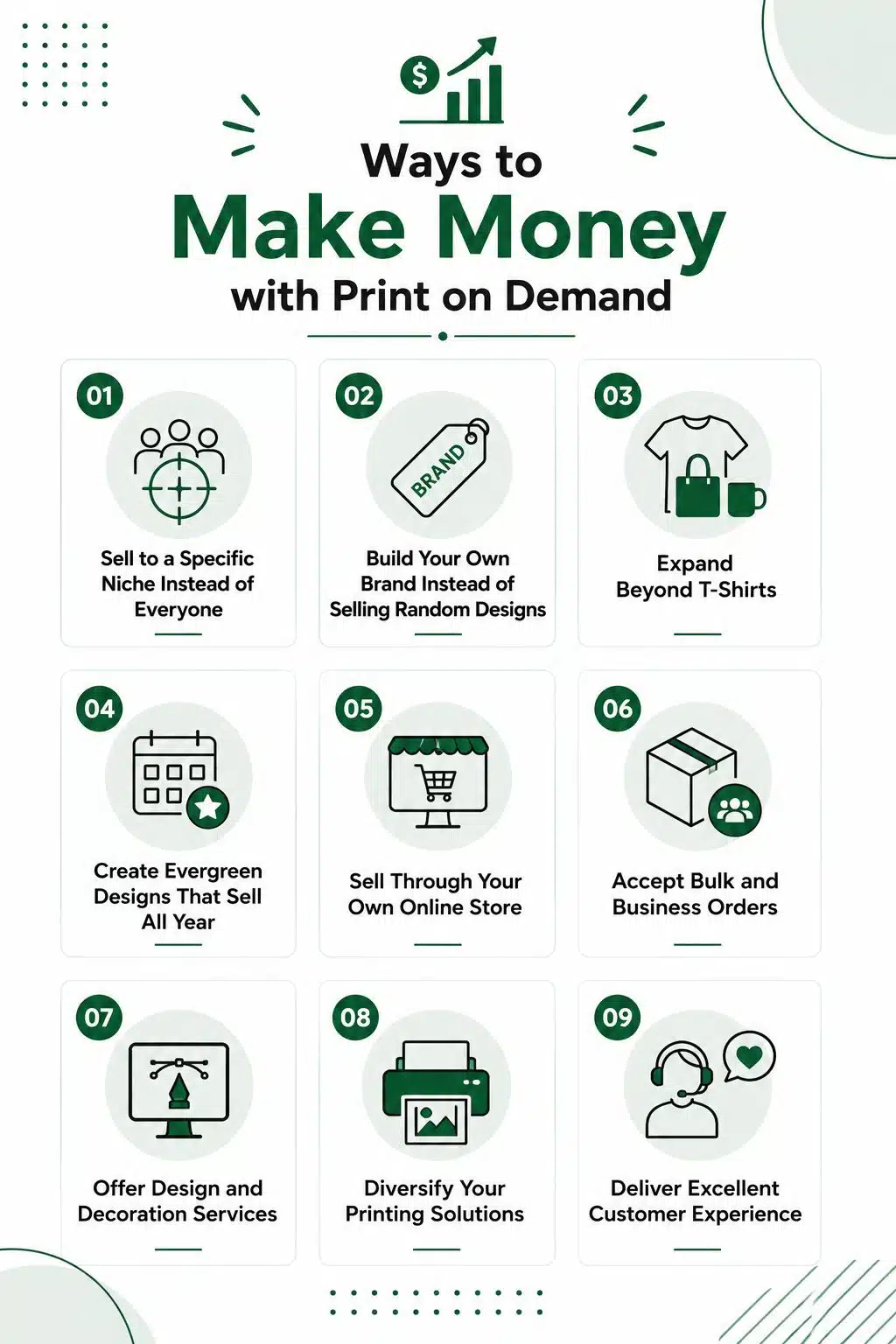
Ways to Make Money with Print on Demand
A successful print-on-demand business isn’t built by uploading a few designs and hoping for sales. The businesses that generate consistent revenue understand their audience, choose the right products, and create a long-term brand rather than chasing quick wins. Below are some of the most effective ways to build sustainable income with Print on Demand.
1. Sell to a Specific Niche Instead of Everyone
The biggest mistake beginners make is designing products for “everyone.” Broad audiences are difficult to target because they have different interests, buying habits, and expectations. Instead, focus on one niche that has passionate buyers.
For example, instead of selling generic T-shirts, create products for hikers, nurses, teachers, pet lovers, gym enthusiasts, or coffee lovers. Customers are much more likely to purchase designs that reflect their personality or interests.
Niche branding also makes marketing easier. Your product descriptions, social media content, and advertisements become more focused because you’re speaking directly to a defined audience.
If you want to make money with print on demand, building authority within one niche often produces better long-term results than trying to serve dozens of unrelated audiences.
2. Build Your Own Brand Instead of Selling Random Designs
Many sellers simply upload trending graphics without building a recognizable identity. While this may generate occasional sales, it rarely creates loyal customers.
Successful brands have a consistent visual style, messaging, and product collection. Customers remember the brand—not just the individual design.
Think about companies like Gymshark or Patagonia. People recognize their branding immediately because everything feels connected.
Even if you’re starting small, develop:
- A memorable brand name
- A consistent color palette
- Similar design aesthetics
- A recognizable logo
- Consistent product photography
Having your own branded collection also allows you to expand into products like branded apparel as your business grows, creating a stronger and more professional customer experience.
3. Expand Beyond T-Shirts
Most beginners only think about selling T-shirts, but Print on Demand offers far more opportunities.
Many customers prefer products they can use daily, including:
- Hoodies
- Sweatshirts
- Tote bags
- Drinkware
- Phone cases
- Stickers
- Hats
- Office accessories
Offering multiple products increases your average order value because customers often purchase matching items together.
For example, someone buying a camping-themed T-shirt may also purchase a matching mug or tote bag if the collection feels cohesive.
Exploring a wider catalog of custom promotional products also helps you serve businesses, schools, sports teams, and organizations looking for branded merchandise rather than individual apparel pieces.
Diversification protects your revenue because you’re no longer dependent on a single product category.
4. Create Evergreen Designs That Sell All Year
Trending products can generate quick sales, but evergreen designs create predictable, recurring revenue.
Evergreen products remain relevant regardless of season or current internet trends.
Examples include:
- Motivational quotes
- Pet-themed artwork
- Minimal typography
- Family-themed graphics
- Hobby designs
- Nature illustrations
- Occupation-specific merchandise
Unlike trend-based graphics that disappear after a few weeks, evergreen collections continue attracting buyers through search engines, marketplaces, and social media over time.
This strategy is particularly valuable for print-on-demand for beginners because it allows designs to build organic visibility without requiring constant redesigns.
As your catalog grows, each evergreen product becomes another opportunity to generate passive sales, helping create a more stable and print-on-demand income stream instead of relying solely on viral moments.
5. Sell Through Your Own Online Store
While marketplaces can generate initial sales, building your own website gives you greater control over pricing, customer relationships, and long-term growth. Instead of competing with hundreds of similar products, you create a branded shopping experience where customers remember your business rather than the marketplace.
An online store also allows you to collect customer emails, launch new collections, and encourage repeat purchases through promotions and loyalty campaigns. As your product catalog grows, search engines can bring in consistent organic traffic, reducing your dependence on paid advertising.
Businesses serious about building a profitable print-on-demand business often invest in dedicated online store solutions because they provide greater flexibility for branding, product management, and customer retention.
6. Accept Bulk and Business Orders
Many entrepreneurs overlook one of the most profitable opportunities in Print on Demand—serving businesses instead of only individual customers.
Local companies, schools, sports clubs, nonprofits, and event organizers regularly need branded apparel for staff, campaigns, conferences, and promotional events. A single business client can generate the same revenue as dozens of individual consumer orders.
When you learn how to earn money with print on demand, expanding into corporate orders creates a more stable income because organizations often reorder throughout the year as they hire employees or prepare for new events.
Working with bulk apparel orders also improves production efficiency while allowing you to negotiate larger contracts that increase overall profitability.
7. Offer Design and Decoration Services
Not every customer has artwork ready for production. Many businesses know they need branded apparel but require assistance preparing logos or selecting the right decoration method.
By offering simple design support alongside your products, you create additional revenue while making the buying process easier for customers.
Some clients may need logo cleanup, file preparation, placement recommendations, or advice about which printing technique best suits their garments.
Professional contract decoration services can also help businesses scale production while maintaining consistent quality across different apparel collections.
Providing expertise instead of simply selling products helps establish trust and encourages long-term business relationships.
8. Diversify Your Printing Solutions
Although Print on Demand usually refers to direct garment fulfillment, successful businesses often expand into additional decoration methods to serve different customer requirements.
For example, some customers need vibrant full-color artwork, while others require durable workwear or specialty fabrics. Understanding options such as DTF transfers and contract screen printing allows you to recommend the most appropriate solution based on order size, garment type, and design complexity.
Expanding your production capabilities also makes your business more competitive because customers appreciate working with one supplier capable of handling multiple apparel decoration requirements.
9. Deliver Excellent Customer Experience
The easiest sale is often the second one. Businesses that provide outstanding customer service consistently outperform competitors selling similar products.
Respond quickly to customer questions, provide accurate sizing information, maintain transparent shipping timelines, and communicate proactively whenever issues arise.
Satisfied customers frequently recommend brands to friends, leave positive reviews, and return for future purchases.
If clients require urgent merchandise for product launches, company events, or promotional campaigns, having access to rush production services can become a valuable competitive advantage that strengthens customer loyalty.
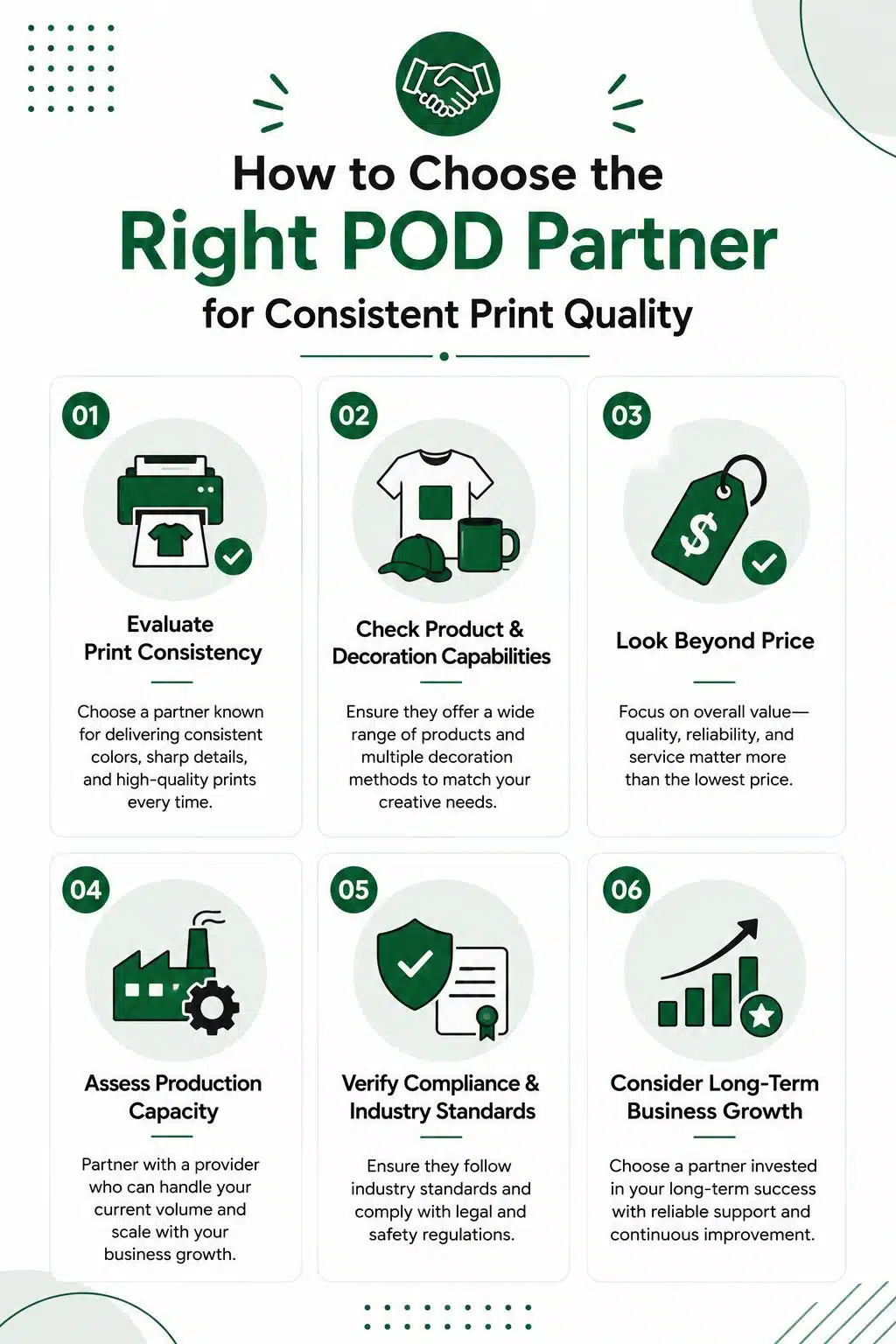
How to Choose the Right POD Partner for Consistent Print Quality
The success of your Print on Demand business depends as much on your production partner as it does on your designs. A poor-quality supplier can lead to faded prints, inconsistent sizing, delayed deliveries, and negative customer reviews that damage your brand. Choosing the right partner helps you maintain customer trust, reduce returns, and build a business that grows through repeat purchases rather than constant problem-solving.
1. Evaluate Print Consistency
Consistent print quality should be your first priority. Every product your customers receive should have the same color accuracy, artwork placement, and finishing quality regardless of when or where it is produced. Imagine ordering the same T-shirt twice and receiving noticeably different colors—that inconsistency immediately reduces confidence in your brand. Before committing to a supplier, request samples and compare them carefully. Look beyond the first order and evaluate whether the provider has systems in place to maintain reliable quality as your order volume increases.
2. Check Product & Decoration Capabilities
A reliable POD partner should offer more than one printing method. Different products require different decoration techniques, and having multiple options allows your business to serve a wider range of customers. For example, embroidery works better for premium polos, while DTF or screen printing may be more suitable for colorful artwork. Shirt.co supports businesses through a wide range of apparel decoration services, making it easier to scale from individual orders to larger branding projects without changing suppliers. This flexibility also allows you to expand into new product categories as your business grows.
3. Look Beyond Price
Choosing the cheapest supplier often becomes the most expensive decision in the long run. Low prices can lead to inconsistent prints, poor garment quality, delayed shipping, and costly reprints that reduce your profit margins. Instead of comparing suppliers only by price, evaluate overall value. Consider product durability, customer support, fulfillment accuracy, and production reliability. Paying slightly more for consistent quality protects your reputation and creates happier customers who are more likely to recommend your business and place future orders.
4. Assess Production Capacity
Your supplier should be capable of growing alongside your business. While they may easily handle a few daily orders, can they manage hundreds of products for a company event or seasonal promotion? Production capacity becomes increasingly important when serving business clients who require consistent fulfillment within tight deadlines. A scalable production partner helps you confidently pursue larger contracts without worrying about fulfillment limitations. Whether you’re shipping one custom shirt or thousands, consistency should never decline as volume increases.
5. Verify Compliance & Industry Standards
If you plan to work with schools, government organizations, healthcare providers, or enterprise businesses, production compliance becomes an important consideration. Many organizations require specific manufacturing or labor standards before awarding contracts. Suppliers offering Union Services help businesses satisfy these procurement requirements while maintaining consistent production quality. Choosing a compliant supplier from the beginning opens opportunities to work with larger organizations that prioritize certified production practices.
6. Consider Long-Term Business Growth
Your POD partner should support your future goals—not just your current orders. As your customer base expands, you may introduce employee merchandise, promotional campaigns, event apparel, or branded onboarding kits. Working with one experienced supplier simplifies production, improves consistency, and reduces operational complexity. Instead of coordinating multiple vendors, businesses often prefer a single partner capable of handling apparel decoration and company swag solutions under one roof. This approach creates a smoother workflow while ensuring your branding remains consistent across every product.
Quick Checklist Before Choosing a POD Partner
Questions to Ask Before Choosing a Print Partner
Evaluate potential suppliers using these key questions to ensure quality, reliability, and long-term success.
| ✅ Ask Yourself | 🎯 Why It Matters |
|---|---|
| 🖨️ Are print samples consistent? | Prevents quality complaints, maintains brand reputation, and reduces costly reprints. |
| 📦 Can the supplier scale production? | Ensures they can support future business growth and handle large-volume orders. |
| 🎨 Do they offer multiple decoration methods? | Provides flexibility for different products, fabrics, and customer requirements. |
| 💬 Is customer support responsive? | Helps resolve production, artwork, or fulfillment issues quickly and efficiently. |
| 🏢 Can they handle corporate branding projects? | Opens opportunities to serve larger business clients, repeat customers, and long-term contracts. |
Don’t choose a print partner based solely on price. Prioritize consistent quality, reliable turnaround times, responsive communication, and the ability to scale as your business grows. These factors have a much greater impact on customer satisfaction and long-term success.
Conclusion
Building a successful Print on Demand business takes more than creative designs—it requires reliable production, consistent quality, and a partner that can grow with your brand. Choosing the right POD supplier helps you deliver products customers trust while creating opportunities to expand into new markets. Shirt.co supports businesses with professional DTF transfers, embroidery, screen printing, branded merchandise, and even online store solutions, making it easier to launch, manage, and scale your POD business from one place. With the right strategy and production partner, Print on Demand can become a sustainable source of long-term business growth and recurring revenue.
Frequently Asked Questions
1. How can I make money with Print on Demand?
You can make money with Print on Demand by selling niche-focused custom products, building your own brand, launching an online store, accepting business orders, and consistently marketing your products through SEO, social media, and email marketing.
2. Is Print on Demand profitable for beginners?
Yes. Print on Demand is considered one of the lowest-risk online business models because you don’t purchase inventory upfront. Profitability depends on choosing the right niche, creating quality designs, pricing products correctly, and attracting targeted customers.
3. What products sell best in a Print on Demand business?
Popular Print on Demand products include T-shirts, hoodies, sweatshirts, hats, tote bags, drinkware, posters, stickers, phone cases, and branded promotional merchandise. Products that solve a specific audience’s interests generally perform better than generic designs.
4. How do I choose the right Print on Demand supplier?
Look for a supplier with consistent print quality, multiple decoration methods, reliable customer support, scalable production capacity, competitive turnaround times, and positive customer reviews. Requesting samples before launching products is also highly recommended.
5. Can Print on Demand businesses sell to companies?
Absolutely. Many Print on Demand businesses generate recurring revenue by producing employee apparel, company swag, event merchandise, promotional products, and branded uniforms for corporate clients, schools, sports teams, and nonprofit organizations.