

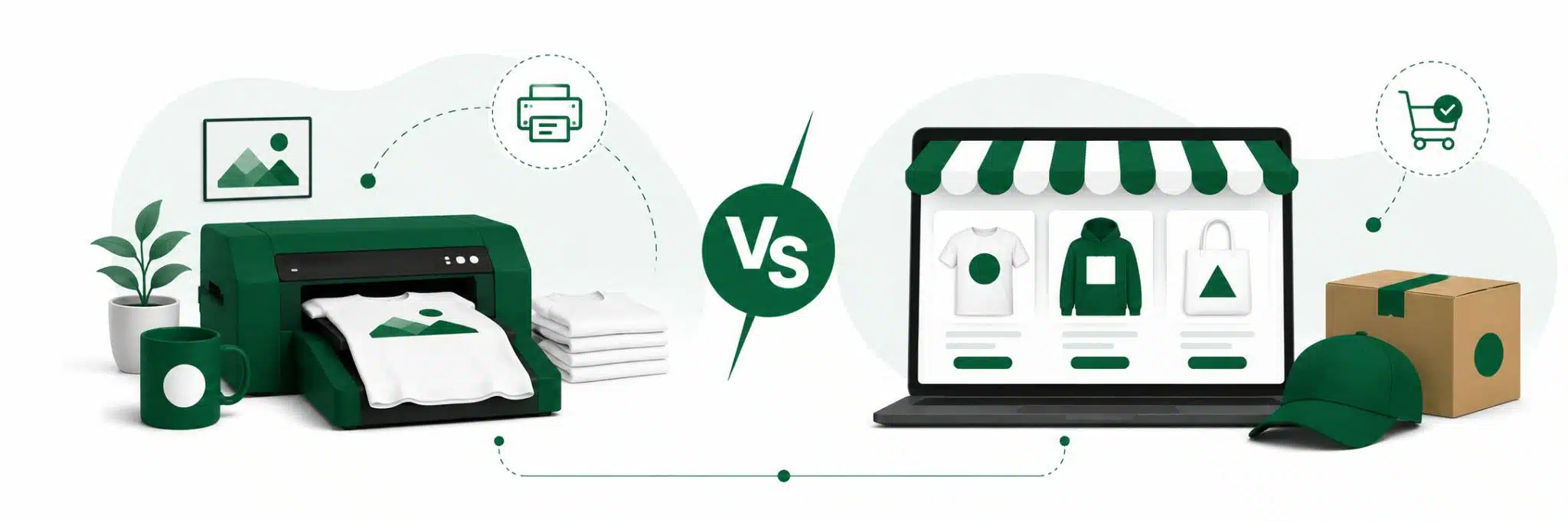

If you’re researching print on demand vs on demand merch, you’re not alone. Many creators, ecommerce brands, startups, and corporate teams use these terms interchangeably, even though they describe different approaches to merchandise fulfillment.
While print-on-demand primarily focuses on digitally printed products made after purchase, on-demand merchandise is a broader fulfillment model that includes multiple decoration methods, branded merchandise programs, promotional products, and scalable business solutions.
Understanding the distinction helps you choose a fulfillment strategy that aligns with your goals, whether you’re selling online, launching employee merchandise, or building a long-term brand. This guide breaks down both models so you can make an informed decision for your business.
Key Takeaways
- Print-on-demand is one category within the broader on-demand merchandise fulfillment model.
- On-demand merchandise includes apparel, promotional products, embroidery, screen printing, and branded merchandise programs.
- Both approaches eliminate the need to maintain physical inventory before products are sold.
- On-demand merchandise provides greater flexibility for corporate branding, employee programs, and promotional campaigns.
- Ecommerce integrations automate production, fulfillment, and shipping for both models.
- Choosing the right fulfillment partner improves product quality, brand consistency, and long-term scalability.
Print on Demand vs On Demand Merch: Understanding the Basics
The discussion around print on demand vs on demand merch often creates confusion because both models eliminate inventory and manufacture products only after customers place orders. However, they aren’t identical.
What Is Print-on-Demand?
Print-on-demand (POD) is a fulfillment method where products are printed individually after an order is placed. The print-on-demand business model is most commonly associated with digitally printed apparel, including T-shirts, hoodies, tote bags, posters, and similar products.
Instead of purchasing inventory upfront, businesses upload artwork to an ecommerce platform. When a customer buys an item, the fulfillment provider prints the design, packages the product, and ships it directly to the customer.
Print-on-demand is particularly popular among:
- Content creators
- Artists
- Ecommerce startups
- Independent brands
- Small online businesses
Its biggest advantage is simplicity. You don’t need warehouse space or significant startup capital to begin selling branded products.
What Is On-Demand Merchandise?
To understand what on-demand merch is, it’s helpful to think beyond apparel printing.
On-demand merchandise refers to a broader fulfillment strategy where products are manufactured, decorated, and shipped only after they’re ordered. Unlike traditional POD, this model supports multiple decoration methods and a wider range of products.
An on-demand merchandise fulfillment program may include:
- Printed apparel
- Embroidered apparel
- Company uniforms
- Promotional products
- Corporate gifts
- Employee onboarding kits
- Drinkware
- Hats
- Office accessories
- Event merchandise
Rather than focusing solely on digital printing, on-demand merchandise allows businesses to choose the most appropriate decoration method for each product category while maintaining inventory-free operations.
Why People Confuse the Two
The confusion exists because print-on-demand shares several characteristics with on-demand merchandise.
Both models:
- Produce products after orders are placed.
- Eliminate warehouse inventory.
- Reduce upfront financial investment.
- Integrate with ecommerce platforms.
- Ship directly to customers.
Since both rely on demand-driven production, many people assume they’re the same service.
The Biggest Differences
The primary distinction is scope.
Print-on-demand is centered around digitally printed products, while on-demand merch explained in its fullest sense includes a much wider merchandise ecosystem.
For example:
- A creator selling graphic T-shirts through Shopify is using print-on-demand.
- A company distributing embroidered employee uniforms, promotional drinkware, branded office supplies, and conference giveaways through one fulfillment partner is operating an on-demand merchandise program.
As businesses grow, many naturally expand beyond basic POD into broader on-demand merchandise solutions that support multiple branding initiatives simultaneously.
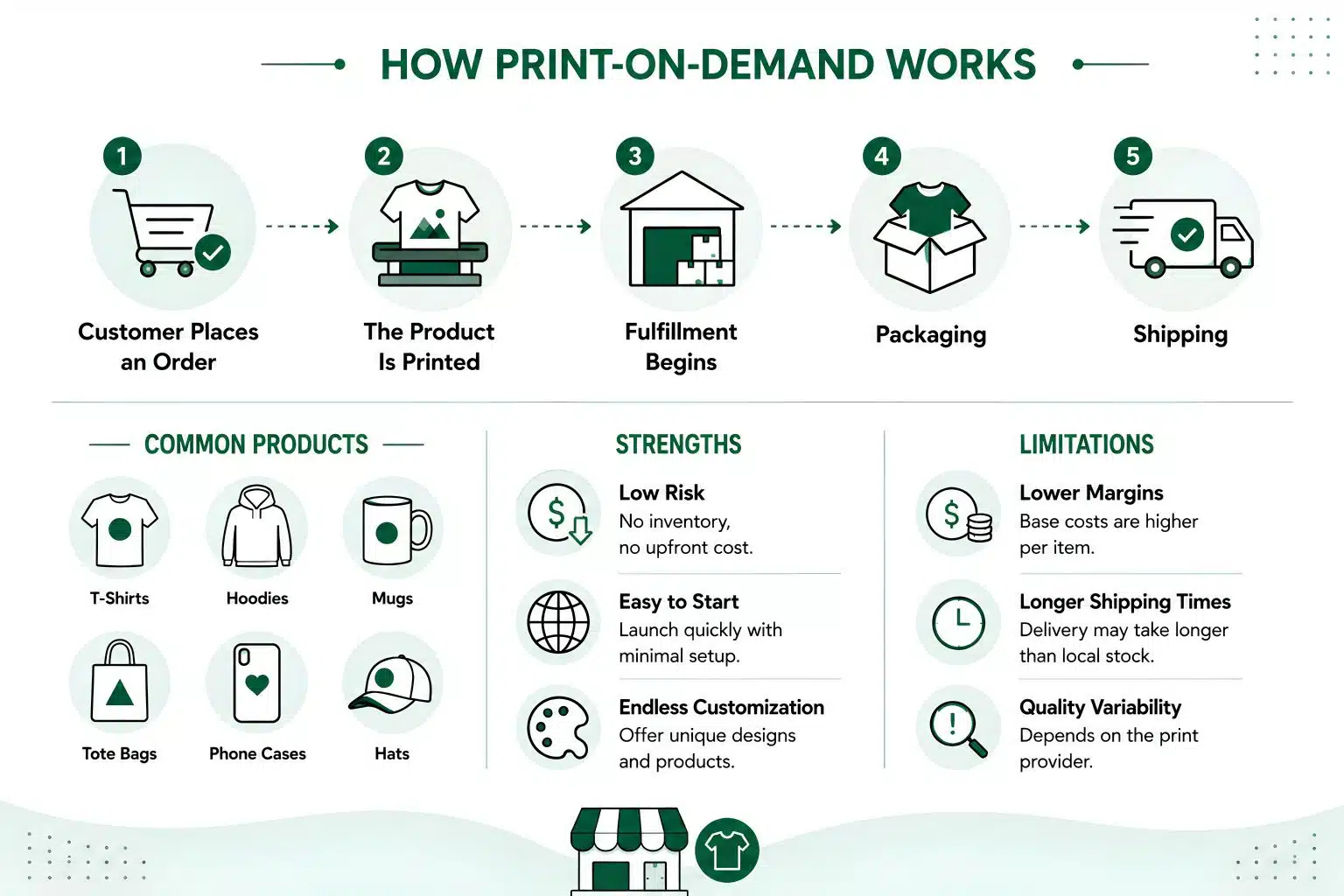
How Print-on-Demand Works
The print-on-demand process is designed to automate fulfillment and minimize operational complexity.
A typical workflow looks like this:
1. Customer Places an Order
A customer visits your online store, selects a product, chooses any available options (such as size or color), and completes checkout.
2. The Product Is Printed
Instead of pulling inventory from a warehouse, the fulfillment provider produces the item after receiving the order. Digital printing is the most common production method because it supports single-item manufacturing economically.
3. Fulfillment Begins
Once production is complete, the product enters the fulfillment process. Quality checks are performed to ensure the artwork, placement, and garment meet production standards.
4. Packaging
Products are packaged for shipping, often using standardized packaging that protects the merchandise during transit.
5. Shipping
Tracking information is generated and automatically shared with both the business owner and the customer.
Common Products
Print-on-demand providers typically specialize in:
- T-shirts
- Hoodies
- Sweatshirts
- Tote bags
- Posters
- Canvas prints
- Phone cases
- Basic accessories
Strengths of Print-on-Demand
- Minimal startup investment
- No inventory management
- Easy product testing
- Automated ecommerce integration
- Low financial risk
Limitations
Print-on-demand may become limiting as businesses expand into corporate merchandise, promotional campaigns, embroidered products, or complex branding programs that require multiple decoration methods beyond digital printing.
How On-Demand Merchandise Works
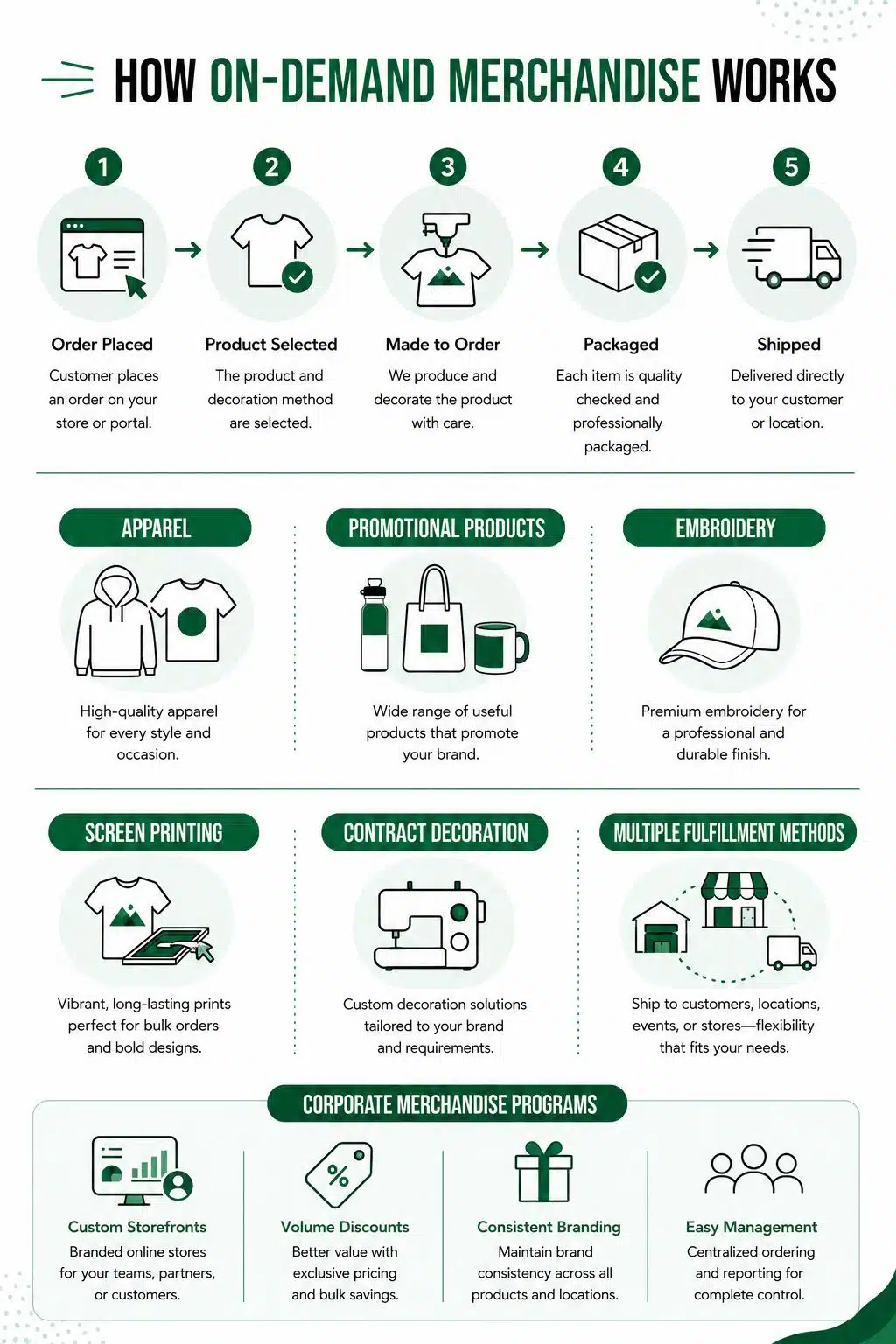
On-demand merchandise follows a similar inventory-free philosophy but expands far beyond traditional print-on-demand.
Instead of limiting production to digitally printed apparel, businesses gain access to a much broader catalog of branded products and decoration techniques.
This approach commonly includes:
Apparel
Businesses can offer:
- T-shirts
- Hoodies
- Sweatshirts
- Polo shirts
- Jackets
- Performance apparel
using whichever decoration method best fits the product and brand.
Promotional Products
Organizations frequently customize:
- Drinkware
- Tote bags
- Office supplies
- Tech accessories
- Event giveaways
- Corporate gifts
These items help strengthen brand recognition beyond clothing.
Embroidery
Embroidery creates a premium appearance for products such as:
- Hats
- Polos
- Jackets
- Uniforms
making it especially popular for employee apparel and corporate branding.
Screen Printing
For larger production runs, screen printing delivers durable, vibrant results while lowering per-unit costs.
Contract Decoration
Businesses that already source blank products may outsource decoration separately, allowing greater flexibility without investing in production equipment.
Multiple Fulfillment Methods
Unlike traditional POD providers, on-demand merchandise partners often combine several production techniques under one fulfillment system, selecting the best method for each product rather than relying exclusively on digital printing.
Corporate Merchandise Programs
Many companies use custom on-demand merchandise to support:
- Employee onboarding
- Client appreciation gifts
- Company swag
- Recruiting campaigns
- Conferences
- Internal recognition programs
This broader fulfillment model gives organizations far greater flexibility than standard print-on-demand.
Businesses looking to build scalable branded merchandise programs often choose on-demand merchandise services because they support multiple product categories while maintaining the same inventory-free workflow.
Print on Demand vs On Demand Merch: Side-by-Side Comparison
Although both models eliminate inventory requirements, print on demand vs on demand merch differs significantly in terms of flexibility, product selection, branding capabilities, and business scalability. Print-on-demand (POD) is ideal for entrepreneurs who primarily sell digitally printed apparel, while on-demand merchandise expands beyond apparel to include promotional products, embroidery, screen printing, employee merchandise, and comprehensive corporate branding programs.
For businesses planning long-term growth, understanding these differences helps prevent expensive operational limitations later.
| 📊 Feature | 🖨️ Print-on-Demand | 🚀 On-Demand Merchandise |
|---|---|---|
| 🛍️ Product Range | Primarily printed apparel and basic merchandise. | Apparel, promotional products, embroidery, screen printing, hats, bags, drinkware, and accessories. |
| 🎨 Decoration Methods | Primarily digital printing methods. | Multiple options including screen printing, embroidery, DTF, DTG, sublimation, UV printing, and more. |
| 🏢 Corporate Programs | Limited support for large corporate apparel programs. | Excellent for employee stores, onboarding kits, uniforms, and branded merchandise programs. |
| 👕 Employee Swag | Moderate selection. | Strong support with diverse apparel and promotional products. |
| ✨ Branding Flexibility | Good customization options. | Excellent flexibility across multiple decoration methods and product categories. |
| ⚙️ Ecommerce Automation | Excellent integration with ecommerce platforms. | Excellent automation for order routing, production, and fulfillment. |
| 📦 Inventory Required | None; products are made after purchase. | None; fulfillment is completely inventory-free. |
Print-on-demand is ideal for creators and apparel-focused ecommerce businesses, while on-demand merchandise is a broader fulfillment solution that supports apparel, promotional products, corporate branding, employee swag, and multi-decoration workflows—all without maintaining inventory.
Product Range
Print-on-demand platforms typically specialize in apparel such as T-shirts, hoodies, sweatshirts, and a limited number of accessories. While this works well for creators and online brands, companies often require much broader merchandise catalogs.
On-demand merchandise supports everything from uniforms and promotional giveaways to drinkware, office products, branded accessories, and event merchandise, making it suitable for organizations that need diverse branding solutions.
Decoration Methods
One of the biggest distinctions is decoration capability.
Most POD companies rely almost exclusively on direct-to-garment (DTG) or digital printing. In contrast, on-demand merchandise providers combine several decoration methods—including embroidery, screen printing, heat transfer, and promotional product decoration—allowing businesses to choose the best option based on durability, budget, and product type.
Corporate Programs
Businesses with ongoing employee onboarding, conferences, sales incentives, or client appreciation campaigns often require structured fulfillment systems rather than one-off product printing.
On-demand merchandise providers can manage recurring branded merchandise fulfillment programs that automatically serve multiple departments, offices, or geographic regions without requiring inventory management.
Employee Swag
While POD platforms allow businesses to order branded apparel, comprehensive employee merchandise programs often require greater customization and logistical support.
On-demand merchandise platforms simplify employee onboarding kits, anniversary gifts, recognition programs, and remote workforce shipments while maintaining consistent branding.
Branding Flexibility
As organizations expand, branding consistency becomes increasingly important.
On-demand merchandise offers more flexibility by supporting embroidered apparel, promotional products, accessories, packaging, and seasonal campaigns under one fulfillment ecosystem rather than limiting branding to digitally printed garments.
Ecommerce Automation
Both fulfillment models integrate well with ecommerce platforms, automatically routing customer orders to production facilities after purchase.
However, on-demand merchandise often extends automation beyond online retail by supporting internal company ordering portals, employee stores, promotional campaigns, and B2B merchandise programs.
Products Available Through Each Model
The products available through each fulfillment model vary considerably. Understanding these differences helps businesses choose the right solution based on customer expectations, branding goals, and future scalability.
Print-on-Demand Products
Print-on-demand works exceptionally well for creators and ecommerce sellers focused on apparel.
Common products include:
- T-shirts
- Hoodies
- Sweatshirts
- Posters
- Tote bags
- Basic accessories
These products are generally digitally printed after an order is placed, making them ideal for testing new designs without purchasing inventory.
On-Demand Merchandise Products
On-demand merchandise supports a much broader range of branded items suitable for both ecommerce sales and corporate branding.
Businesses commonly customize:
- Premium apparel
- Employee uniforms
- Promotional products
- Drinkware
- Hats
- Office accessories
- Company swag
- Corporate gifts
Organizations seeking premium branded merchandise fulfillment often benefit from working with providers that offer professionally decorated apparel alongside promotional products. Services like branded apparel solutions allow businesses to expand their product catalogs without managing inventory.
Similarly, companies looking to diversify into giveaways and event merchandise can integrate custom promotional products into their overall branding strategy, creating consistent customer experiences across multiple product categories.
Which Business Model Is Better for Different Types of Companies?
Not every organization has identical merchandise requirements. The ideal fulfillment model depends on business goals, audience, and branding complexity.
Ecommerce Brands
Online stores selling fashion collections or creator merchandise often begin with print-on-demand because it enables rapid product launches with minimal investment.
However, as product lines expand into drinkware, accessories, or promotional products, many brands transition toward broader ecommerce merchandise fulfillment solutions that support multiple decoration methods and product categories.
Creators
YouTubers, streamers, podcasters, artists, and influencers frequently launch merchandise before investing heavily in inventory.
Both fulfillment models work well, but on-demand merchandise provides more flexibility for limited-edition releases, premium embroidery, and branded accessories as audiences grow.
Startups
Startups benefit from avoiding inventory costs during early growth stages.
An inventory-free fulfillment model allows founders to validate demand while preserving cash flow for marketing, hiring, and product development instead of warehouse expenses.
Corporate Companies
Businesses managing employee onboarding, client appreciation gifts, conferences, and internal branding typically require more than basic apparel printing.
On-demand merchandise offers centralized ordering, consistent branding, and scalable fulfillment programs that better support enterprise operations.
Schools
Schools, colleges, athletic departments, and alumni organizations frequently experience seasonal purchasing cycles.
On-demand fulfillment helps eliminate excess inventory while making spirit wear and fundraising merchandise available year-round.
Nonprofits
Charitable organizations often launch merchandise around fundraising campaigns or awareness events.
Inventory-free fulfillment reduces financial risk while allowing organizations to focus more resources on their mission.
Marketing Agencies
Agencies managing multiple client campaigns benefit from centralized production that accommodates different decoration methods, fulfillment destinations, and product categories without maintaining inventory for every client.
Branding Flexibility: Where On-Demand Merchandise Wins
Brand consistency extends far beyond placing a logo on a T-shirt. Growing organizations require merchandise programs that support every customer and employee interaction.
On-demand merchandise excels by supporting:
- Employee onboarding kits
- Client appreciation gifts
- Promotional campaigns
- Uniform programs
- Corporate events
- Seasonal merchandise
- Internal recognition programs
Businesses running ongoing corporate on-demand merch initiatives often discover that a centralized fulfillment system simplifies ordering while ensuring every item reflects current brand standards.
Similarly, comprehensive employee merchandise programs become much easier to manage when new hires, remote employees, and multiple office locations can all access the same branded merchandise through a unified ordering platform.
Organizations seeking scalable employee branding frequently implement company swag programs that automate fulfillment while maintaining consistent quality across every order.
Decoration Methods Available
Perhaps the biggest advantage of on-demand merchandise lies in decoration flexibility.
Different products require different decoration methods based on durability, appearance, and intended use.
| 🎨 Decoration Method | 🖨️ Print-on-Demand | 🚀 On-Demand Merchandise |
|---|---|---|
| 🖌️ Digital Printing | ✔ Supported | ✔ Supported |
| 🎯 Screen Printing | ⚠️ Limited availability | ✔ Fully supported |
| 🧵 Embroidery | ⚠️ Limited product selection | ✔ Fully supported |
| 🤝 Contract Decoration | ❌ Not available | ✔ Available |
| 🎁 Promotional Product Branding | ⚠️ Limited options | ✔ Extensive capabilities |
Print-on-demand focuses primarily on digital printing for apparel, making it ideal for simple ecommerce stores. On-demand merchandise offers a wider range of decoration methods—including screen printing, embroidery, contract decoration, and promotional product branding—making it a more comprehensive solution for businesses, corporate programs, and branded merchandise.
Digital printing works exceptionally well for colorful artwork and smaller apparel runs.
However, premium corporate apparel often benefits from embroidery, while high-volume event merchandise may require screen printing for greater durability and cost efficiency.
Companies offering professional screen printing services alongside other decoration methods provide greater flexibility as branding needs evolve.
Likewise, organizations requiring specialized production workflows or wholesale decoration often rely on contract decoration services to manage complex merchandise programs efficiently.
Cost Comparison
Both fulfillment models eliminate inventory expenses, but total operational costs differ depending on product variety, decoration requirements, and long-term growth.
| 💼 Cost Factor | 🖨️ Print-on-Demand | 🚀 On-Demand Merchandise |
|---|---|---|
| 📦 Inventory | ✅ None required | ✅ None required |
| 💰 Startup Cost | 🟢 Low; minimal upfront investment | 🟢 Low; pay only as orders are fulfilled |
| 🛍️ Product Variety | ⚖️ Moderate selection, primarily apparel-focused | 🌟 High; supports apparel, promotional products, accessories, and more |
| 🏢 Corporate Scaling | ⚖️ Moderate; suitable for smaller business programs | 🚀 Excellent; ideal for enterprise branding, employee stores, and large-scale merchandise programs |
Both Print-on-Demand and On-Demand Merchandise eliminate inventory and reduce startup costs. However, On-Demand Merchandise offers broader product selection and superior scalability, making it a better choice for businesses planning long-term growth, corporate branding initiatives, and multi-product ecommerce stores.
Startup Investment
Both options require very little upfront capital because products are produced only after purchase.
Inventory Costs
Neither model requires warehousing, significantly reducing financial risk compared to traditional merchandise programs.
Production Costs
Print-on-demand generally offers lower setup complexity for apparel, while on-demand merchandise becomes increasingly cost-effective as businesses diversify into additional product categories.
Profit Margins
Businesses selling premium embroidered apparel, promotional products, or branded corporate merchandise often achieve stronger perceived value through on-demand merchandise programs.
Scaling Costs
As organizations expand, on-demand merchandise typically scales more efficiently because multiple decoration methods and product categories operate under one fulfillment ecosystem.
Bulk Orders vs On-Demand Fulfillment
Although inventory-free fulfillment works well for many businesses, there are situations where bulk production remains the better option.
Bulk orders often make sense for:
- Large conferences
- Corporate events
- Product launches
- Promotional campaigns
- Retail distribution
- Seasonal merchandise
On-demand fulfillment, meanwhile, excels when:
- Demand fluctuates
- Product catalogs frequently change
- Businesses want to test new designs
- Inventory risk must remain low
Many successful brands adopt hybrid fulfillment strategies, using on-demand production for evergreen products while placing bulk merchandise orders for predictable, high-volume campaigns where lower per-unit costs justify larger production runs.
Common Misconceptions
As inventory-free fulfillment continues to grow, many business owners still misunderstand how these models work. These misconceptions can lead companies to choose the wrong fulfillment strategy or overlook opportunities to scale more efficiently.
Here are some of the most common myths:
- Print-on-demand and on-demand merchandise are identical.
While related, they are not the same. Print-on-demand focuses mainly on digitally printed products, whereas on-demand merchandise includes a broader range of products and decoration methods such as embroidery, screen printing, promotional products, and corporate fulfillment programs. - On-demand merchandise only includes apparel.
Modern on-demand fulfillment extends far beyond clothing. Businesses can customize drinkware, office supplies, promotional products, accessories, company swag, corporate gifts, and much more. - Bulk production is always cheaper.
Bulk ordering reduces the unit cost only when demand is predictable. For businesses with fluctuating sales or frequently changing designs, inventory-free fulfillment often delivers better overall profitability by eliminating storage costs and unsold inventory. - On-demand businesses can’t scale.
In reality, many rapidly growing ecommerce brands, creators, and enterprise organizations use on-demand fulfillment because it easily supports expanding product catalogs, multiple sales channels, and nationwide shipping without increasing inventory risk. - Corporate merchandise requires inventory.
Modern company stores allow employees and departments to order branded merchandise whenever needed. Products are decorated and shipped after purchase, removing the need for warehouses full of pre-printed inventory. - Print quality is always the same across providers.
Quality varies significantly depending on production equipment, decoration expertise, quality control standards, and fulfillment processes. Selecting the right provider has a major impact on customer satisfaction and brand perception.
How to Choose the Right Fulfillment Partner
Choosing the right fulfillment provider affects far more than shipping speed. The partner you select directly influences product quality, customer experience, brand consistency, and your ability to grow without operational headaches.
Here are the key factors to evaluate before making a decision.
Product Quality
Your merchandise represents your brand long after customers receive it. Request product samples to evaluate fabric quality, print durability, embroidery precision, promotional product construction, and overall craftsmanship before committing to a provider.
Decoration Capabilities
Not every product is best decorated using the same technique. A strong fulfillment partner should offer multiple decoration methods—including digital printing, screen printing, embroidery, and promotional product branding—so your merchandise always matches its intended use.
Fulfillment Reliability
Fast production means little if orders arrive late or inconsistently. Look for providers with dependable production timelines, accurate order processing, shipment tracking, and scalable logistics.
Ecommerce Integrations
Automation reduces manual work and minimizes fulfillment errors. Your provider should integrate easily with ecommerce platforms such as Shopify, WooCommerce, BigCommerce, and marketplace channels so orders flow directly into production.
Customer Support
Problems occasionally happen, whether it’s artwork revisions, shipping delays, or product questions. Responsive support helps resolve issues quickly before they affect your customers.
Scalability
The fulfillment system that works for 50 monthly orders should also support 5,000. As your business expands, your provider should accommodate larger product catalogs, higher order volumes, additional decoration methods, and more shipping destinations without disrupting operations.
Production Consistency
Perhaps the most overlooked factor is consistency. Reliable branded merchandise fulfillment ensures logos, colors, placement, and overall product quality remain uniform across every order, regardless of order size or destination.
Whether you’re launching creator merchandise or managing enterprise branding, investing in high-quality custom on-demand merchandise helps protect your brand reputation while making future growth much easier.
To Wrap Up
Understanding the difference between print on demand vs on demand merch helps businesses choose a fulfillment strategy that supports both current goals and future growth. While print-on-demand is ideal for simple apparel businesses, on-demand merchandise provides greater branding flexibility, multiple decoration methods, broader product selections, and scalable fulfillment without inventory.
Companies can reduce financial risk, automate operations, strengthen branding, and adapt quickly to changing customer demand. By partnering with an experienced provider like Shirt.co, businesses gain access to professional on-demand merchandise, branded apparel, promotional products, company swag, screen printing, contract decoration, and bulk ordering solutions—all designed to grow alongside their brand.
FAQs
What is the difference between print-on-demand and on-demand merchandise?
Print-on-demand focuses primarily on digitally printed products like apparel, while on-demand merchandise includes a broader fulfillment model covering promotional products, embroidery, screen printing, branded apparel, company swag, and corporate merchandise programs.
Is print-on-demand part of on-demand merchandise?
Yes. Print-on-demand is one fulfillment method within the larger category of on-demand merchandise.
Which model is better for businesses?
Businesses needing employee apparel, promotional products, or long-term branding programs generally benefit more from on-demand merchandise, while creators selling simple apparel collections may find print-on-demand sufficient.
Can companies use on-demand merchandise for employee programs?
Absolutely. Many organizations use inventory-free fulfillment for onboarding kits, employee recognition, uniforms, internal stores, and company swag without maintaining warehouses.
What products are available through on-demand merchandise?
On-demand merchandise can include apparel, hats, drinkware, office accessories, promotional products, uniforms, bags, corporate gifts, and branded merchandise for events or ecommerce.
Does on-demand merchandise require inventory?
No. Products are manufactured or decorated only after an order is placed, eliminating the need to purchase or store inventory in advance.
When should businesses choose bulk orders?
Bulk production works best for conferences, trade shows, seasonal campaigns, product launches, or situations where demand is highly predictable and lower per-unit pricing offsets inventory costs.
Can ecommerce brands use both models together?
Yes. Many brands use print-on-demand for testing new products while relying on broader on-demand merchandise programs for premium collections, promotional items, and corporate branding.
What decoration methods are available with on-demand merchandise?
Depending on the provider, businesses can choose from digital printing, screen printing, embroidery, heat transfers, promotional product decoration, and other specialized finishing methods.
How do I choose the best merchandise fulfillment partner?
Evaluate product quality, decoration capabilities, ecommerce integrations, fulfillment reliability, production consistency, scalability, customer support, and the provider’s experience handling brands similar to yours.